




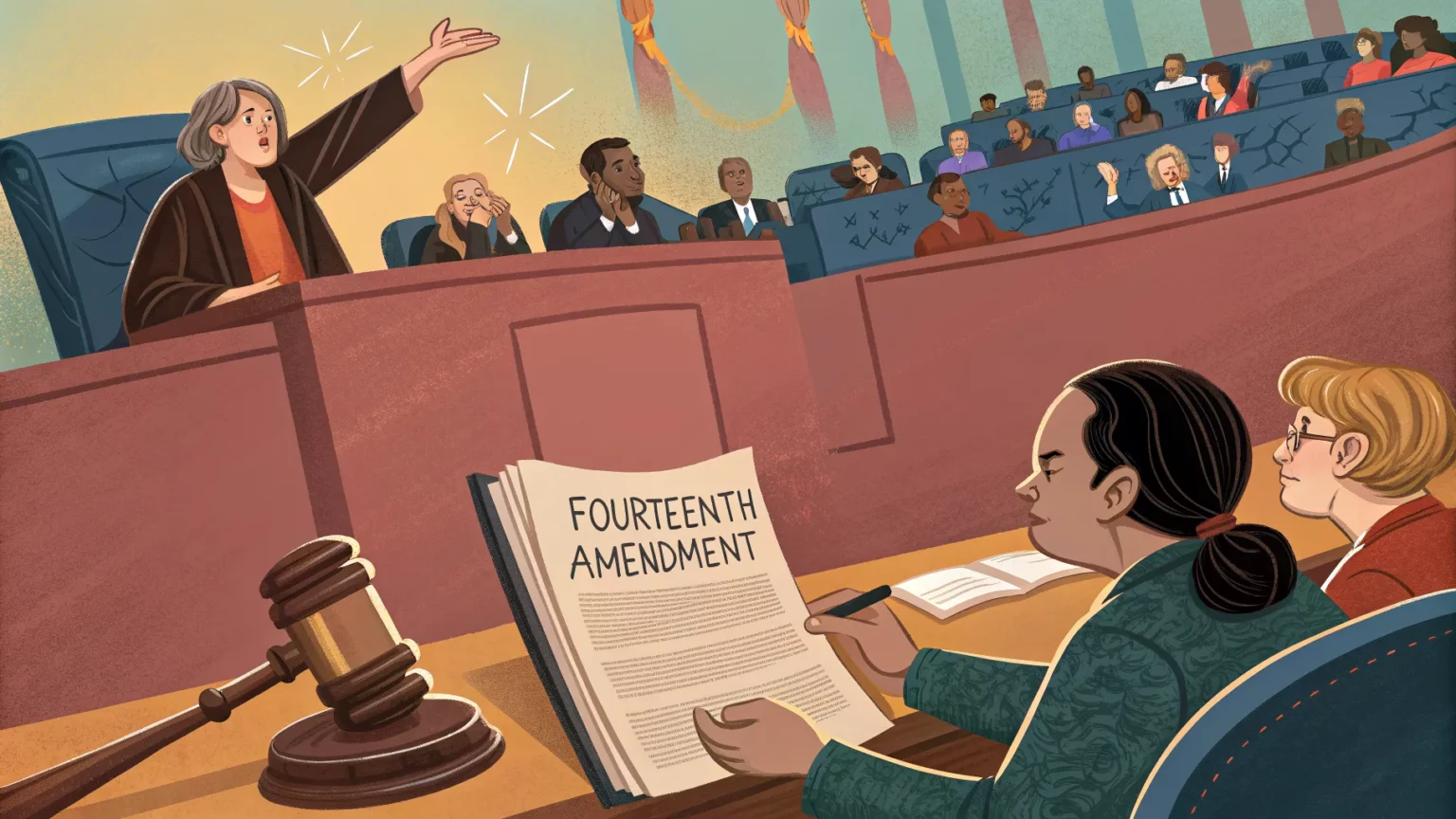
A fresh round of debate over U.S. birthright citizenship is narrowing to a single phrase: subject to the jurisdiction thereof. At issue is who counts as a citizen at birth under the Fourteenth Amendment, and whether Congress, the courts, or a future administration could change that understanding without a constitutional amendment.
The fight centers on the Citizenship Clause, written after the Civil War and tested in court for more than a century. Advocates on one side say the text is clear and settled. Critics argue those five words leave room to limit citizenship for the children of noncitizens, especially those in the country unlawfully.
The Clause at the Center
The Fourteenth Amendment begins with a sweeping guarantee. It says:
“All persons born or naturalized in the United States, and subject to the jurisdiction thereof, are citizens of the United States and of the State wherein they reside.”
Supporters of current policy say the phrase covers almost everyone born on U.S. soil, except narrow categories recognized in law. Opponents claim “jurisdiction” means full political allegiance and should exclude children whose parents are not legally present.
The Supreme Court addressed much of this in 1898. In United States v. Wong Kim Ark, the Court held that a man born in San Francisco to Chinese parents was a citizen at birth. The majority wrote that the Amendment “affirms the ancient and fundamental rule of citizenship by birth within the territory.”
What Courts Have Said
Two earlier and later cases shape today’s arguments. In Elk v. Wilkins (1884), the Court said a Native American born into a sovereign tribal nation was not a citizen by birth under the Clause, an interpretation later overtaken by Congress with the Indian Citizenship Act of 1924. In Plyler v. Doe (1982), the Court held that children of undocumented immigrants are “within the jurisdiction” of a state for equal protection purposes, though it did not decide citizenship.
Taken together, the rulings point to a broad reading of jurisdiction, with a few carved-out exceptions. Those exceptions have long included the children of foreign diplomats and of enemy soldiers occupying U.S. territory. Before 1924, many Native Americans also fell outside the guarantee due to separate sovereignty.
- Citizenship at birth generally follows place of birth.
- Recognized exceptions: foreign diplomats, enemy occupiers, historical tribal sovereignty (changed by statute).
- Key precedents: Wong Kim Ark (1898), Elk v. Wilkins (1884), Plyler v. Doe (1982, equal protection).
The Policy Stakes Today
Modern proposals focus on children born to noncitizen parents, especially when the parents lack legal status. Some lawmakers have urged Congress to define “subject to the jurisdiction” more narrowly by statute. Others have floated executive action.



Legal analysts across the spectrum agree that any such effort would trigger immediate lawsuits. Backers of change argue Congress can clarify ambiguous text and align practice with original meaning. Opponents say the Supreme Court’s reading in Wong Kim Ark leaves little room to move without a constitutional amendment.
State officials are also watching. If federal policy shifts, they would face questions about issuing birth certificates, access to services, and school enrollment. Hospitals and county offices could become early flashpoints as they interpret federal guidance while cases work through the courts.
How a New Challenge Could Play Out
Any statute or order narrowing birthright rules would likely be enjoined by a federal district court within days. Appeals would follow, with a fast track to the Supreme Court. The justices would revisit the meaning of jurisdiction, the force of historical practice, and the scope of Wong Kim Ark.
Opponents would highlight 125 years of reliance by families, agencies, and businesses. They would stress administrative burdens and the risk of creating a new class of people without clear status. Proponents would emphasize border control, legislative power, and historical sources from the 1860s debates.
Recent immigration cases show the Court divides on both text and practical effects. A majority could focus on the original public meaning of “jurisdiction,” or on stare decisis and stability. Either path would carry sweeping consequences.
What to Watch Next
Lawmakers may introduce bills that aim to redefine the phrase or condition citizenship on at least one parent’s status. Parallel efforts could appear in statehouses, even if federal law preempts them. Advocacy groups are preparing model complaints and venue strategies.
If a new policy emerges, hospitals, vital-records offices, and consulates will need rapid guidance. Employers and schools will also seek clarity as families present different documents to prove status.
One sentence from the Reconstruction era still frames the dispute:
Birthright arguments could come down to these five words.
For now, the governing rule remains broad citizenship by birth on U.S. soil, with a few narrow exceptions. Any shift would move through the courts at high speed. The outcome will set the nation’s definition of membership for generations. Watch for test cases, emergency stays, and, eventually, a ruling that either reaffirms the existing rule or rewrites it.