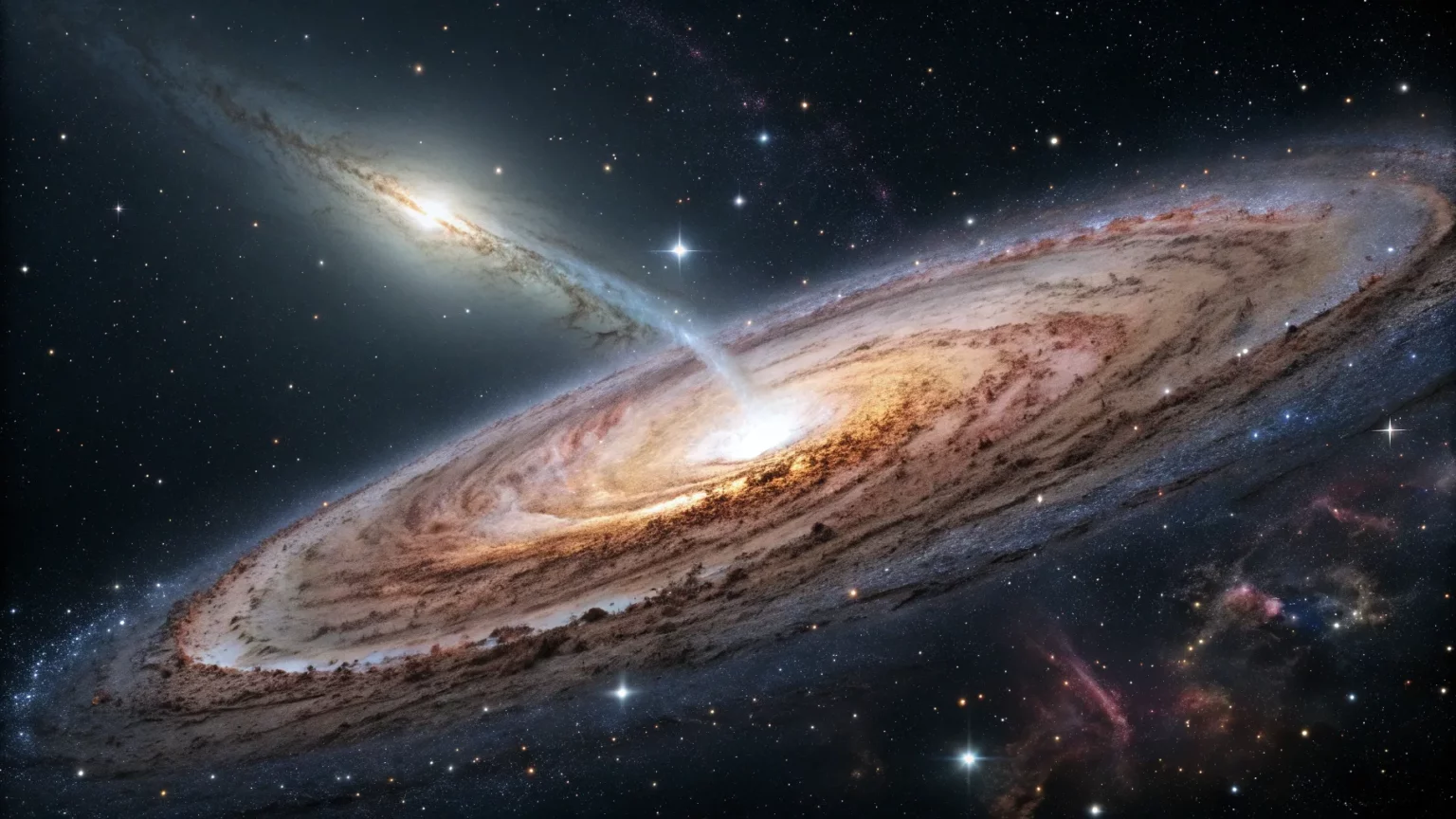
Astronomers say they have identified where a colossal jet bursting from the galaxy M87 begins, marking a step in a decades-long quest to understand how black holes launch such streams. The jet spans thousands of light-years and is powered by the galaxy’s central supermassive black hole, known as M87*. The finding narrows the launch zone to the black hole’s immediate surroundings and could help settle a key debate in high-energy astrophysics.
“Astronomers have traced the origin point of a jet of material that is thousands of light-years long emanating from the supermassive black hole M87*”
Background: A Giant in the Nearby Universe
M87 sits in the Virgo Cluster, about 55 million light-years from Earth. Its central black hole, M87*, holds roughly 6.5 billion times the mass of the Sun. The galaxy’s jet is famous. It shines in radio, optical, and X-ray light and has been imaged by telescopes for more than a century.
In 2019, the Event Horizon Telescope released the first image of a black hole’s shadow, focusing on M87*. That image showed a bright ring of hot gas and hinted at the jet’s base. But the exact launch point remained unclear.
Scientists have long asked whether jets are driven by the black hole’s spin or by winds from the swirling disk of gas. The two leading ideas are the Blandford–Znajek process, which taps energy from the black hole through magnetic fields, and the Blandford–Payne model, which drives a wind from the disk along magnetic field lines.
A Jet Anchored Near the Heart
The new result places the start of the jet very close to M87*. That is where gravity, magnetism, and plasma collide in extreme ways. By isolating the origin point, researchers tighten the limits on models that describe how jets turn on and stay stable across vast distances.
Locating the launch zone also links two scales that are hard to connect: the event horizon, which is smaller than our solar system, and the jet, which reaches across interstellar space. That bridge is key to testing theory with real data.
Why the Launch Point Matters
Pinpointing the start of the jet helps answer core questions:
- How close to the event horizon does the jet form?
- Do magnetic fields anchored in the black hole or in the disk dominate?
- How does the jet stay narrow for thousands of light-years?
If the launch region hugs the event horizon, it favors a spin-powered engine. If it sits farther out in the disk, a wind-driven model gains support. The evidence tilts the debate toward a compact launch zone, which many theorists have predicted for a fast-spinning black hole threaded by strong magnetic fields.



How Scientists Pursued the Answer
Teams have combined ultra-sharp radio images with optical and X-ray maps to trace the jet back to its base. Very long baseline radio arrays can resolve structures near the shadow seen by the Event Horizon Telescope. Coordinated campaigns compare brightness, polarization, and timing across wavelengths. These checks show how matter moves and where magnetic fields line up.
Over years of monitoring, astronomers tracked flares and knots racing down the jet at near-light speed. By projecting these tracks upstream, they marked a common origin close to the black hole. The new analysis strengthens that case.
What It Means for Black Holes and Galaxies
Jets likely help regulate how galaxies grow. They heat gas, slow star formation, and sculpt galaxy clusters. M87’s jet is a prime example of that feedback. Knowing where the engine turns on gives modelers the input they need to simulate the energy flow from horizon to halo.
The result also supports the idea that black hole spin matters. If magnetic fields can tap spin energy near the horizon, similar engines could power jets in other active galaxies and even in some stellar-mass black holes.
What Comes Next
Researchers plan more joint observations that link horizon-scale imaging with wider-field views. Polarization maps can trace magnetic field lines near the launch point. Faster cadence campaigns can catch new flares and test how the jet reacts at its base.
Future upgrades to radio arrays, plus next-generation X-ray and optical telescopes, should sharpen the picture. The goal is to watch the jet turn on and evolve in real time near M87*.
The latest finding ties the jet to the black hole’s inner engine with new precision. It narrows the theory gap and sets the stage for stronger tests. Watch for tighter constraints on the role of spin, the shape of the magnetic field, and how these jets keep their power over cosmic distances.