




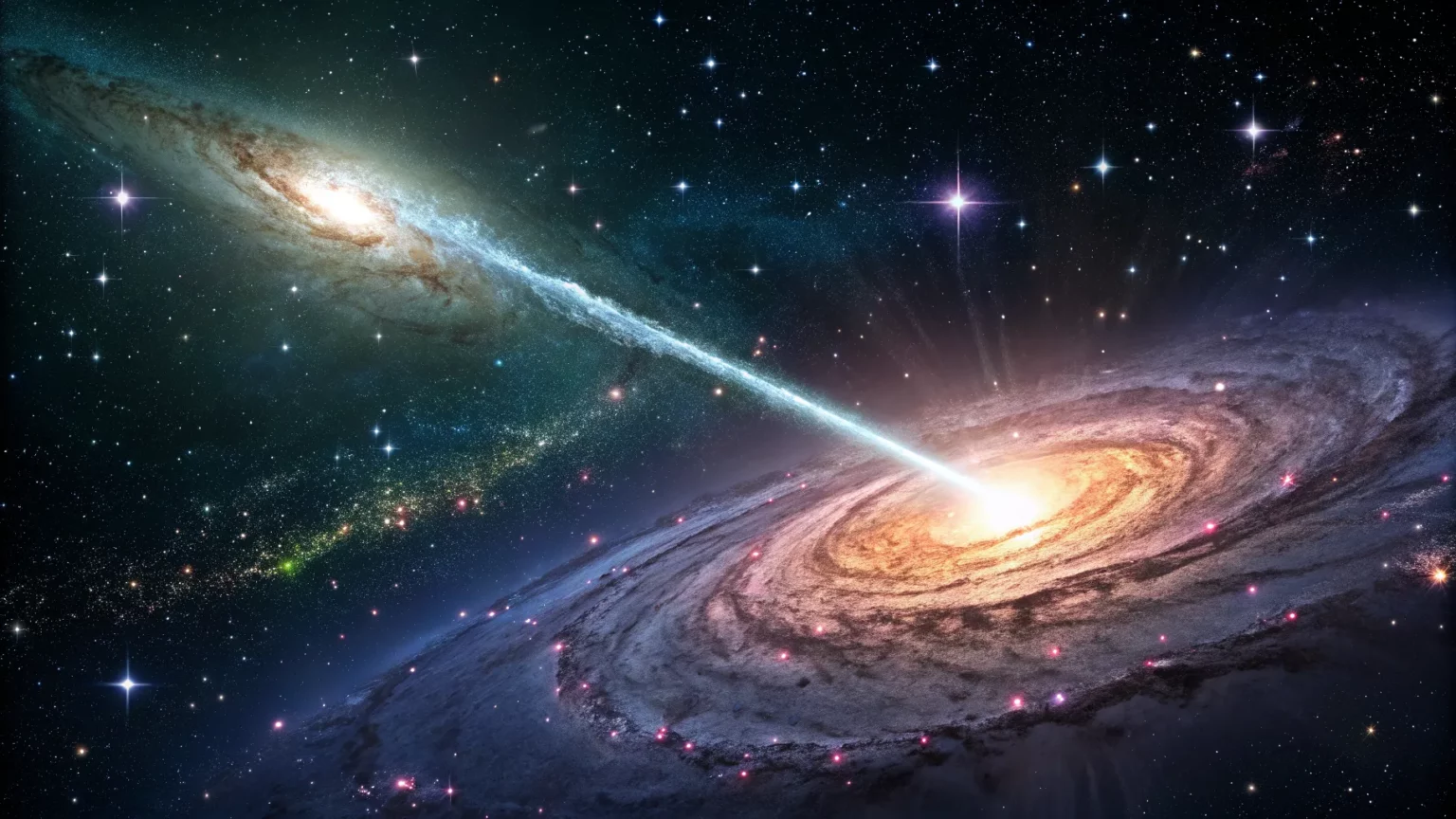
Astronomers say they have spotted the brightest and most distant megamaser ever recorded, a signal beaming toward Earth from about 8 billion light-years away. The detection, made possible by an effect first predicted by Albert Einstein, offers a rare view into the distant universe and the energetic processes that power galaxies.
The find centers on a cosmic energy beam known as a megamaser. Researchers report that the beam’s extreme brightness and reach were amplified by a “weird space-time trick” that bent and magnified its light on its journey to Earth. The technique, known as gravitational lensing, turned a faint signal into a record-breaking detection and set the stage for new studies of star formation and galactic activity in the early universe.
“Astronomers have discovered the brightest and most distant ‘megamaser’ to date. The cosmic energy beam is shooting toward Earth from 8 billion light-years away and was spotted thanks to a weird space-time trick first predicted by Einstein.”
What Is a Megamaser?
A megamaser is a natural radio laser produced by gas in and around galaxies. Instead of visible light, it emits intense microwave or radio waves. These signals often come from molecules such as water or hydroxyl, energized by processes linked to star birth, supermassive black holes, or galaxy mergers.
Because they are bright and narrow in frequency, megamasers work as precise markers. Astronomers use them to map gas flows near black holes, measure galaxy motions, and estimate cosmic distances. The farther the megamaser, the deeper the view into earlier cosmic times, when galaxies were younger and more active.
Einstein’s Space-Time “Trick” Made It Visible
The record signal was magnified by gravitational lensing. Massive objects such as galaxies bend the path of light passing near them, focusing and brightening signals that would otherwise be too faint. Einstein’s theory of general relativity predicted this bending, and modern telescopes rely on it to study distant objects.
In this case, lensing turned a distant, weak radio beam into a signal strong enough to measure from Earth. The effect not only brightens the target but can stretch and duplicate images, giving scientists multiple lines of sight to study the same source.
Why This Discovery Matters
Setting new records for both brightness and distance expands the range of environments where megamasers can be found. It also shows how lensing can reveal hidden sources at extreme distances. By pushing detection limits, astronomers can test ideas about how galaxies evolve and feed their central black holes.
- Distance: About 8 billion light-years, offering a view into the universe’s earlier epochs.
- Brightness: Strong enough to set a new mark for megamaser detections.
- Method: Gravitational lensing made a faint target measurable from Earth.
The record signal suggests that the conditions needed to power megamasers—dense gas, strong radiation fields, and energetic dynamics—were present far earlier than many local studies imply. That has implications for how often galaxies collided and how quickly black holes grew in that era.



What Scientists Hope to Learn Next
Researchers will aim to pin down the megamaser’s molecular makeup, which can indicate the physical environment that pumped the emission. If it is a water megamaser, it may trace gas spiraling near a supermassive black hole. If it is hydroxyl, it could signal intense star formation or a galaxy merger.
Follow-up work can also use the megamaser as a tool. Precise measurements of its frequency and variability can help map the motion of gas, estimate masses near galaxy centers, and refine cosmic distance scales. When combined with other lensed sources, the data can improve estimates of how matter is spread across the universe.
Wider Impact on Astronomy
The result highlights the growing role of gravitational lensing in radio astronomy. As telescopes add sensitivity and survey speed, lensed megamasers may become key probes of the distant cosmos. They can complement optical and infrared studies by cutting through dust that blocks shorter wavelengths.
Radio surveys that scan large swaths of the sky could uncover more lensed signals at similar distances. Each new find would add a data point from a time when galaxies were rapidly building stars and central black holes. That record can help connect the dots between young, active systems and the quieter galaxies seen closer to home.
The discovery opens a fresh path to study the early universe with radio light. Astronomers now have a brighter target to test ideas about how galaxies ignite, merge, and evolve. Watch for deeper observations that identify the megamaser’s molecular source, map the lensing system, and search for more distant signals that push the frontier even further.