




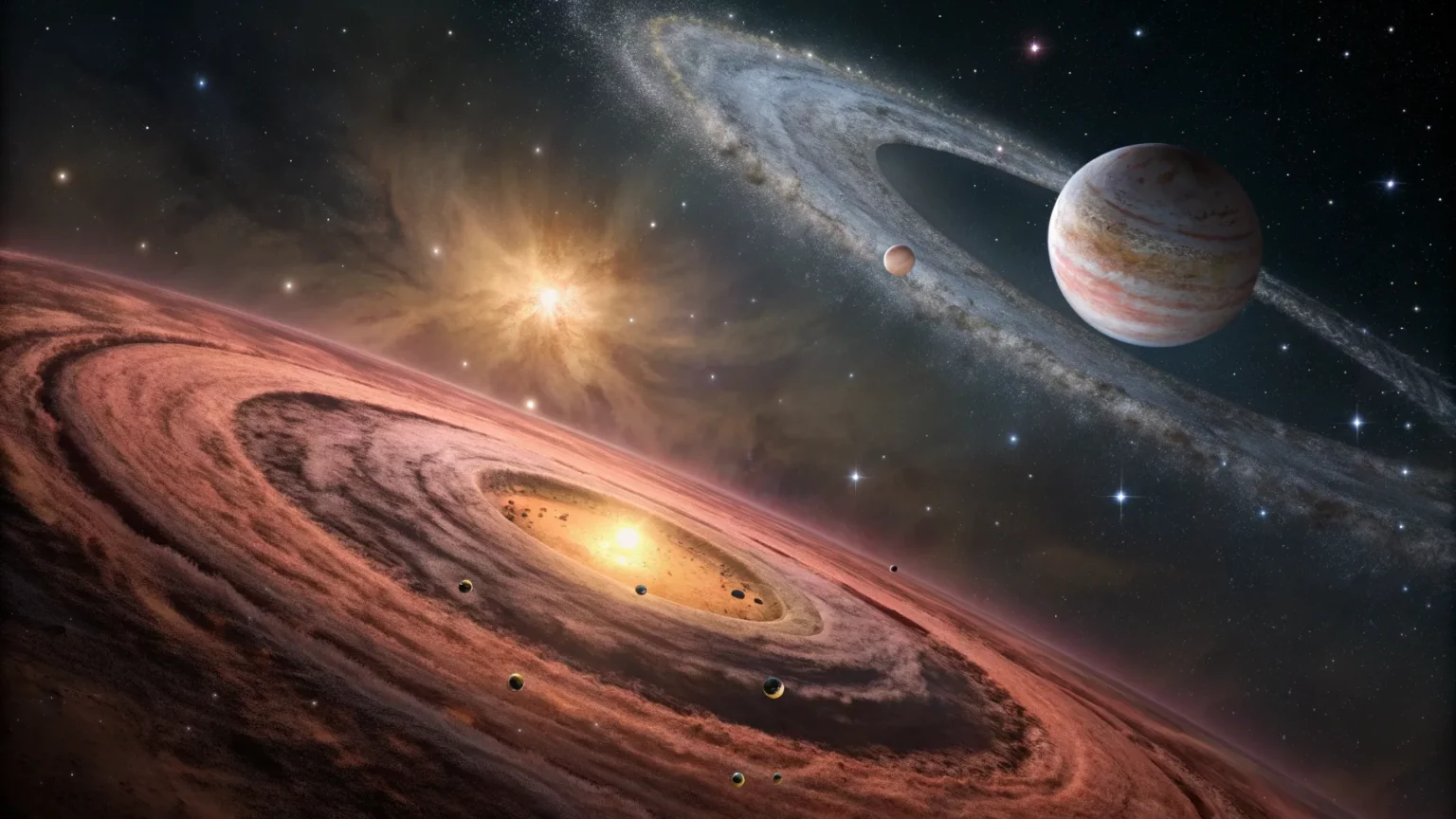
Astronomers have achieved a groundbreaking milestone by directly imaging a young planet forming within a gap in the disk of material surrounding its parent star. This unprecedented observation provides visual confirmation of long-standing theories about planetary formation and ring development in protoplanetary disks.
The discovery marks a significant advancement in our understanding of how planets are born and how they interact with their surrounding environment during the early stages of stellar system formation.
Confirming Planetary Formation Theories
The newly imaged planet was detected within a distinct gap in the protoplanetary disk – a rotating collection of gas and dust that surrounds young stars. For decades, scientists have theorized that such gaps are created by forming planets as they sweep up material and clear their orbital paths, but direct visual evidence has been elusive until now.
This observation validates models predicting that young planets can create ring-like structures in these disks. As planets grow, they exert gravitational influence on nearby dust and gas, creating visible gaps and rings that astronomers can detect from Earth.
The imaging required extremely high-resolution techniques to distinguish the faint light of the forming planet from the bright glare of its host star – a technical challenge that has limited similar discoveries in the past.
Implications for Understanding Solar System Formation
This discovery has far-reaching implications for how scientists understand the formation of our own solar system and others throughout the galaxy. By directly observing a planet in its formative stages, researchers can better understand:
- How quickly planets can form within protoplanetary disks
- The mechanisms that create the ring and gap structures seen in many stellar disks
- How planets acquire their mass from surrounding materials
- The timeline of planetary development relative to their host stars
“This observation connects theory with reality,” noted one researcher involved with the study. “We’ve moved from mathematical models to actually seeing a planet creating these structures in real time.”
Technical Achievement in Astronomical Imaging
The imaging represents a technical triumph in astronomical observation. Detecting planets around other stars is difficult under any circumstances, but capturing one still in formation presents additional challenges due to the dusty environment and the planet’s proximity to its bright host star.



The achievement likely involved a combination of adaptive optics technology, which compensates for Earth’s atmospheric distortion, and coronagraphic techniques that block out the star’s light to reveal fainter objects nearby.
Several major observatories have been working to capture such images, including facilities equipped with specialized planet-finding instruments designed specifically to detect objects within protoplanetary disks.
“Finding a planet within a disk gap is like catching evolution in action. It’s a snapshot of a critical moment in the life of a solar system,” explained one astronomer associated with the project.
The research team plans to conduct follow-up observations to track the planet’s development over time and analyze the composition of both the planet and its surrounding disk material. This ongoing monitoring will provide insight into how planets grow and how their characteristics are determined by their formation environment.
As telescope technology continues to advance, astronomers expect to find more examples of planets in various stages of formation, building a more complete picture of how planetary systems develop from swirling disks of gas and dust into organized systems like our own solar system.