




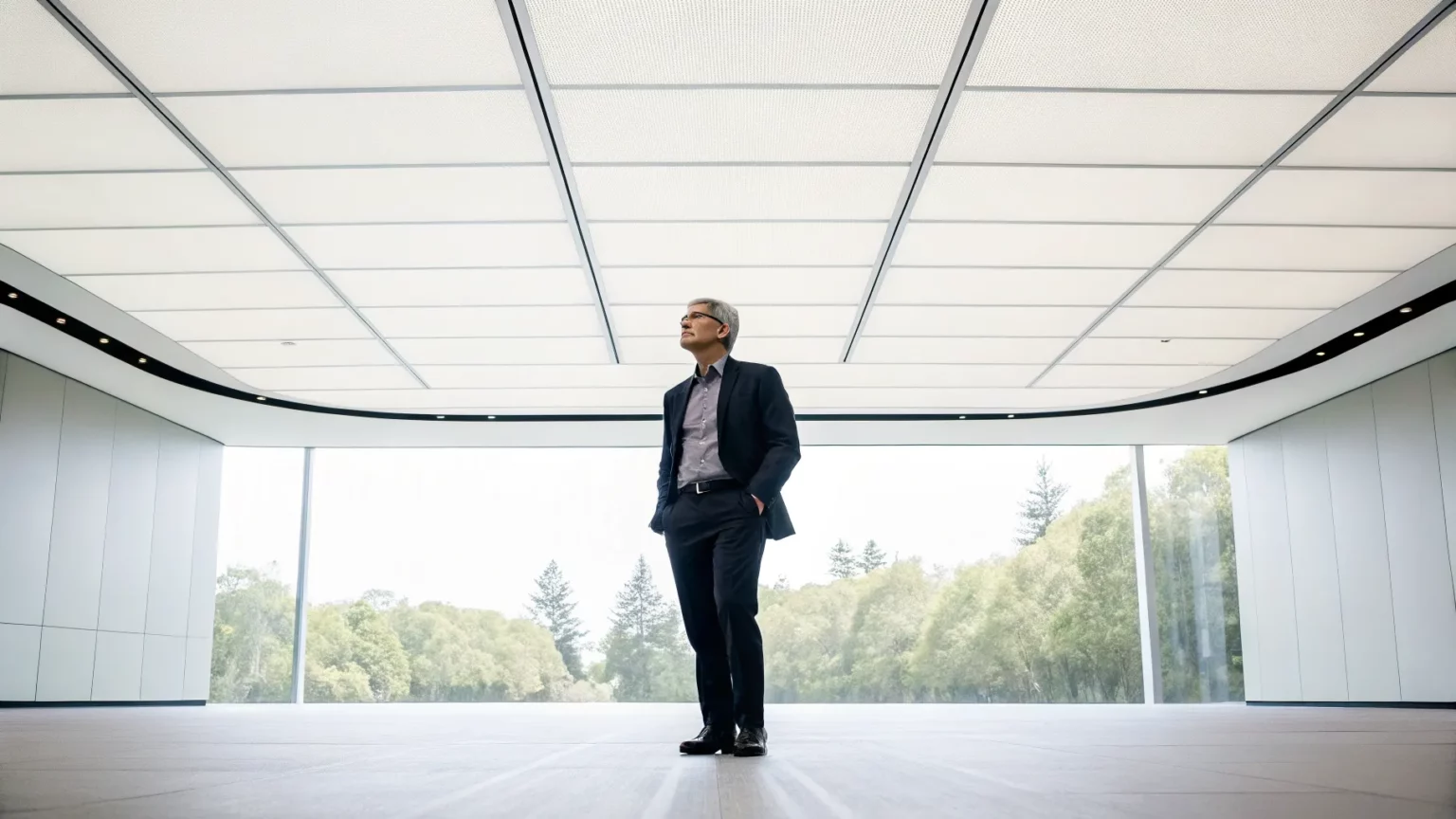
Apple said Monday that Tim Cook is stepping down as chief executive, ending a 13-year run that reshaped the company’s products, business model, and scale.
“Tim Cook, the executive who led Apple to become a $4 trillion company and defined its identity in the post-Steve Jobs era, is stepping down as CEO, Apple said on Monday.”
The announcement marks the most important leadership change at Apple since 2011. It raises immediate questions about succession, product strategy, and growth as the company navigates new markets and regulatory scrutiny.
A Tenure Defined by Scale and Stability
Cook took the top job in August 2011. He inherited Apple at the height of the iPhone’s rise and steered it through a decade of steady expansion.
Under his leadership, Apple broadened its product line, launched new categories, and built a vast services and wearables business. It also executed the move to Apple-designed chips across Macs, improving performance and margins.
Cook emphasized supply chain discipline and global manufacturing partnerships. That approach helped Apple weather component shortages and pandemic disruptions with fewer shocks than many peers.
- Tenure: CEO since 2011
- New lines: Apple Watch, AirPods, Services
- Strategy: In-house chips, privacy features, buybacks
Shifting From Hardware Hits to Recurring Revenue
The Cook era changed how Apple makes money. Services—like the App Store, iCloud, Apple Music, TV+, and AppleCare—became a larger share of revenue and profit. Wearables turned into a major segment with Apple Watch and AirPods.
This shift reduced Apple’s reliance on the iPhone cycle. It also gave investors a steadier earnings profile and supported one of the largest share repurchase programs in corporate history.
Privacy became a central brand promise. Changes to iOS limited tracking by advertisers, affecting parts of the digital ad market but aligning Apple with user data protections that regulators were pushing.



What Changes With Cook’s Exit
Any leadership transition at Apple is sensitive because product timing, secrecy, and integration are central to its model. While the company did not share details on the transition in the brief statement, several priorities are likely to dominate the agenda.
First, Apple must sustain growth in services while rekindling hardware excitement. Recent cycles focused on incremental improvements, battery life, and cameras. The next phase may require bolder features, new devices, or deeper software intelligence.
Second, Apple is investing in on-device AI. The challenge is to build features that feel useful and private without risking battery life or performance. Execution across the iPhone, iPad, and Mac will be key.
Third, supply chain diversification continues. Apple has expanded assembly in India and Vietnam to reduce reliance on any single country. That strategy will remain important amid trade and regulatory pressures.
Investor and Industry Impact
Cook’s departure will test investor confidence. Markets often react to uncertainty, especially when a company’s identity is closely tied to leadership and product cadence.
Analysts will watch for continuity among senior operations, chip design, and software leads. A smooth handoff, plus a clear product roadmap, could calm volatility. Absent that, questions about timing and new leadership style may weigh on the stock in the short term.
Rivals may try to capitalize on any pause in Apple’s launch rhythm. Google, Samsung, and Microsoft are racing to advance AI features, while device makers in China compete on price and innovation. Apple’s integration of hardware, software, and services remains its edge if the cadence holds.
What To Watch Next
The next steps hinge on clarity about succession and the timeline for the transition. Investors and developers will look for continuity signals at the next major product event and software conference.
Key markers include guidance on AI features across devices, updates on services growth, and progress in new markets. Any shift in capital returns or manufacturing footprint would also signal the new leader’s priorities.
Cook’s tenure leaves Apple with strong cash flow, a loyal ecosystem, and global reach. The task now is to maintain that strength while finding the next wave of consumer appeal. The company set high expectations; meeting them will define the post-Cook era.