



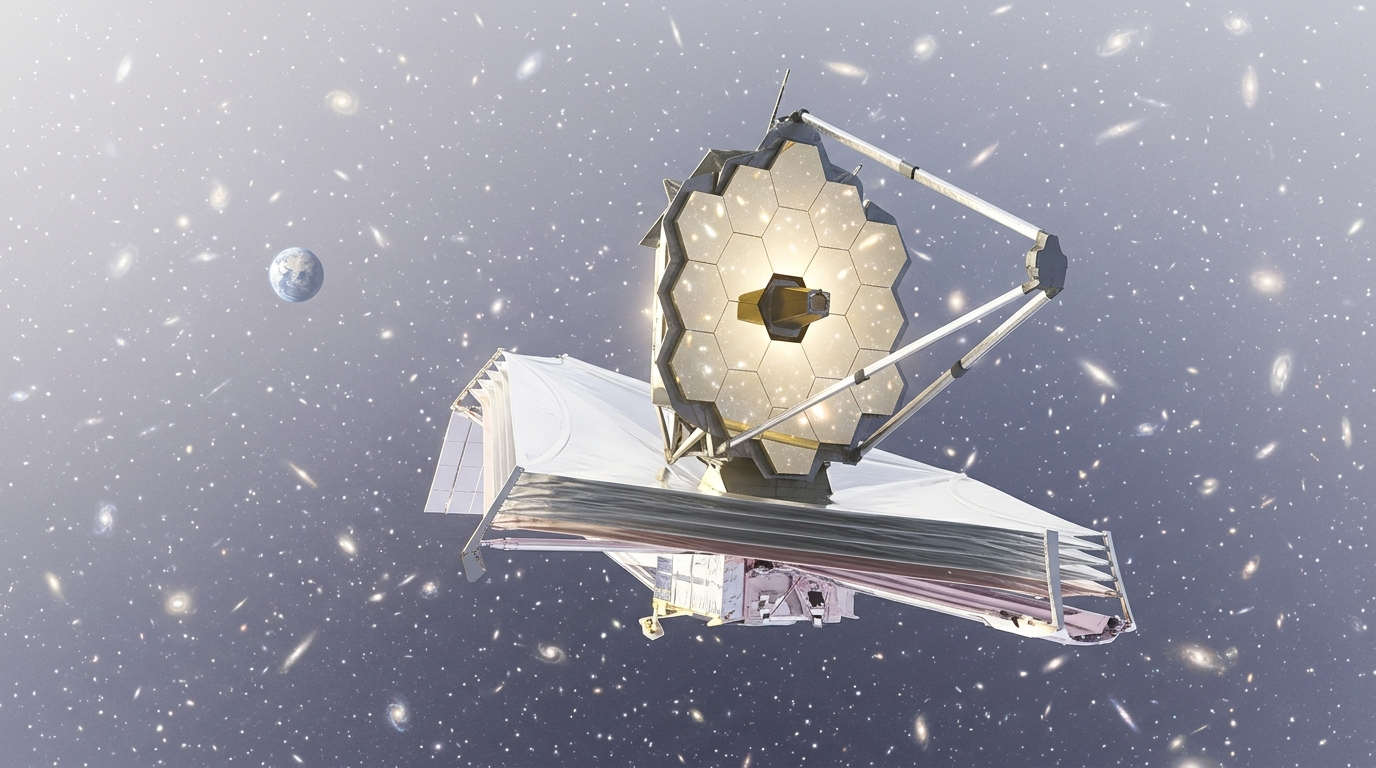
A flagship space observatory is heading toward an orbit about 1 million miles from Earth, beginning a mission to chart billions of galaxies and find thousands of distant planetary systems.
The observatory will use wide infrared surveys to study objects that are difficult to detect in visible light. Its planned location will give it a distant platform for repeated observations, far outside low Earth orbit.
“The flagship observatory heads toward an orbit about 1 million miles from Earth, where its sweeping infrared surveys will map billions of galaxies and search for thousands of distant planetary systems.”
A Wide View of the Universe
The mission’s scale sets it apart from observatories that focus on smaller sections of the sky. Mapping billions of galaxies could give scientists a broad record of how matter is distributed across space.
Large galaxy surveys help researchers compare objects at different distances. Because light takes time to travel, distant galaxies appear as they existed earlier in cosmic history.
The resulting map could support studies of how galaxies formed, changed, and gathered into large groups. It may also help scientists test models of cosmic expansion.
Infrared instruments are central to that work. As the universe expands, light from many distant objects shifts into infrared wavelengths. Dust can also block visible light while allowing some infrared radiation to pass through.
Searching for Distant Planetary Systems
The observatory will also search for thousands of planetary systems far outside the solar system. That work could expand the known population of distant worlds and improve estimates of how common different systems are.
The planned survey may help researchers study planets across a broad range of locations and conditions. A large sample can reveal patterns that individual discoveries cannot show.



- Billions of galaxies are expected to be mapped.
- Thousands of planetary systems may be identified.
- Infrared surveys will support both research goals.
The mission’s broad approach offers scale, but detailed follow-up will still matter. Other telescopes may need to examine selected targets to confirm findings or measure their properties more closely.
A Remote Orbit Brings Benefits and Risks
An orbit about 1 million miles from Earth can provide a stable setting for sensitive observations. Greater distance can reduce some interference associated with operating near the planet.
That location also creates practical limits. Repairs would be far harder than for observatories closer to Earth. Mission teams must rely on careful planning, dependable systems, and remote software updates.
The journey is therefore only the first major test. The observatory must reach its intended orbit, complete technical checks, and prepare its instruments before full scientific surveys can begin.
Data Volume Will Shape the Mission
Surveys covering billions of galaxies will produce a large scientific archive. Researchers will need reliable methods to process images, identify objects, and separate genuine signals from instrument effects.
The archive could support work well outside the mission’s main goals. Astronomers may use it to examine stars, faint galaxies, and unusual events that were not the primary survey targets.
If the observatory performs as planned, it will connect two major fields of research: the history of the universe and the search for distant worlds. Its long-term value will depend on reaching orbit safely, producing accurate surveys, and making those records useful for years of follow-up study.