






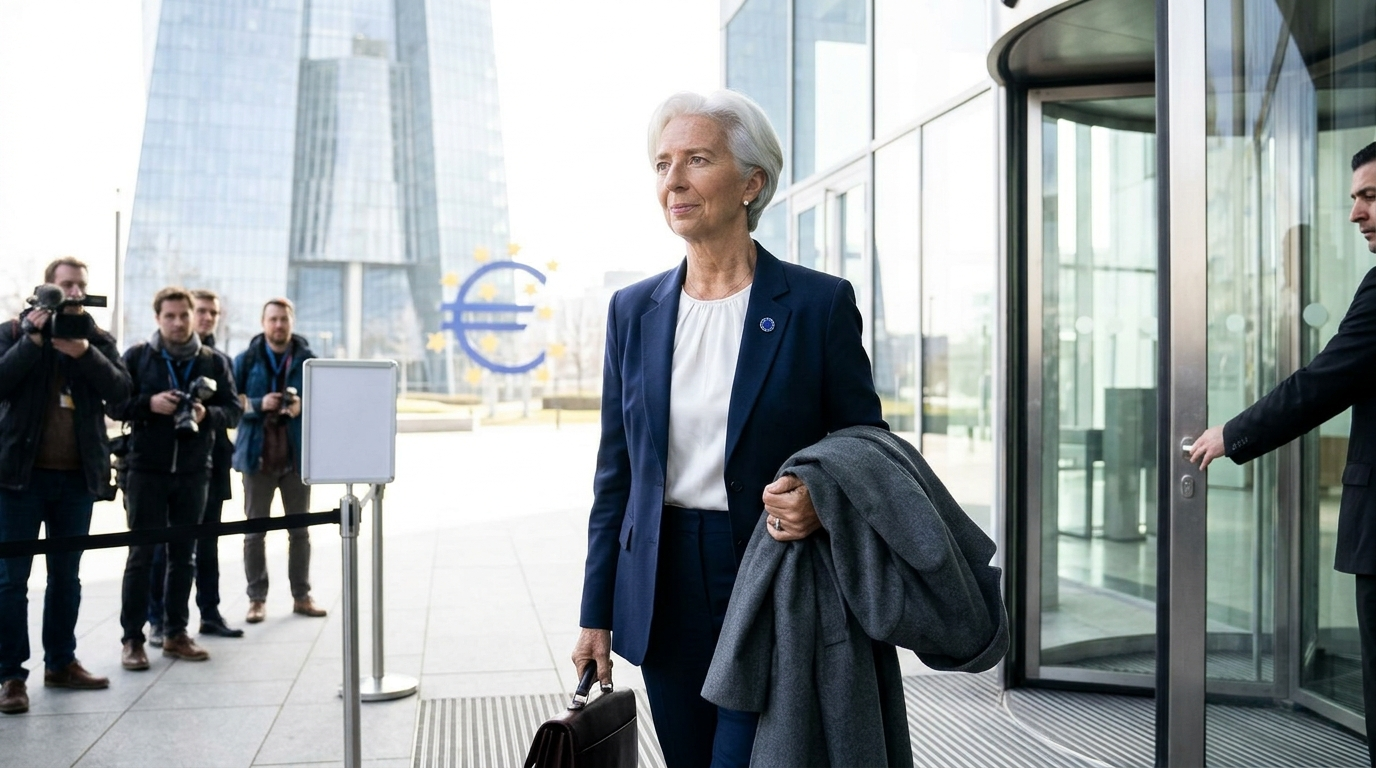
European Central Bank President Christine Lagarde will resign on Feb. 7, leaving nine months before her eight-year term was due to end.
The ECB announced the decision on Thursday in Frankfurt, opening an early contest among European leaders to select her successor. The central bank did not provide a reason for the departure in its initial announcement.
The change will place fresh attention on monetary policy leadership in the euro area. The ECB sets interest rates for countries using the euro and plays a central role in managing inflation and financial stability.
An Early End to Lagarde’s Term
Lagarde’s resignation shortens a term designed to give the ECB president independence from election cycles and national political pressure. ECB presidents serve one eight-year term.
Lagarde “will resign Feb. 7, nine months ahead of the end of her 8-year term,” the ECB said.
The timing gives European governments less time than expected to settle on a replacement. Leadership contests for major European Union institutions often require negotiations among countries, political groups and regional blocs.
Lagarde brought extensive political and financial experience to the bank. Before joining the ECB, she led the International Monetary Fund and served as France’s finance minister.
Her ECB tenure covered severe economic shocks. These included the COVID-19 pandemic, supply shortages, an energy crisis and a sharp increase in consumer prices. The bank responded first with emergency support, then with higher interest rates as inflation rose.
European Leaders Face a High-Stakes Choice
The succession process will test whether European leaders can agree quickly on a candidate. The choice will carry economic and political weight across the euro area.



Under EU rules, national leaders appoint the ECB president after consulting the European Parliament and the ECB’s Governing Council. Candidates are usually judged on central banking experience, economic knowledge and their ability to build agreement.
Several factors are likely to shape the negotiations:
- The candidate’s position on inflation and interest rates
- Balance among northern and southern European countries
- Representation across the EU’s senior institutions
- Experience handling financial or sovereign debt risks
Governments may favor a leader who supports strict inflation control. Others may seek greater attention to weak growth, borrowing costs and pressure on public finances.
Policy Continuity Will Be Closely Watched
The ECB president does not set policy alone. Interest-rate decisions are made by the Governing Council, which includes national central bank governors and the ECB’s Executive Board.
That structure can limit sudden policy shifts after a leadership change. Still, the president has major influence over internal debate, public communication and relations with governments and financial markets.
Investors will watch for signs that the succession could change expectations for rates. They will also assess whether the process creates uncertainty during the final months of Lagarde’s leadership.
The immediate questions are why Lagarde is leaving early, who will enter the contest and how quickly EU leaders can agree. Until those details emerge, the ECB’s announcement marks the start of a consequential transition at the institution responsible for the euro.