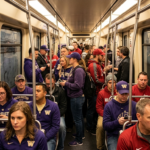



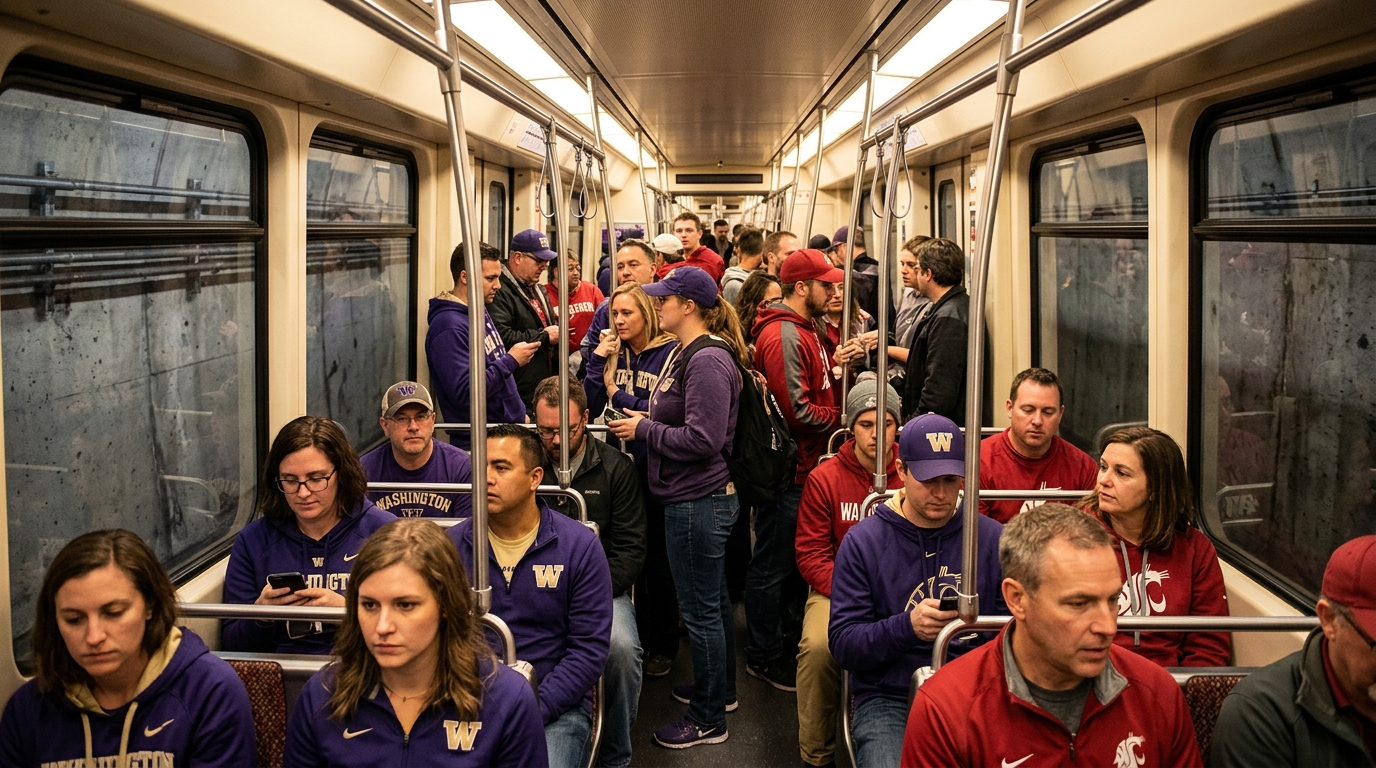
A Sound Transit light rail train packed with college football fans broke down inside a tunnel soon after Sunday’s Apple Cup, disrupting postgame travel for riders.
The failure occurred as fans were leaving the annual rivalry game between the University of Washington and Washington State University. The available information did not identify the tunnel, train line, or exact time of the breakdown.
Sound Transit also had not provided details about the cause, the length of the delay, or how passengers left the disabled train. No injuries were reported in the initial account.
Crowded Conditions Raise the Stakes
Rail failures are especially difficult after major sporting events. Large groups often reach stations within a short period, leaving transit systems with little spare capacity.
A disabled train inside a tunnel can create wider problems across a rail line. Trains behind it may be forced to stop, hold at stations, or reverse direction. Limited access can also slow inspections and passenger assistance.
The incident occurred soon after the Apple Cup, when many riders were likely making the same trip from the stadium area. That timing increased the risk of crowded platforms and longer waits.
Several basic questions remained unanswered:
- How long passengers remained aboard the train
- Whether another train moved the stranded riders
- How many later trips were delayed or canceled
- What mechanical or electrical problem stopped the train
A Major Test for Event Transit
The Apple Cup is one of Washington state’s best-known college football traditions. Its large attendance creates a predictable surge in demand for roads, buses, and rail service.



Public agencies often encourage fans to use transit for major games because trains can move many people without adding cars near a stadium. That strategy depends on reliable service during the busiest travel periods.
Sunday’s breakdown shows how one disabled train can strain that plan. A failure in an enclosed tunnel offers fewer options than a disruption on an open section of track. Passengers may also receive limited information while crews assess conditions.
For riders, timely announcements are a key part of the response. Updates about delays, alternate routes, and expected recovery times can reduce confusion at stations and aboard trains.
Cause and Service Impact Remain Unclear
The initial report did not say whether the problem involved the train itself, the track, power equipment, or a safety system. Each possible cause would require a different inspection and response.
Further information from Sound Transit could show whether the breakdown was an isolated equipment failure or part of a wider service issue. Maintenance records and operating reports may also clarify what happened.
The agency’s handling of the incident will matter to regular commuters as well as event organizers. Riders depend on clear plans for moving passengers safely when trains stop in confined areas.
The immediate focus is now on the cause, the duration of the disruption, and the experience of those aboard. Those details will help measure whether emergency procedures worked as intended and what changes may be needed before the next major event.