




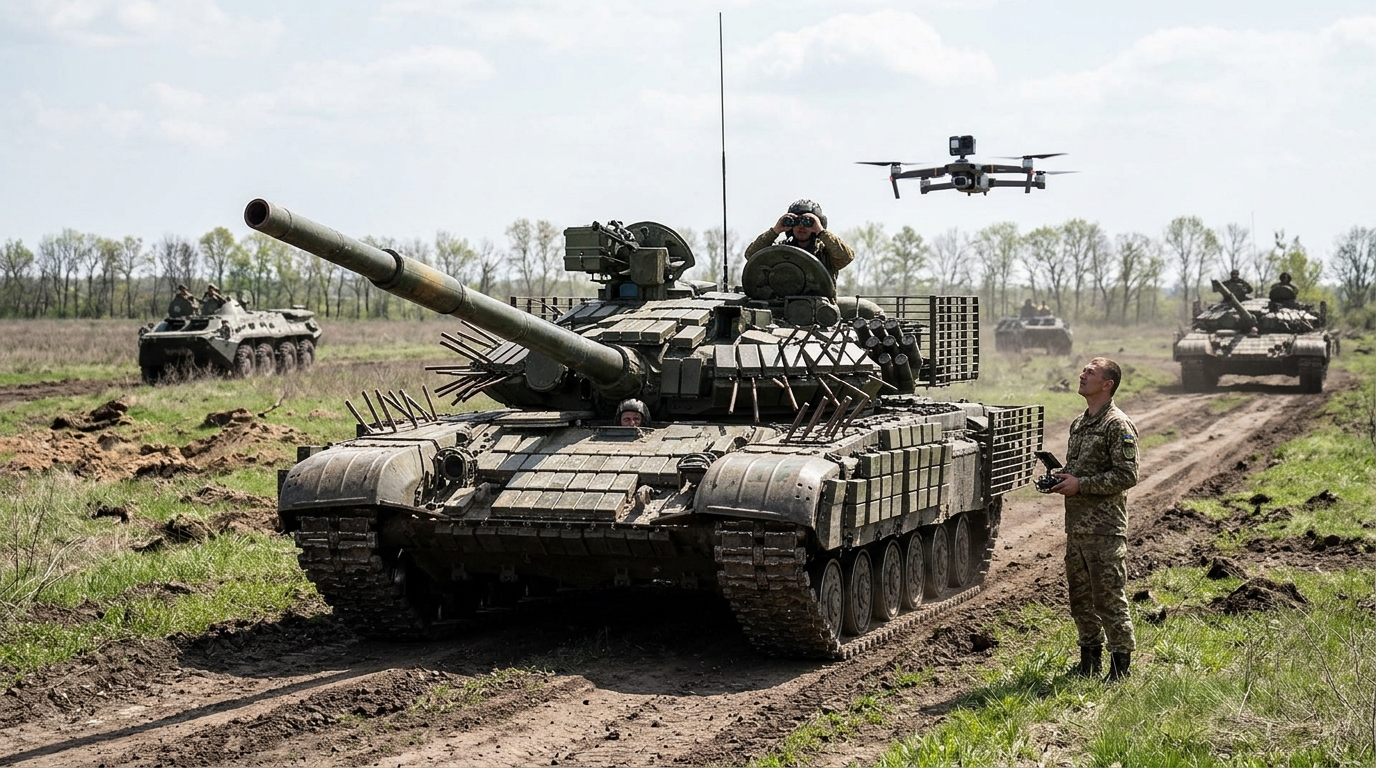
Ukraine is pairing tanks with drone escorts and hedgehog-style armor to restore limited armored movement under heavy Russian drone pressure. The battlefield adaptation reflects a wider contest between protection, mobility, and constant aerial surveillance.
The approach does not signal a full return to large tank formations. Instead, it offers a way to use armor for focused missions where infantry units need protected firepower or support.
Drone Escorts Watch for Threats
Small drones can scout routes before tanks advance. They can also monitor nearby terrain during an operation, giving crews earlier warning of Russian forces and approaching unmanned aircraft.
This escort role turns drones into an extra set of eyes. Operators can identify hazards that tank crews may struggle to see through narrow viewing systems or damaged equipment.
The tactic also reflects a basic lesson from the war: a vehicle’s protection now depends on information around it. A tank can have thick armor, but it remains exposed if the crew cannot detect threats early.
Drone escorts may support several tasks:
- Checking roads and fields for potential ambushes.
- Watching likely launch areas for Russian drones.
- Helping crews choose covered routes and firing positions.
- Assessing damage after tanks strike a target.
These benefits depend on reliable communications and skilled coordination. Electronic interference, bad weather, limited battery life, and enemy fire can disrupt the escort system.
Hedgehog Armor Adds Physical Protection
Ukraine is also using metal structures often described as hedgehog-style armor. The frames create distance between a drone’s explosive charge and the tank’s main armor.



Similar protective cages have appeared on vehicles used by both Ukraine and Russia. Their spread shows how quickly military units are modifying equipment in response to low-cost attack drones.
The added armor can reduce damage in some encounters, but it is not a complete defense. Results depend on the drone’s warhead, impact point, and angle of attack. Repeated strikes can also overwhelm improvised protection.
Extra metal may increase a vehicle’s weight and profile. It can obstruct visibility, complicate maintenance, or make it harder for crews to leave a damaged tank. Commanders must balance those costs against improved protection.
Armored Warfare Shifts to Smaller Missions
The renewed use of tanks appears centered on limited armored maneuvers, rather than mass advances across open ground. Persistent surveillance makes large vehicle groups easier to detect and target.
Tanks can still deliver direct fire, survive hazards that would stop lighter vehicles, and support troops attacking defended positions. Yet they increasingly operate as part of a coordinated team that includes drones, infantry, electronic warfare, and artillery.
This shift challenges claims that drones have made tanks obsolete. The stronger conclusion is that unprotected or poorly coordinated armor has become far more vulnerable.
Russia is also adapting its tactics and vehicle protection. That creates a continuing cycle in which one side improves defenses, while the other changes drone flight paths, warheads, frequencies, or attack methods.
Adaptation Offers Gains but Not Immunity
Ukraine’s approach could preserve scarce armored vehicles and give crews more options near contested positions. It may also allow tanks to operate for short periods where drone activity had previously made movement too dangerous.
However, the tactic remains constrained by Russia’s surveillance network and strike systems. Drone escorts can be jammed or destroyed, while protective frames cannot stop every attack.
The key measure will be whether these methods produce repeatable battlefield gains without unacceptable losses. Future developments will likely focus on tighter drone coordination, improved electronic defenses, and armor designed specifically for attacks from above.
For now, Ukraine is not restoring the tank’s former freedom of movement. It is finding narrower ways to keep armored firepower useful in a war where almost every movement may be watched.