




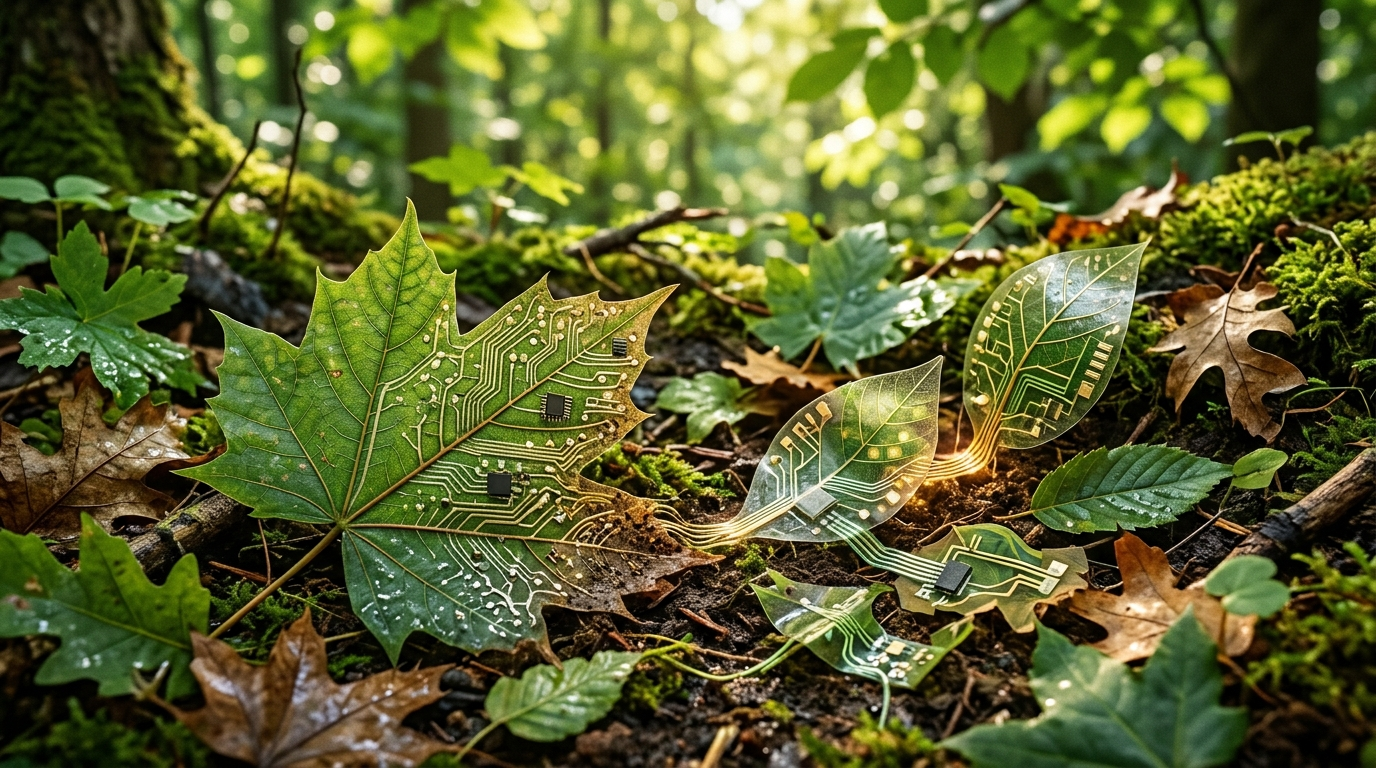
Leaves could guide the development of electronics that work reliably, then break down after use instead of becoming waste. Hans Kleeman has described this biological model as a route to a new generation of sustainable, biodegradable devices.
The idea targets a growing environmental problem. Many conventional electronics contain plastics, metals, and other materials that can remain in the environment for years. Small or short-lived products can also be difficult to collect and recycle.
Why Leaves Offer a Useful Model
A leaf is thin, light, and made from materials that return to nature after its useful life. Yet it can also manage energy, move water, exchange gases, and respond to changing conditions.
Those traits make leaves a useful source of ideas for researchers designing temporary electronics. Rather than copying a leaf’s appearance, scientists can study its structure and life cycle.
Kleeman describes inspiration from leaves as a way to enable “a new generation of sustainable, biodegradable electronics.”
The central principle is planned degradation. A device should remain stable while operating, but decompose safely under selected conditions after disposal. Achieving both goals is difficult because durability and rapid breakdown often conflict.
Potential Uses and Design Challenges
Biodegradable electronics may be suited to products with limited operating lives. Possible uses include environmental sensors, disposable medical devices, smart packaging, and agricultural monitoring tools.
Such products could reduce the need to retrieve devices from remote sites or from inside the body. They may also cut waste from applications where recycling is impractical.
Researchers must still address several technical and environmental questions:



- How long can a device operate before it begins to degrade?
- What heat, moisture, or soil conditions trigger its breakdown?
- Do its materials leave harmful residues?
- Can manufacturers produce it at a practical cost?
Every layer matters. Conductive paths, insulating films, sensors, power sources, and protective coatings must either biodegrade or be recoverable. Replacing only the outer casing would leave much of the waste problem unchanged.
Sustainability Requires Full-Life Testing
Biodegradability alone does not guarantee a lower environmental impact. Manufacturing may still require energy, water, chemicals, and scarce raw materials. A fair assessment must examine production, transport, use, disposal, and decomposition.
The breakdown environment also matters. A material that decomposes in an industrial facility may persist in ordinary soil or seawater. Clear testing standards will be needed before companies can make credible environmental claims.
Leaf-inspired electronics therefore represent both a design strategy and a change in how product life is defined. Engineers have long worked to make electronics last. Kleeman’s approach asks them to create devices that last only as long as needed.
The next steps will depend on material safety, stable performance, and proof that degradation works outside controlled laboratories. If those tests succeed, temporary electronics could become less burdensome after use, much like the leaves that inspired them.