



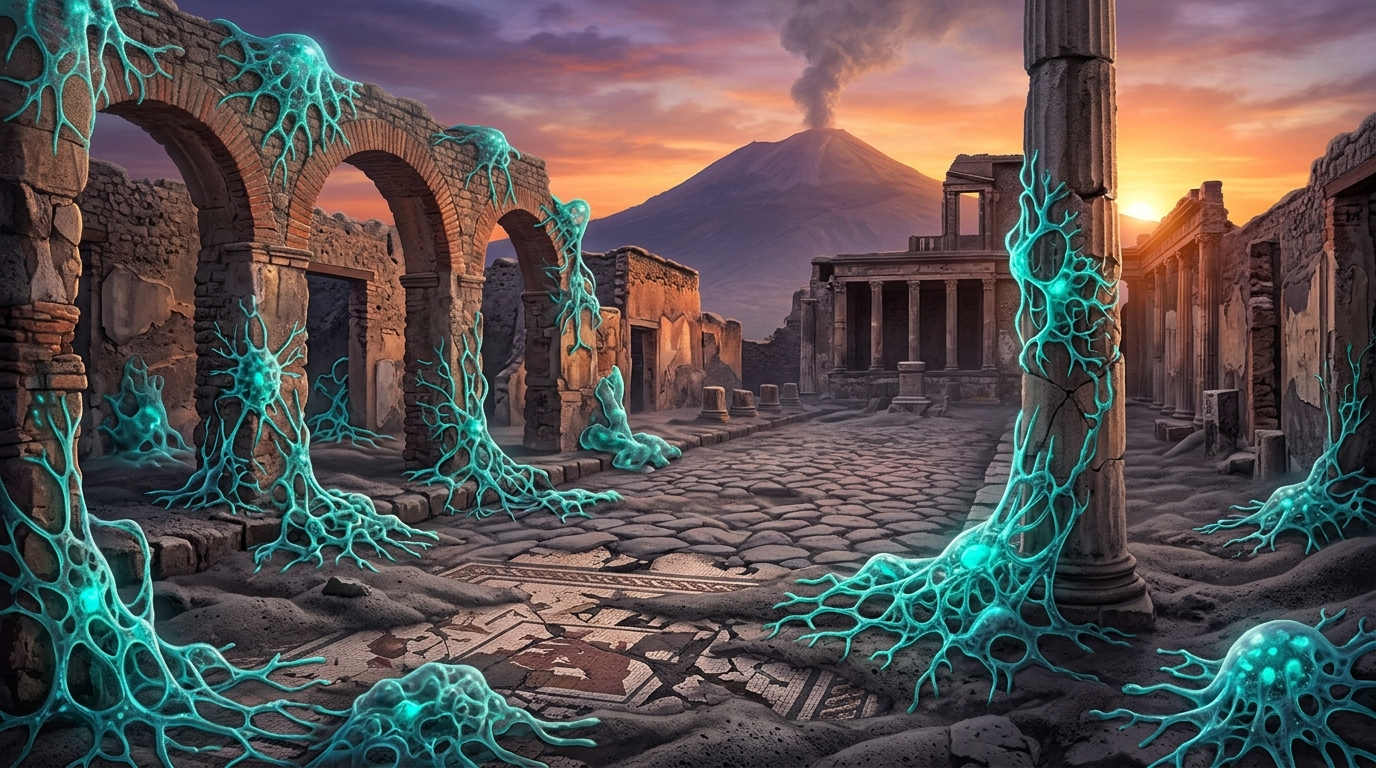
Annalee Newitz’s new book sends slime mold aliens into Pompeii, using an ancient disaster site to examine humanity through unfamiliar eyes.
The premise links speculative fiction with one of history’s best-preserved Roman cities. It also raises a striking question: What would an intelligent life-form, built unlike humans, make of human society?
An Alien View of Human Life
Slime molds are unusual organisms that can solve simple problems without a brain. Their behavior has inspired research into movement, cooperation, and collective decision-making.
Turning that model into an alien species gives Newitz a tool for testing human assumptions. A nonhuman visitor may not recognize familiar ideas about identity, power, family, or social order.
The concept also avoids the common science-fiction pattern of aliens that look and behave much like people. Slime mold aliens suggest intelligence could emerge in a radically different physical form.
- They may think through distributed networks rather than a central brain.
- They could view individuality differently from humans.
- Their biology may change how they understand memory and survival.
Those differences can create humor and unease. They can also let readers reconsider behavior that seems ordinary only because it is familiar.
Why Pompeii Matters
Pompeii was buried after Mount Vesuvius erupted in 79 CE. Volcanic material preserved streets, buildings, artwork, and traces of daily life.
That record offers more than a dramatic setting. Pompeii provides evidence of commerce, religion, housing, entertainment, and inequality within the Roman Empire.


For fictional alien observers, the city could function as a preserved sample of human culture. Its remains show how people worked and lived, but also how quickly established systems could collapse.
The setting creates tension between ordinary routines and disaster. Residents went about their lives near a volcano whose eruption would define how later generations remembered them.
That contrast may support the book’s larger examination of humanity. Modern societies also live with known dangers, including environmental threats, disease, and war. Yet daily life often continues as if those risks were distant.
Science Fiction as Social Inquiry
Newitz’s premise fits a long tradition of speculative fiction that uses outsiders to study human conduct. Alien narrators can expose contradictions without accepting the rules that humans take for granted.
Pompeii adds an archaeological layer to that method. The aliens are not simply meeting humanity. They are exploring remains that must be interpreted from incomplete evidence.
That process resembles the work of historians and archaeologists. Objects can reveal much about a society, but they do not always explain motives, relationships, or personal beliefs.
The book’s central pairing, slime mold aliens and Pompeii, therefore joins two forms of distance. One comes from biology. The other comes from time.
Further details about the plot, characters, and publication were not provided. Still, the core idea points to a story concerned with intelligence, historical memory, and human vulnerability.
Its success will depend on whether the alien perspective produces more than novelty. If the visitors make Pompeii feel both strange and recognizable, Newitz’s book could offer a sharp study of how humanity sees itself, and what it leaves behind.