




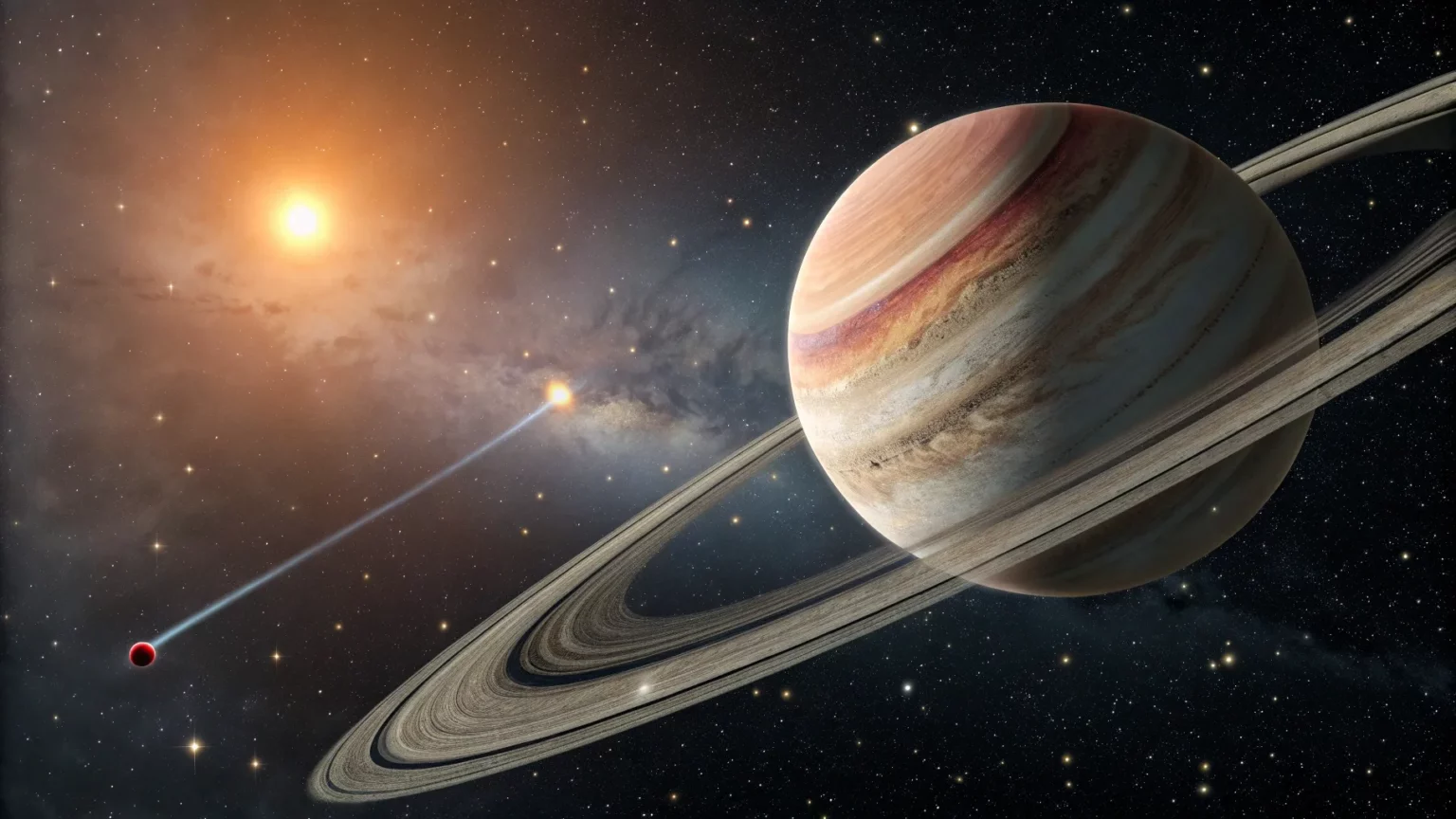
Astronomers have made a groundbreaking discovery that challenges existing theories about planetary formation. They’ve found a Saturn-sized planet orbiting TOI-6894, which is now the smallest star ever known to host such a massive world.
This unexpected finding contradicts what scientists have long believed about the relationship between star size and planetary formation. Until now, astronomers theorized that tiny, low-mass stars simply didn’t have enough material in their systems to form or maintain giant planets.
Challenging Established Theories
The discovery represents a significant shift in our understanding of how planetary systems form around different types of stars. Previously, astronomers thought there was a direct correlation between a star’s mass and its ability to host large planets.
The conventional wisdom suggested that smaller stars would have less material in their protoplanetary disks – the rings of gas and dust that eventually form planets. With less material available, the formation of gas giants like Saturn or Jupiter was thought to be highly unlikely around very small stars.
TOI-6894’s planetary system proves this assumption wrong. Despite the star’s minimal mass, it has successfully formed and maintained a planet comparable in size to Saturn – one of our solar system’s gas giants.
The Significance of the Finding
This discovery opens up new possibilities for where astronomers might look for exoplanets in the future. If even the smallest stars can host giant planets, the potential locations for finding new worlds expands dramatically.
The finding also raises questions about the mechanisms of planetary formation. Scientists will now need to revisit models that explain how planets form around stars of different masses and compositions.
Some key implications include:


- Small stars may have more complex planetary systems than previously thought
- The material needed for giant planet formation might be more readily available than assumed
- Current models of star-planet relationships need revision
What This Means For Exoplanet Research
The TOI-6894 system provides astronomers with a rare opportunity to study how giant planets interact with very small stars. This could help explain planetary migration patterns, orbital stability, and atmospheric composition in these unusual systems.
“This finding forces us to reconsider what we know about planetary formation,” an astronomer involved in the research might say. “We now have to explain how a star with so little mass managed to form a Saturn-sized planet.”
The discovery was made possible by advances in detection technology that allow astronomers to find planets around increasingly smaller and dimmer stars. As these technologies improve, more surprising planetary systems may come to light.
For now, TOI-6894 and its giant companion stand as evidence that the universe continues to surprise us, even when we think we understand the rules. The small star and its oversized planet remind astronomers that cosmic systems don’t always follow our expectations.
As research continues, scientists will work to understand exactly how this unusual planetary system formed and whether it represents a rare exception or a more common occurrence that has simply gone undetected until now.