



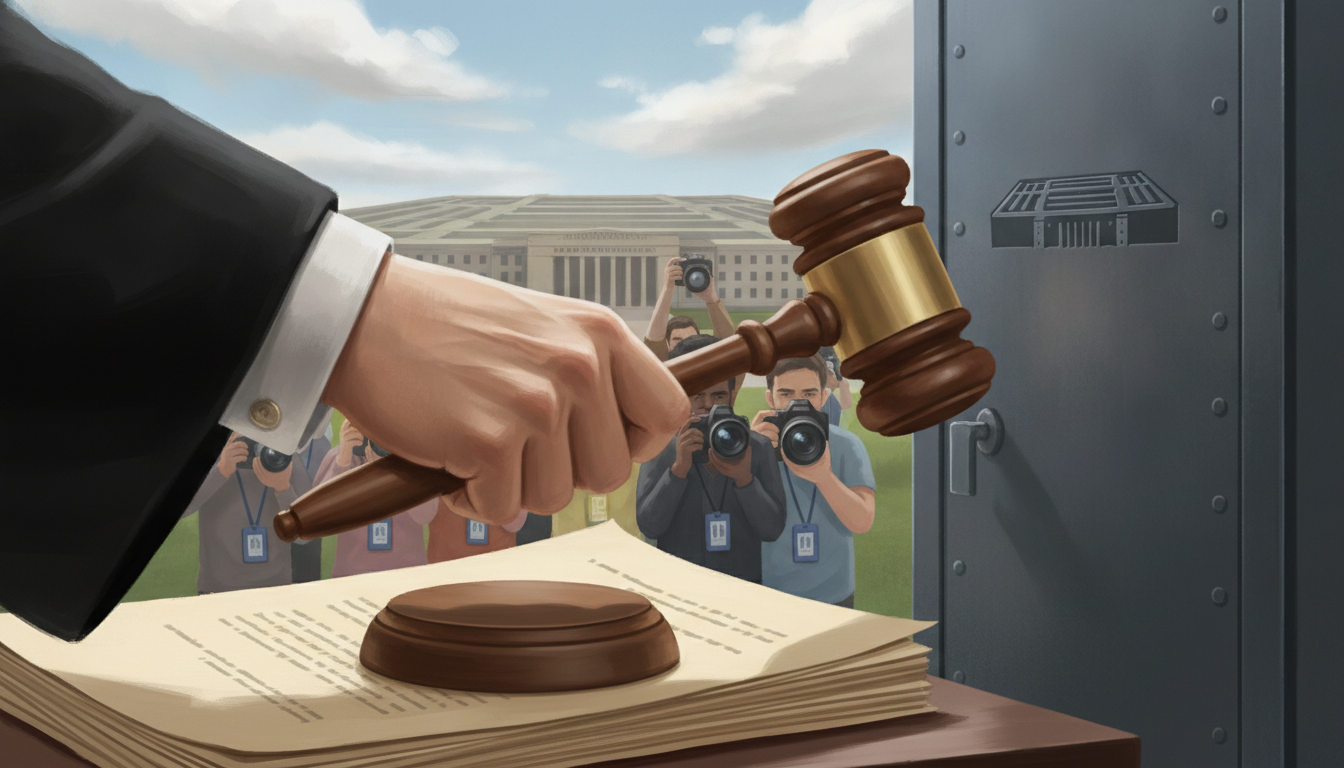
A federal judge has temporarily blocked a new Pentagon rule that limited reporters’ access, following a challenge filed by The New York Times. The order pauses enforcement while the case proceeds, raising fresh questions about press rights at the nation’s military headquarters and the government’s security priorities.
The dispute centers on how far the Defense Department can go in restricting journalists who cover military policy and operations from inside the building. While the terms of the stalled rule were not made public in detail, the case reflects a broader struggle over access to public officials, briefing rooms, and on-site interviews in sensitive federal facilities.
A federal judge temporarily blocked a new rule that restricted reporters’ access to the Pentagon, in a lawsuit brought by The New York Times.
What the Ruling Does
The temporary order keeps current access arrangements in place for now. It does not decide the lawsuit on the merits, but it suggests the court sees potential harm if the policy went ahead. Legal watchers say these early rulings often turn on whether the policy could chill newsgathering in a way that cannot be easily fixed later.
The Times argues that limiting access would damage day-to-day reporting on defense matters, including briefings and in-person interviews that inform the public. The Pentagon, in turn, is expected to argue that any limits address security, crowding, and orderly operations.
Press Access and the First Amendment
Courts have long recognized that the press has no special constitutional right to enter every government building. But when agencies create press systems—such as passes, pools, or designated spaces—they must apply clear, non-arbitrary standards. In the 1977 case Sherrill v. Knight, the D.C. Circuit held that the government must use fair criteria and provide due process when granting or revoking press credentials.
That precedent often guides disputes over press access at the White House and other federal hubs. Press advocates say the same logic applies at the Pentagon. If rules limit entry, they argue, the standards should be narrow, objective, and tied to legitimate concerns, not broad restrictions that could sideline critical coverage.
Why Pentagon Access Matters
The Pentagon is a central source for information on U.S. military operations, global posture, budgeting, and personnel policy. On-site access helps reporters ask follow-up questions, test claims, and gather context that is hard to obtain by phone or email. In-person briefings also allow for real-time challenge and clarification.
- Access affects daily coverage of defense policy and operations.
- On-site reporting can improve accuracy and public understanding.
- Limits can reduce visibility into decision-making that impacts national security and taxpayer funds.
Security Versus Transparency
Government officials often cite physical security and operational needs when tightening access. The Pentagon is one of the most sensitive buildings in the country, and crowd control, credential verification, and movement restrictions are common features of large federal facilities.



Press groups counter that reasonable safeguards can coexist with open reporting. They warn that overbroad rules can blur the line between safety and control of information, especially when reporters seek to question leaders on urgent issues like war planning, procurement, or whistleblower claims.
How This Fits Recent Trends
The lawsuit follows years of push and pull over access at high-profile institutions. During the pandemic, many agencies scaled back in-person availability, and some limits remained even after public health restrictions eased. News organizations have pressed for a return to fuller on-site coverage, arguing that public trust depends on closer scrutiny and more face time with officials.
The Pentagon has a long history of daily briefings and scheduled interactions with the press. Changes that limit routine contact can shift reporting toward official statements and curated releases, which may narrow the range of questions and reduce spontaneity.
What Comes Next
The court will likely consider whether the Pentagon’s rule uses clear, objective criteria and whether less restrictive measures could address security concerns. The judge could request more information on how the rule was developed, how it would be applied, and how affected reporters could appeal decisions.
For now, reporters can continue working under existing procedures while the case moves ahead. The outcome could guide future access rules across federal agencies, setting a practical standard for balancing security and an open press.
The ruling marks an early but important stage. If the court finds that the rule lacks narrow, neutral limits or a fair process, it could be struck down or sent back for revision. If the Pentagon demonstrates a tight fit between the rule and proven security needs, it may revive parts of the policy. Either way, the public has a direct stake in the result, which will shape how journalists cover the nation’s military in the months ahead.