



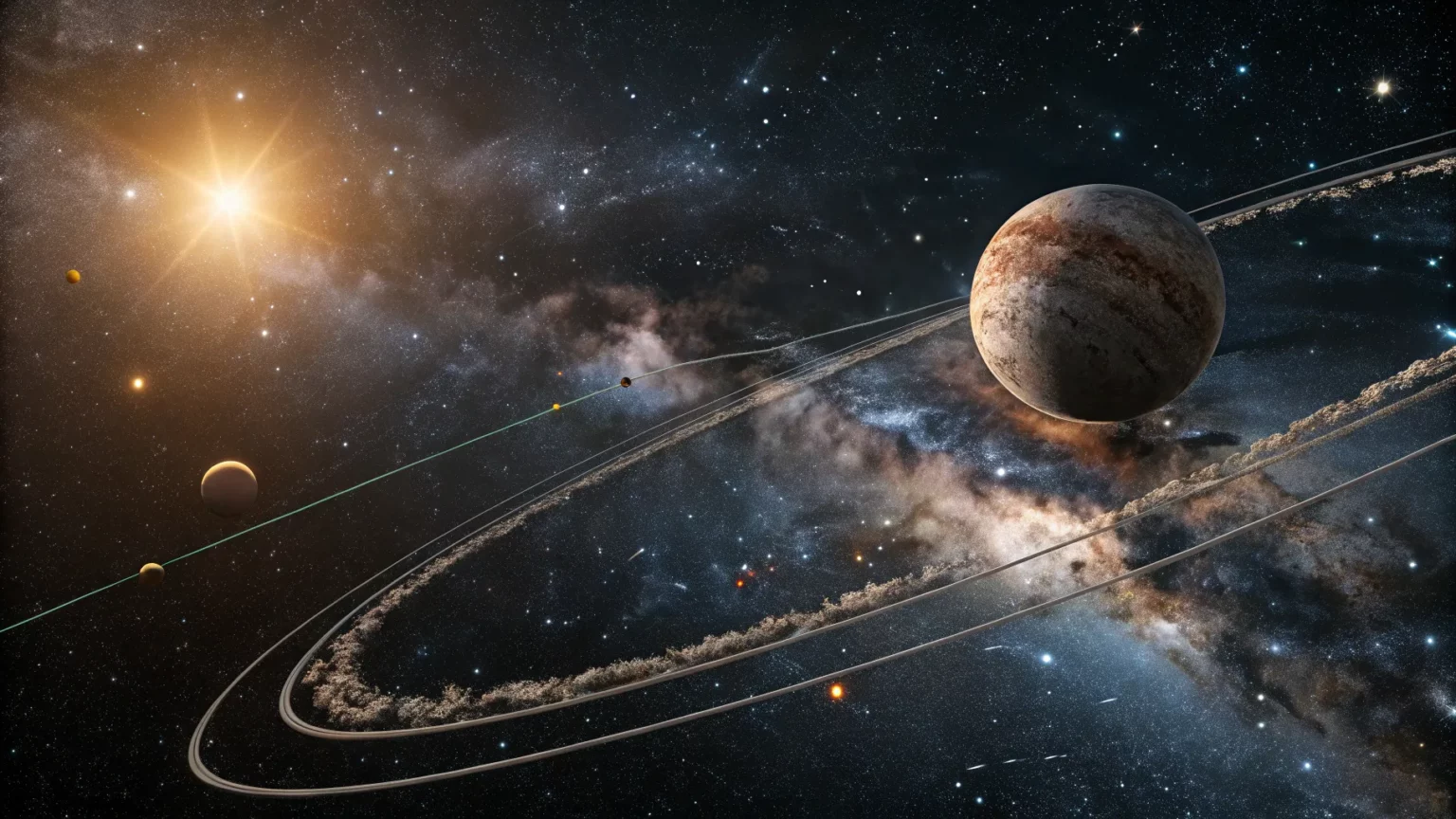
A newly analyzed, likely dwarf planet in the outer solar system appears to complete a single orbit in more than 24,000 years, and its path may upend ideas about a hidden giant world. The object’s extreme journey through the distant reaches could clash with leading models for a proposed “Planet Nine,” the hypothetical planet some researchers say shapes orbits far from Neptune.
The finding arrives as interest in the far-flung solar system grows. Researchers have spent years tracking faint, slow-moving bodies whose paths might reveal whether a massive planet lurks far from the sun. Early readings of the new object suggest a long, stretched orbit that does not line up with some predictions for Planet Nine’s influence.
“One trip around the sun takes the likely dwarf planet over 24,000 years. Its orbit challenges a proposed path for a hypothetical ‘Planet Nine.’”
How We Got Here
The Planet Nine idea gained traction in 2016, when researchers noted unusual clustering among several distant, elongated orbits. They argued a yet-unseen planet, perhaps several times Earth’s mass, could herd these bodies into aligned paths. Multiple discoveries since then, including objects that swing hundreds of astronomical units from the sun, have fueled the debate.
But the argument has never been settled. Some studies say the apparent clustering could result from where telescopes look and when they look. Others point to dwarf planets like Sedna and Leleākūhonua, whose long periods hint at strong past disruptions by passing stars or the early solar system’s birth cluster.
What the New Orbit Suggests
The newly highlighted object’s path adds a fresh data point. A period beyond 24,000 years implies a very large, oval orbit, with the sun near one end. That shape can be sensitive to gravitational nudges from unseen bodies, the galactic tide, or ancient stellar flybys.
If Planet Nine exists on a specific track, it should tend to steer distant orbits into certain alignments. Early modeling indicates this object does not match that pattern, at least for one popular version of Planet Nine’s path. That tension could mean the planet, if real, follows a different route, or that other forces are at play.
- The orbit is extremely long, exceeding 24,000 years.
- Its alignment appears to differ from some Planet Nine models.
- Alternative processes, like stellar encounters, could explain the shape.
Competing Views Among Astronomers
Supporters of Planet Nine say one outlier does not decide the case. They note that distant bodies can be tugged by many influences, and small changes in an assumed orbit for the hidden planet can flip predictions. They also argue that more discoveries will tighten the picture.
Skeptics point to detection bias. Telescopes survey the sky unevenly, often near the ecliptic and during certain seasons. That bias can create patterns that look like alignment. They also cite computer simulations showing that passing stars and the Milky Way’s pull can stretch orbits without needing an extra planet.



Both sides agree on one thing: better data is key. Refining the object’s orbit will take years of tracking. Slight shifts in position can change the calculated period and tilt, which in turn affects any test of Planet Nine models.
What Comes Next
New surveys are on the horizon. The Vera C. Rubin Observatory, set to begin wide-sky scans soon, is expected to spot thousands of faint solar system bodies. A larger, more uniform sample should cut bias and reveal whether distant orbits truly cluster in a way that demands a massive perturber.
Follow-up work will also aim to map the object’s path with higher precision. The arc of observation is still short compared with a 24,000-year period. Each additional year sharpens estimates and allows stronger tests against different Planet Nine scenarios.
If the orbit continues to defy leading models, researchers may revisit ideas about the solar system’s early years. That could include a closer look at stellar encounters, a reshaped Kuiper Belt, or even a past migration of the giant planets.
The latest finding does not settle the Planet Nine debate, but it raises the bar for any proposed solution. For now, the distant object stands as a new clue from the solar system’s edge, urging scientists to refine their models and expand the search. Watch for improved orbit fits, deeper surveys, and—if it exists—the first direct sign of a hidden giant.