



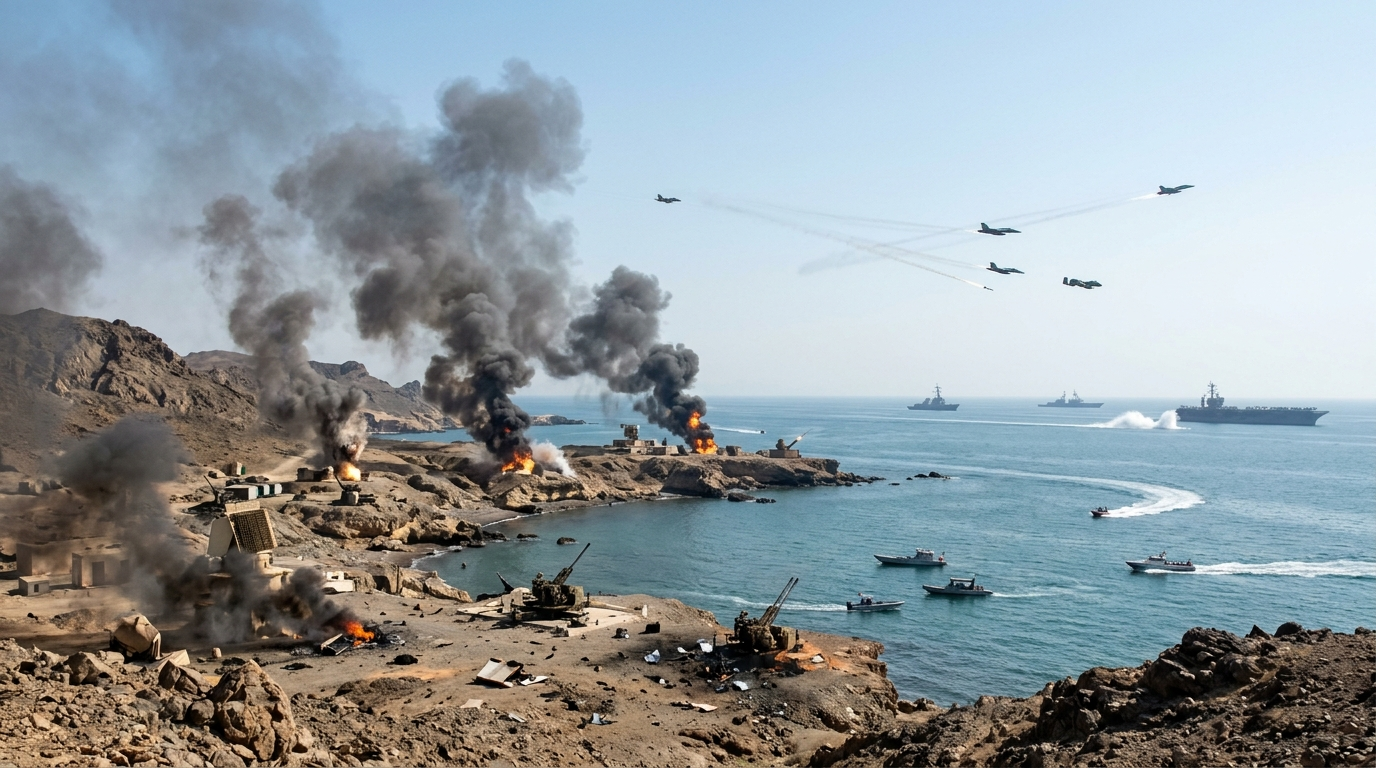
President Donald Trump said the United States launched “large and powerful” strikes on Iranian targets near the Strait of Hormuz, prompting an Iranian threat of retaliation.
U.S. Central Command said American forces targeted sites linked to Iran’s Islamic Revolutionary Guard Corps, or IRGC. Iran’s armed forces general staff responded by saying the country would retaliate.
The exchange raises the risk of a wider military conflict near one of the world’s most important shipping routes. It could also increase pressure on governments seeking to prevent further escalation.
U.S. Military Targets the IRGC
Trump described the operation in forceful terms but did not provide details about the targets, weapons or damage.
The United States launched “large and powerful” strikes on Iranian targets near the Strait of Hormuz, Trump said.
U.S. Central Command offered a limited account of the mission. It said the strikes hit “Islamic Revolutionary Guard Corps targets in Iran.”
The IRGC is a major branch of Iran’s security system. It operates military forces and plays a central role in Iran’s regional strategy.
Key details remained unclear in the first reports:
- The number and location of the targets
- Whether anyone was killed or injured
- Which U.S. forces and weapons were used
- Whether more strikes were planned
The lack of public detail makes it difficult to judge the operation’s size or immediate military effect. It also leaves open whether Washington intended a limited response or a broader campaign.



Iran Promises a Response
Iran’s armed forces general staff said the country would retaliate. It did not identify when or where that response might occur.
Iran has several possible options. These could include direct military action, attacks on U.S. positions in the region or pressure on commercial shipping. The initial statement did not confirm any specific plan.
The threat creates a period of uncertainty for U.S. forces and regional governments. Any retaliation could lead to another American response, increasing the danger of repeated attacks.
Washington has framed the operation around IRGC targets. Tehran, however, is likely to view strikes inside Iran as a direct challenge to its sovereignty and security.
Why the Strait of Hormuz Matters
The Strait of Hormuz connects the Persian Gulf with the Gulf of Oman and the Arabian Sea. It is a key route for oil and gas shipments from Gulf producers.
Military action near the strait can affect shipping even if commercial vessels are not targeted. Companies may reroute ships, delay departures or face higher insurance and security costs.
Energy markets also watch the area closely. Fear of disrupted supplies can move oil prices before any physical shortage occurs.
The waterway’s narrow geography adds to the risk. U.S., Iranian and commercial vessels may operate close to one another, leaving less time to assess sudden military movements.
Escalation Risks Remain Unclear
Both sides now face decisions that could shape the next stage of the confrontation. Iran must decide whether to carry out its retaliation threat. The United States must determine how it would answer.
A limited Iranian response could offer both governments a path to contain the conflict. A strike causing major casualties or damage could produce a much larger military exchange.
Immediate attention will focus on confirmation of damage, possible casualties and signs of new military activity. Shipping conditions near Hormuz will also provide an early measure of the wider economic impact.
The strikes and Iran’s response threat mark a dangerous turn. Without clear limits or renewed diplomacy, each move may increase the pressure for another, with consequences for regional security and global energy trade.