





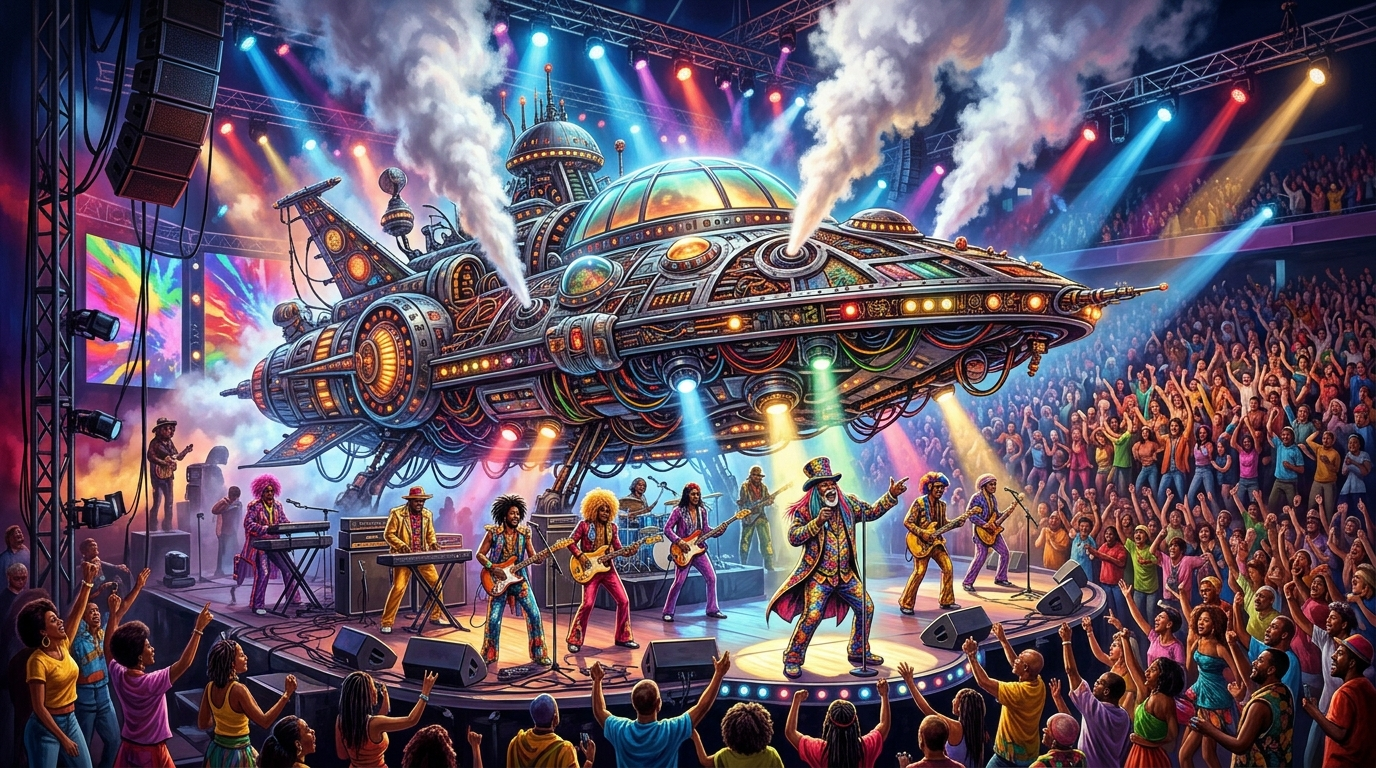
Fifty years after its dramatic concert debut, George Clinton’s smoke-spewing Mothership still stands as a landmark of live music and Afrofuturist art.
The spacecraft became a defining feature of Parliament-Funkadelic’s 1976 tour. It turned a funk concert into a theatrical journey and placed Black performers at the center of a futuristic story.
A Spaceship Lands on the Concert Stage
The Mothership appeared during Parliament-Funkadelic’s rise as one of the most ambitious acts of the 1970s. Clinton led the musical collective, often called P-Funk, through a mix of funk, rock, soul and science fiction.
During performances, the craft descended amid smoke and flashing lights. Clinton emerged as Dr. Funkenstein, a character who brought funk to Earth. The arrival gave audiences a spectacle more common in arena rock than funk and R&B.
The production supported the story introduced on Parliament’s 1975 album Mothership Connection. Songs such as “P. Funk (Wants to Get Funked Up)” and “Give Up the Funk” helped turn that record into a lasting part of popular music.
George Clinton’s smoke-spewing spaceship remains “a marvel of live-music technology and Afrofuturist imagination.”
The stagecraft also carried a larger message. At a time when popular science fiction rarely placed Black people in the future, P-Funk created its own space mythology. Humor, costumes and music became tools for challenging exclusion.
Afrofuturism Through Funk
Afrofuturism links Black history and culture with technology, fantasy and visions of the future. The term gained wider use after P-Funk’s early work, but the Mothership became one of its clearest symbols.
Clinton’s approach shared ideas with artists such as jazz composer Sun Ra, who also used space travel and other planets in his performances. Yet P-Funk brought those ideas to large concert crowds through dance music and elaborate stage effects.


The Mothership worked on several levels:
- It gave the audience an unforgettable visual centerpiece.
- It extended P-Funk’s album stories into live performance.
- It presented Black musicians as travelers, scientists and heroes.
- It raised expectations for theatrical staging in funk concerts.
A Lasting Piece of Music History
The original stage prop was later discarded after years of storage. A rebuilt version eventually entered the collection of the Smithsonian’s National Museum of African American History and Culture.
Its museum status shows how concert objects can carry meaning far outside an arena. The craft represents engineering and showmanship, but it also reflects who gets to imagine the future.
P-Funk’s influence can be heard across hip-hop, electronic music, rock and modern R&B. Clinton’s recordings have been sampled widely, while the group’s visual language has shaped performers who treat concerts as stories rather than simple song lists.
The Mothership’s 50th anniversary offers more than nostalgia. It marks a moment when music, machinery and cultural commentary met onstage. Future concert technology may become more advanced, but Clinton’s spacecraft remains powerful because its central idea still matters: Black creativity belongs in every vision of tomorrow.