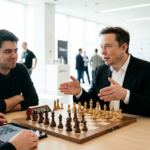


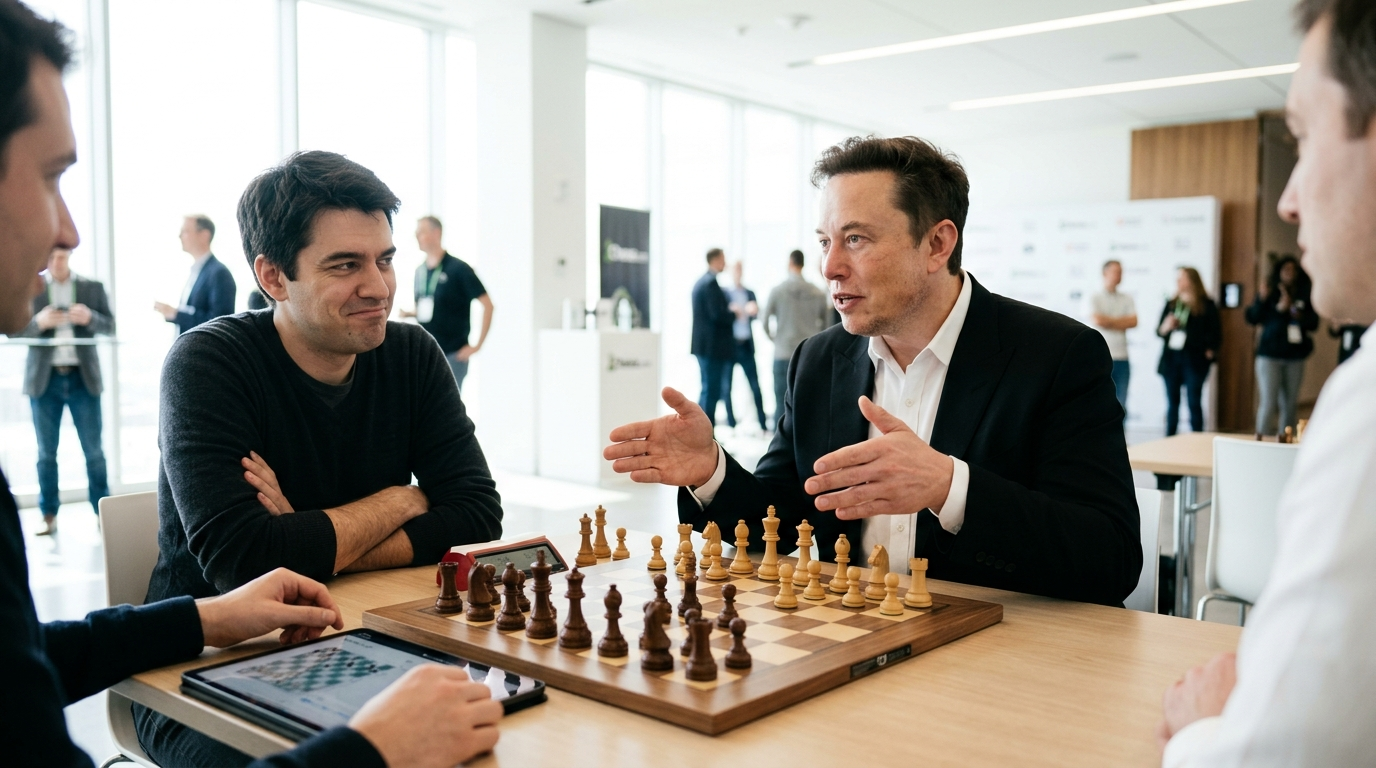
Elon Musk has predicted that artificial superintelligence will “solve” chess, prompting a brief and skeptical reply from Chess.com: “Good luck.” The exchange renewed a central debate about artificial intelligence, computing limits, and what solving the centuries-old game would actually mean.
Musk’s statement looks past the success of current chess engines. Those systems can defeat the strongest human players, but dominant play is not the same as a mathematical solution. His forecast rests on a hypothetical form of AI that would exceed human intelligence across many fields.
What Solving Chess Would Require
Chess is a finite game with fixed rules and no hidden information. In principle, every legal position has a best outcome if both players make perfect moves.
A full solution would establish whether the starting position leads to a win for White, a win for Black, or a draw under flawless play. It would also identify a correct move for every possible position that could follow.
This standard differs from playing at a superhuman level. Modern engines can assess positions, calculate variations, and defeat elite competitors. They still do not provide a complete proof covering the entire game.
The practical challenge is scale. Chess allows a vast number of possible positions and move sequences. Even powerful computers must narrow their searches instead of checking every continuation from the opening to the final move.
A Claim About Intelligence and Computing
“Chess would be ‘solved’ with artificial superintelligence.”
Musk’s comment suggests that a sufficiently capable AI could overcome barriers that remain out of reach for existing systems. Yet raw intelligence alone may not settle the question. A solution could also demand immense computing capacity, storage, energy, and time.
The term artificial superintelligence also lacks a single proven technical definition. It generally refers to a system that performs better than humans across most intellectual tasks. No publicly verified system currently meets that description.



That uncertainty makes Musk’s prediction difficult to test. It does not specify when such a system might exist, how it would solve chess, or what evidence would count as proof.
Chess.com Signals Skepticism
“Good luck.”
Chess.com’s two-word response captured the gap between confidence about future AI and the difficulty of exhaustive game analysis. The remark did not reject Musk’s claim outright. Instead, it stressed the size of the task.
The disagreement can be reduced to three questions:
- Would superintelligence automatically bring enough computing resources?
- Would a mathematical proof be required, or would near-perfect play qualify?
- Could researchers verify an answer produced by a system smarter than its human examiners?
The final issue may prove especially important. A claimed solution would need to be checked independently. Without a verifiable proof or database, players and researchers might have to trust conclusions they could not fully inspect.
Why the Debate Matters
Chess has long served as a public test of machine reasoning. However, success at the board does not prove broad intelligence. Chess has clear rules, measurable outcomes, and a restricted set of actions, unlike many scientific or social problems.
A verified solution would reshape competitive chess and computer science. Opening theory could become fixed, while tournaments might need stronger rules separating human play from machine assistance. It could also show whether advanced AI can complete massive reasoning tasks while producing evidence that people can audit.
For now, Musk has offered a forecast rather than a timetable or technical plan. Chess.com’s reply reflects the harder standard: defeating people is established, but proving the outcome of every possible game remains another challenge. Future claims will depend less on confident predictions and more on transparent, independently checked results.