



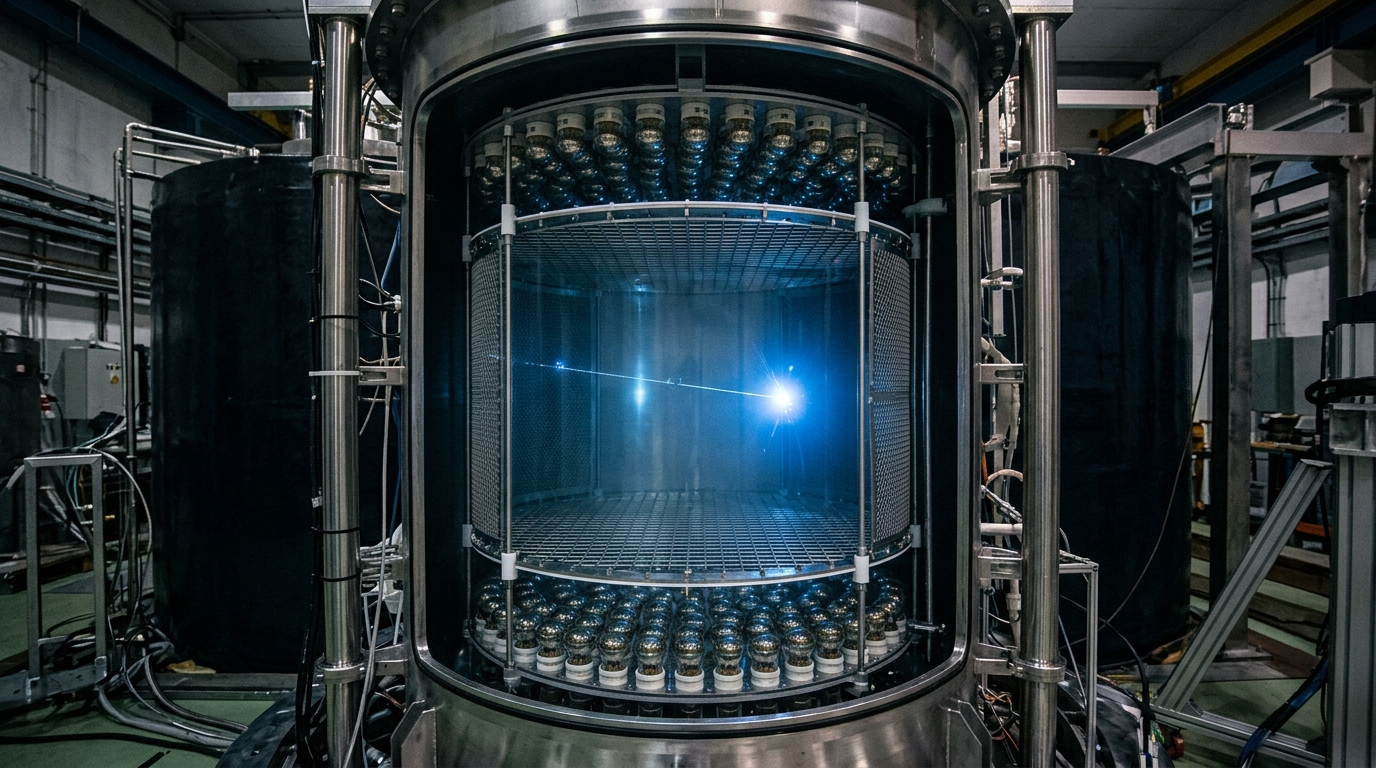
The XENONnT experiment has detected a faint signal from neutrinos striking electrons, an interaction that can resemble the dark matter events it seeks.
The underground detector at Italy’s Gran Sasso National Laboratory uses liquid xenon to search for particles that may explain dark matter. Its sensitivity also lets scientists study known particles that interact only weakly with ordinary matter.
The reported signal is the “rare, feeble glow of neutrinos smacking into electrons.” Detecting that glow shows how precisely XENONnT can measure small energy deposits. It also highlights a growing challenge: neutrinos can become background noise in dark matter searches.
A Detector Built for Faint Signals
Dark matter does not emit, absorb or reflect light. Scientists infer its presence from its gravitational effects on galaxies and larger structures. Yet its particle identity remains unknown.
XENONnT searches for dark matter particles passing through a tank of highly purified liquid xenon. A collision with a xenon atom can produce a flash of light and free electrons.
Sensors record both signals. Their timing and strength help researchers estimate the collision’s location and energy. Events near the detector’s center are especially useful because surrounding xenon helps block radioactive interference.
The experiment operates deep underground to reduce interference from cosmic rays. Layers of rock shield the detector from many particles that constantly strike Earth’s surface.
Researchers must still account for several sources of background:



- Radioactive material in the detector and its surroundings
- Particles produced by cosmic-ray interactions
- Electronic noise and detector effects
- Neutrinos from the Sun and other natural sources
Why Neutrino Collisions Matter
Neutrinos have almost no mass and no electric charge. Vast numbers pass through Earth, buildings and human bodies without leaving a trace.
On rare occasions, however, a neutrino collides with an electron. That electron recoils and deposits energy in the xenon. The detector then records a small burst of light and charge.
The experiment detected the “rare, feeble glow of neutrinos smacking into electrons.”
This type of interaction differs from many leading dark matter models, which predict collisions with atomic nuclei. Still, some dark matter theories allow interactions with electrons. That creates possible overlap between ordinary neutrino events and new physics.
The observation therefore serves two purposes. It provides a measurement of neutrino interactions while testing the detector’s ability to identify extremely weak signals.
Neutrinos Set a Future Limit
As dark matter detectors grow larger and quieter, neutrinos become harder to ignore. Radioactive contamination can be reduced through cleaner materials and stronger shielding. Neutrinos cannot be screened out so easily.
Scientists sometimes describe this problem as the neutrino fog. In that region of sensitivity, neutrino collisions can imitate the recoil patterns expected from dark matter. Researchers must use event rates, energy patterns and direction-related evidence to separate them.
The new detection is therefore both an achievement and a warning. It confirms that XENONnT can reach energy levels where rare neutrino physics becomes visible. It also shows that future dark matter claims will require careful statistical tests.
What Researchers Will Watch Next
More observations should help the XENON collaboration measure the signal with greater precision. A larger data set may also improve models of background events across the detector’s energy range.
Other liquid-xenon experiments face the same scientific tradeoff. Greater sensitivity improves the chance of finding dark matter, but it also reveals more neutrino collisions. Comparisons among experiments can test whether faint signals remain consistent across different instruments.
XENONnT has not identified dark matter through this observation. Instead, it has measured a known particle process at the edge of detectability. That result validates the detector while clarifying the obstacles ahead.
The next task is to determine how well researchers can separate neutrino events from possible dark matter collisions. That distinction will shape the search as detectors collect more data and approach the natural background created by the universe itself.