

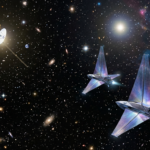


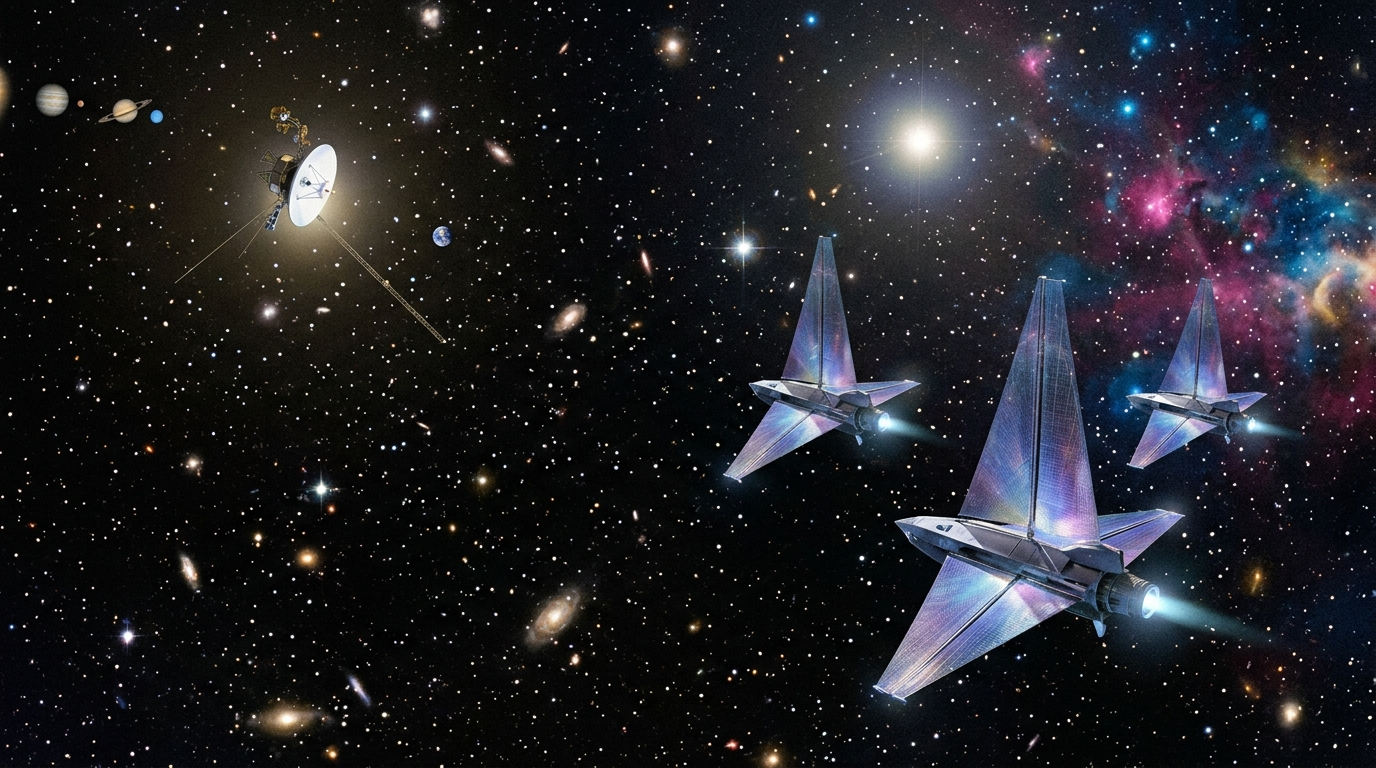
Voyager 1 remains humanity’s farthest spacecraft, but new mission concepts could send faster and more capable probes into interstellar space.
NASA launched the probe from Florida in 1977 to study the outer planets. Nearly five decades later, it is traveling through the space between stars. Its longevity has made it both a scientific instrument and a cultural symbol.
Voyager 1 is humanity’s farthest and best-known interstellar “message in a bottle,” but it is probably not the last.
That description points to two parts of Voyager’s legacy. The spacecraft continues to return limited scientific data. It also carries a physical message intended for any distant civilization that might someday find it.
A Record Made for Deep Time
Voyager 1 carries the Golden Record, a gold-plated copper disc containing sounds and images from Earth. Its contents include music, greetings in many languages and recordings of nature.
A team led by astronomer Carl Sagan selected the material. The record was designed to present a brief account of life and human culture. Instructions on its cover explain how to play it and identify Earth’s location.
The record followed earlier attempts to place messages aboard spacecraft. Pioneer 10 and Pioneer 11 carried plaques showing human figures and astronomical information. Those missions helped establish the idea that a probe could act as a long-lived artifact.
The chance of another civilization finding Voyager is extremely small. Space is vast, and the craft is not aimed at a known inhabited system. Its message still has symbolic value, however. It may survive long after its power and communications fail.
From Planetary Mission to Interstellar Explorer
Voyager 1 was built for planetary science, not as a dedicated mission to another star. It made close observations of Jupiter in 1979 and Saturn in 1980. Those encounters revealed new details about the planets, rings and moons.

NASA then directed the probe out of the solar system’s planetary region. In 2012, it crossed the heliopause, where the solar wind gives way to the interstellar environment.
Its main achievements include:
- Detailed studies of Jupiter and Saturn
- Discovery of active volcanoes on Jupiter’s moon Io
- Direct measurements near and outside the heliopause
- The most distant spacecraft communications ever maintained
Voyager 2 later crossed the heliopause as well. Together, the probes gave scientists observations from two separate locations at the edge of the Sun’s influence.
New Probes Could Travel Farther Faster
Future spacecraft may be designed specifically for the interstellar environment. Researchers have studied concepts that would travel much farther from the Sun while their instruments remain active.
One proposal, often called Interstellar Probe, would examine the outer heliosphere and nearby interstellar medium. Such a mission could study how the Sun’s protective bubble interacts with material between stars.
Other plans are more ambitious. The privately funded Breakthrough Starshot initiative has examined tiny spacecraft pushed by powerful ground-based lasers. Its stated goal is to explore whether lightweight probes could eventually reach the Alpha Centauri system within decades.
Major barriers remain. Interstellar missions require high speeds, reliable electronics and communications across immense distances. They must also operate with limited power for many years. Laser-driven craft would need technologies that have not yet been demonstrated at mission scale.
Messages Raise Scientific and Cultural Questions
Any Voyager successor could carry another record, plaque or digital archive. That choice would reopen a difficult question: Who gets to describe Earth?
The Golden Record reflects the hopes and limits of its time. A future message could include more cultures, newer science and a broader account of human history. It could also avoid sending a message and focus only on research.
Voyager 1’s importance does not depend on extraterrestrials finding it. The probe has already changed planetary science and extended direct observation past the heliopause.
Its eventual successors may travel faster and carry better instruments. Yet they will inherit the same dual role. Each will be both a scientific machine and an artifact sent into deep time, carrying evidence that humanity once reached outward from Earth.