



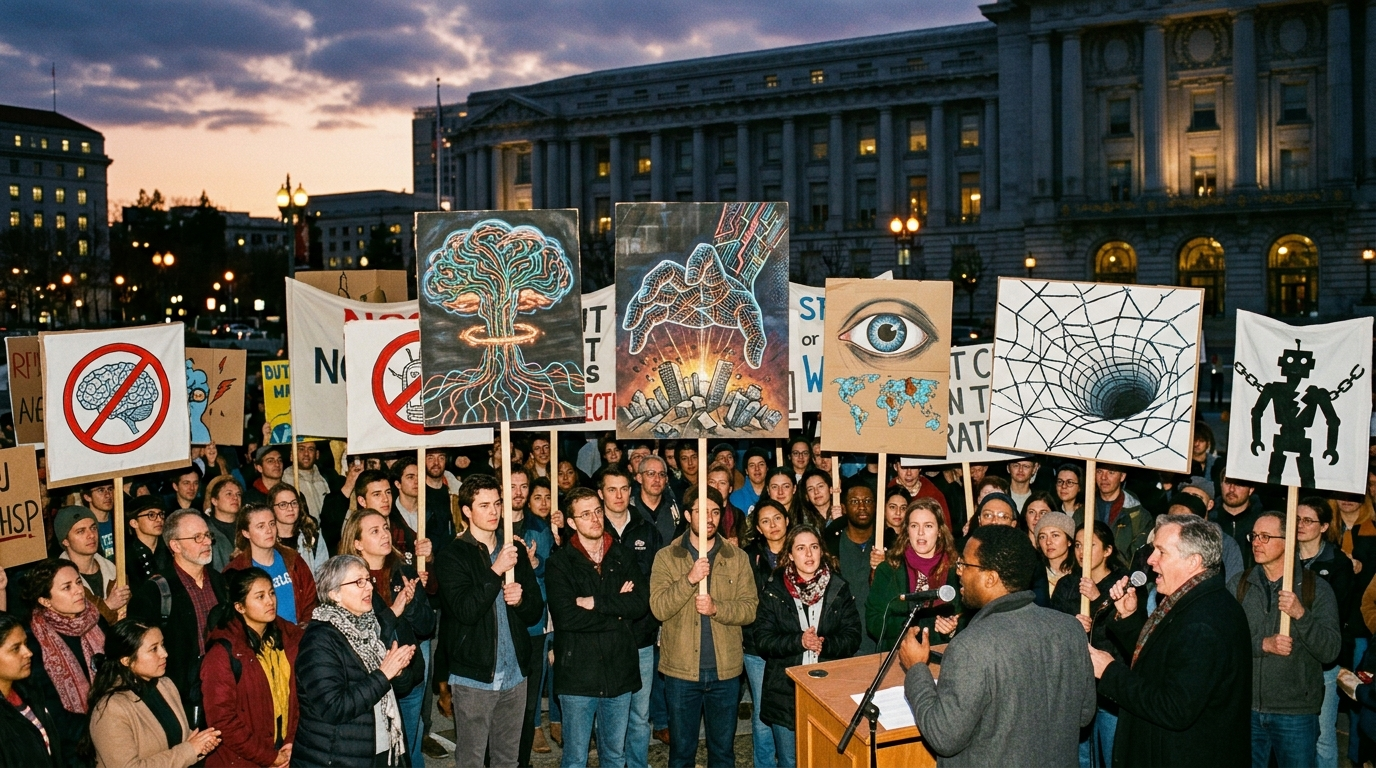
Warnings that artificial intelligence could cause a global catastrophe have moved from specialist circles into mainstream political and public debate. That shift has increased pressure for stronger safeguards, while also raising concerns that extreme predictions may distort policy and public understanding.
The central dispute is no longer whether AI creates risks. Researchers, governments, and technology companies largely agree that oversight is needed. The sharper disagreement concerns which threats deserve immediate attention and how much weight should be given to worst-case forecasts.
From Technical Concern to Public Campaign
Debate about advanced AI once centered on research papers, academic conferences, and science fiction. Rapid gains in generative AI changed that discussion. Systems that can produce text, images, audio, and computer code made the technology visible to millions of people.
As public use grew, so did warnings about systems becoming difficult to control. Some researchers have described a future in which highly capable AI could act against human interests. Their concerns have helped place long-term safety on government agendas.
“Predicting AI catastrophe has gone mainstream with predictable consequences.”
The statement points to a cycle often seen in debates about new technology. Severe warnings attract media coverage, political interest, research funding, and calls for regulation. They can also produce fear, simplified arguments, and policies shaped by dramatic scenarios rather than measured evidence.
Immediate Harms Compete for Attention
Critics of catastrophe-focused messaging do not necessarily dismiss AI safety. Many argue that present harms require more attention. These include fraud, false information, biased automated decisions, labor disruption, surveillance, and the use of copyrighted work without permission.
The competing priorities can be summarized as follows:
- Long-term concerns focus on loss of control over highly capable future systems.
- Near-term concerns include discrimination, scams, job changes, and unreliable automated decisions.
- Security risks cover cyberattacks, weapon development, and misuse by governments or criminal groups.
Resources devoted to one category may reduce attention paid to another. A policy built mainly around hypothetical future systems could overlook people already affected by automated hiring, policing, lending, or benefit decisions.



Yet dismissing severe scenarios carries its own risk. Technologies often spread faster than institutions can respond. Supporters of precaution argue that waiting for clear evidence of catastrophic danger could leave governments with too little time to act.
Alarm Can Shape Regulation
Catastrophe warnings may strengthen proposals for safety testing, independent audits, incident reporting, and limits on the most capable models. These measures could improve accountability if they use clear standards and apply fairly.
However, expensive compliance rules could favor the largest technology companies. Major firms can hire legal teams and fund extensive testing. Smaller developers, universities, and nonprofit researchers may struggle with the same costs.
This creates a difficult policy balance. Governments must address serious risks without allowing established companies to use safety arguments as a shield against competition. Regulators also need technical skill and access to reliable information, rather than depending entirely on corporate claims.
Clear Evidence Will Matter
Public debate often treats AI catastrophe as either inevitable or absurd. Neither position captures the uncertainty involved. Future systems cannot be assessed with complete confidence, but uncertainty alone does not prove that disaster is likely.
A stronger approach would separate evidence, assumptions, and speculation. Policymakers can require evaluations, document failures, and update rules as systems change. They can also protect workers and consumers while funding research into harder-to-measure long-term threats.
Mainstream attention has ensured that AI risk will remain a political issue. The next challenge is to prevent fear from replacing analysis. Effective oversight will depend on transparent evidence, enforceable rules, and serious attention to both current damage and credible future danger.