




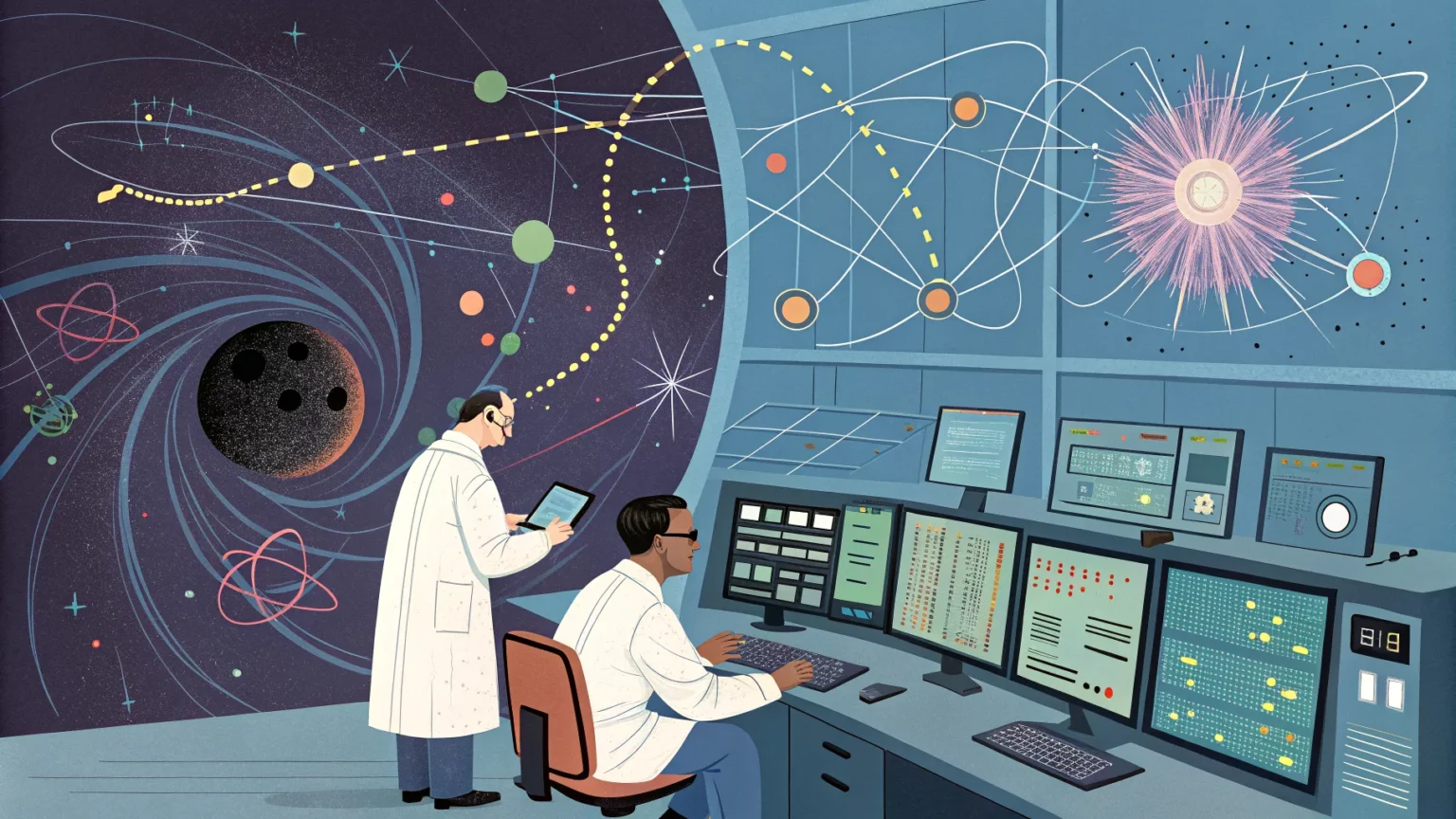
A fresh connection between particle physics and gravity has been extended to Hawking radiation, hinting at a new way to probe black hole mysteries. The advance centers on the “double copy,” a method that translates calculations from forces inside atoms into equations for gravity. Researchers say this could simplify how scientists study what black holes emit and what that says about the nature of space and time.
The work matters now because tools for crunching gravity are scarce, while particle physics has efficient techniques. If the double copy holds for Hawking radiation, it could trim complex math and offer a clearer view of how information might escape a black hole. That question sits at the heart of one of physics’ longest-running puzzles.
“A link between particle physics and gravity equations, called the double copy, applies to Hawking radiation, creating a new way into black hole puzzles.”
What the Double Copy Means
The double copy grew out of studies of particle collisions. Physicists noticed that equations for the strong force can be reorganized so that replacing certain parts with gravity pieces yields the equations of general relativity. This trick has helped compute gravitational waves and has guided theory for over a decade.
Hawking radiation is different. It is a quantum effect that lets black holes emit a faint glow. Applying the double copy here suggests that even some quantum features of gravity might be mapped from particle physics. That is a striking claim, because gravity and quantum theory rarely fit together well.
Why Hawking Radiation Matters
Stephen Hawking predicted in the 1970s that black holes are not fully black. Tiny quantum fluctuations near the event horizon let pairs of particles form, with one escaping as radiation. Over immense times, a black hole could evaporate.
This raised a sharp question. If a black hole vanishes, where does the information about what fell in go? Quantum theory says information cannot be destroyed. General relativity is silent on the matter. This “information paradox” has driven research for decades.
Any new method that can track the fine details of Hawking radiation might show whether information leaks out in subtle patterns. A double copy approach promises streamlined calculations that could test such ideas more directly.
Potential Payoffs for Theory and Computation
If the mapping works as advertised, several payoffs are possible:



- Faster calculations of radiation spectra near black hole horizons.
- New checks on proposals for how information escapes, such as correlations in emitted particles.
- Better cross-talk between collider physics and gravitational physics.
Over the past years, double copy methods helped compute scattering amplitudes for gravitons, and even informed models of gravitational waves. Extending this logic to Hawking radiation could make once intractable problems more manageable.
Different Views and Open Questions
Specialists will ask how broad the mapping is. Does it hold only for idealized setups, or for realistic black holes with spin, charge, and messy environments? They will also press for proofs that the quantum subtleties near an event horizon are captured, not just the classical limits.
Some will want to see whether the approach tracks late-time radiation, where the information puzzle becomes most severe. Others will probe whether the method relies on symmetries that break down under strong gravity or when matter fields are included.
There is also a practical test. Can this approach reproduce known benchmark results, and can it predict features that numerical relativity or other quantum gravity ideas can then check?
What Comes Next
The path forward is clear. Teams will try to compute simple Hawking spectra using the double copy and compare them to established methods. They will add layers of complexity: rotating black holes, interactions among the emitted quanta, and time-dependent evaporation.
They may also apply the same mapping to related phenomena, such as particle production in expanding universes or near cosmic strings. Success across several cases would build confidence that the method captures real physics, not just clever math.
For now, the appeal is practical and conceptual. It promises a simpler handle on a difficult effect. It also hints that forces inside atoms and the pull of gravity might be two faces of a single toolkit.
The connection between the double copy and Hawking radiation marks a fresh opening in a long-stalled debate. If follow-up work confirms the claim, theorists could gain a sharper probe of the information puzzle and a faster route to predictions. Watch for early test calculations, cross-checks with gravitational wave methods, and signs that this bridge between particles and gravity can carry heavier loads.