



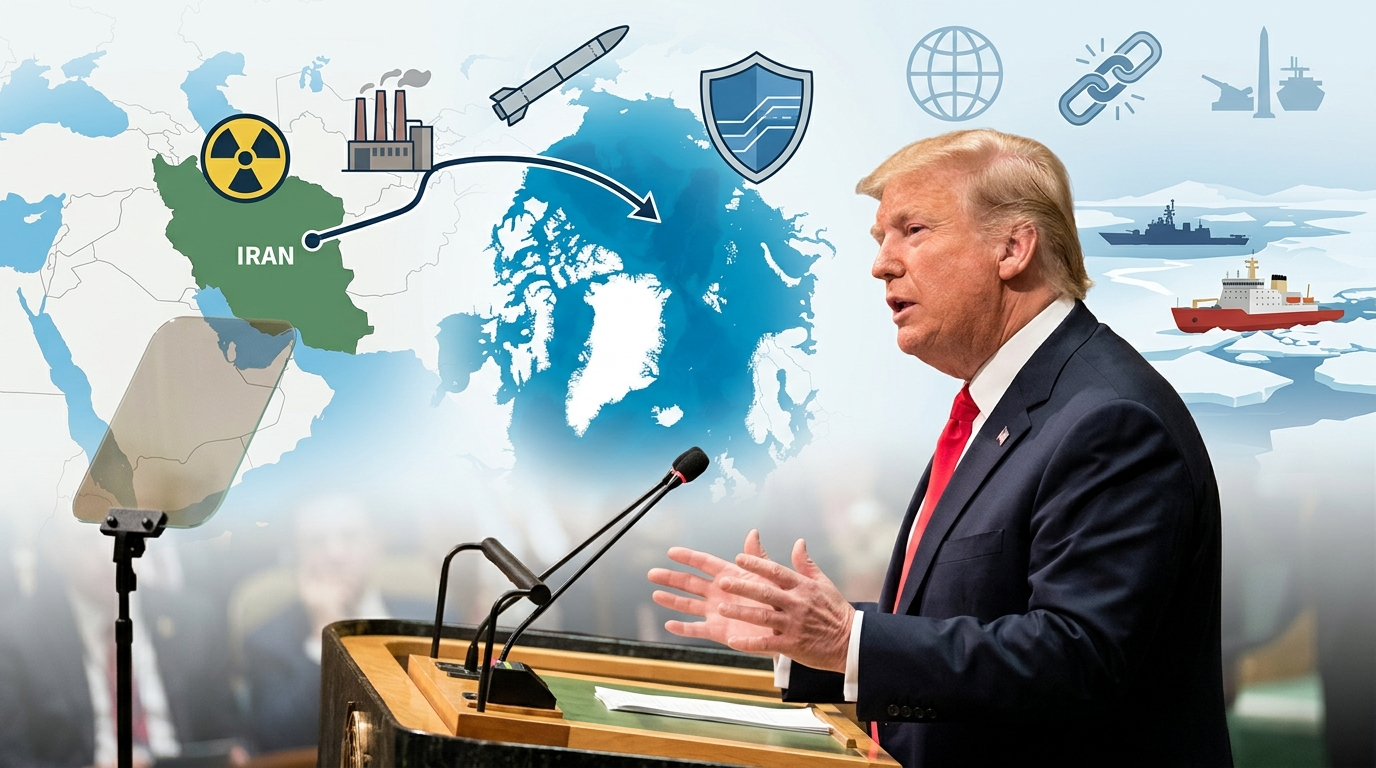
President Donald Trump used his United Nations General Assembly address to warn Iran as the United States signed a security deal with Denmark and Greenland. The paired developments placed nuclear risk and Arctic defense at the center of Washington’s foreign policy agenda.
Elizabeth Pipko discussed the speech and agreement with Fox Business anchor Cheryl Casone. Their discussion connected two distant security concerns: Iran’s conduct in the Middle East and rising strategic competition around Greenland.
Iran Warning Signals Continued Pressure
Trump’s warning at the UN reflected his long-standing policy of applying economic and diplomatic pressure on Tehran. His administration has argued that Iran must not obtain a nuclear weapon or use regional armed groups to threaten US interests and allies.
The address also carried added weight because the General Assembly gives national leaders a global audience. Statements delivered there can influence diplomatic talks, financial markets, and relations among allies.
Trump’s speech included a warning directed at Iran, according to the discussion between Pipko and Casone.
The limited account did not include Trump’s exact language or describe any new military or economic action. That distinction matters. A warning may signal tougher policy, but it does not by itself establish a change in sanctions, force deployments, or negotiations.
US policy toward Iran has shifted several times over the past decade. Trump withdrew the United States from the 2015 nuclear agreement during his first term. He then restored sanctions under a campaign of maximum pressure.
Supporters said that approach restricted Tehran’s revenue and challenged its regional influence. Critics argued that it weakened limits on Iran’s nuclear work and reduced space for diplomacy.
Greenland Deal Expands Arctic Focus
The security agreement involving the United States, Denmark, and Greenland points to growing concern about the Arctic. Greenland is a self-governing territory within the Kingdom of Denmark. Its location makes it important for missile warning, space monitoring, and North Atlantic defense.


The United States has maintained a military presence on Greenland for decades. Pituffik Space Base, formerly known as Thule Air Base, supports missile detection and space surveillance.
The agreement’s full terms were not detailed in the discussion. However, such cooperation may address several shared priorities:
- Improved monitoring of Arctic airspace and waters
- Protection of military sites and critical infrastructure
- Closer coordination among the United States, Denmark, and Greenland
- Responses to increased Russian and Chinese activity in the region
Greenland’s role also requires careful diplomacy. Danish authorities oversee defense and foreign policy, while Greenland’s government has authority over many domestic matters. Any lasting security plan must account for local interests and political consent.
Two Regions, One Strategic Message
The Iran warning and Greenland agreement show an administration focused on deterrence across separate regions. One issue centers on nuclear development and armed conflict in the Middle East. The other involves Arctic access, surveillance, and territorial defense.
Supporters may view the approach as a clear statement that Washington will protect its interests. Skeptics may seek details about costs, legal duties, allied support, and the risk of escalation.
The next steps will determine the practical impact. Observers will watch for specific measures against Iran and published terms for the Greenland agreement. They will also look for reactions from Tehran, Copenhagen, Greenland’s government, and other Arctic powers.
Taken together, the developments suggest that Trump is pairing public pressure with formal security partnerships. The central test will be whether that strategy strengthens deterrence without closing diplomatic channels or creating new tensions.