



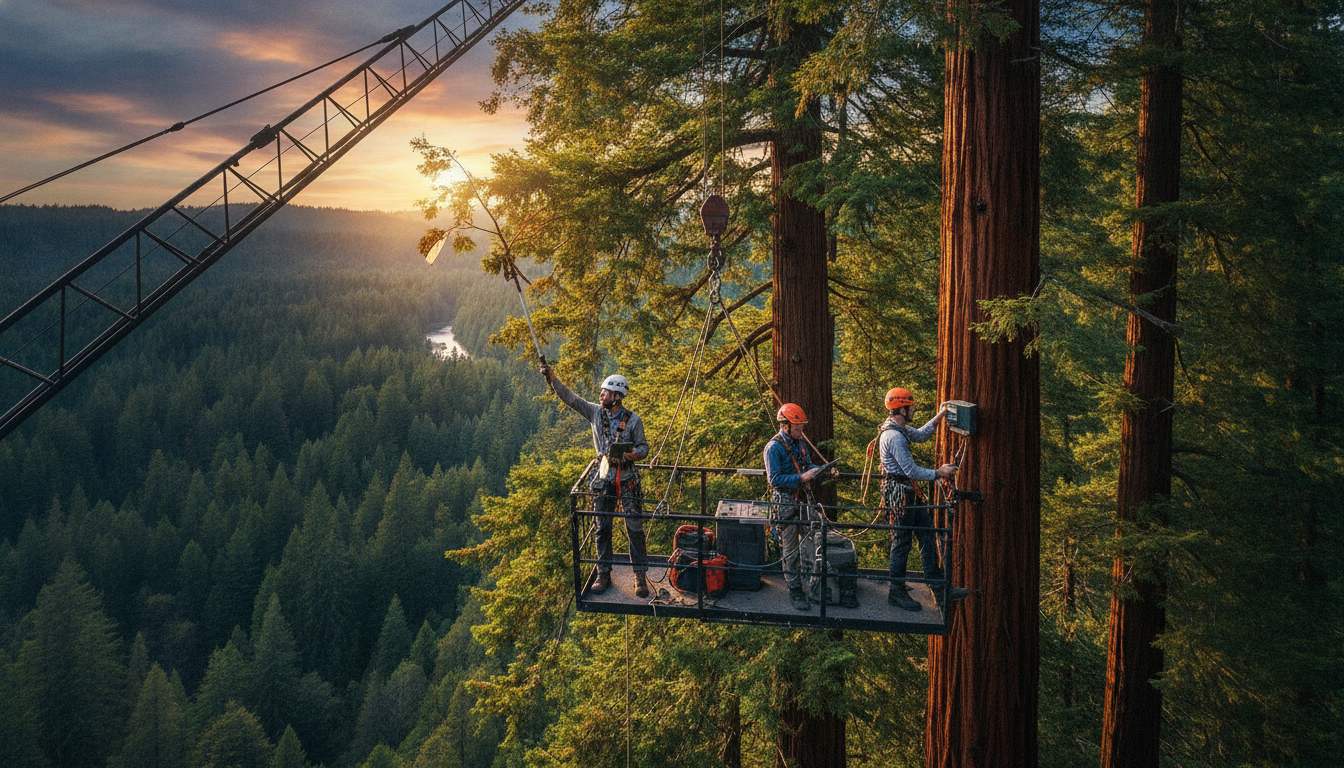
Perched hundreds of feet above the forest floor, researchers gathered rare samples from the crowns of mature trees and reported evidence that shifts a core debate over how forests survive drought. The work, carried out this season at high-canopy sites, suggests trees adjust to water stress in ways not captured by older models, while challenging a rival idea long used to predict die-off risk.
The teams worked across rugged terrain and used cranes, rope access, and drones to reach twigs, needles, and small branches at the very top of the canopy. Their goal was to test whether the harshest, sun‑blasted parts of a tree show special traits that help it ride out longer, hotter dry spells. Early findings indicate they do.
“Samples collected at daring heights provide evidence for an untested theory of tree drought adaptation, while countering another.”
Why the Canopy Matters
The upper canopy is where leaves face the strongest light and wind and the driest air. That exposure drives rapid water loss. Most past studies focused on lower branches or saplings near the ground, where conditions are milder. As droughts grow longer across many regions, the mismatch between study sites and the true frontline of stress has grown more important.
Tree drought response research often centers on how plants balance water loss with carbon gain. Two well-known strategies are tight control of leaf pores to conserve water, and deeper rooting to tap hidden moisture. The new work points to a third factor getting less attention: physical and chemical traits at the crown that protect the water transport system itself.
A New Signal at the Tree Tops
Researchers report that branches closest to the sky show features linked to drought survival. These include smaller leaves, thicker outer layers, and denser wood in the youngest twigs. Such traits can reduce water loss and help keep water moving through the tree without dangerous air bubbles.
Several experts said that this pattern fits a long-discussed, but rarely tested, idea that trees “segment” risk. The most exposed tissues bear the brunt of stress, shielding the trunk and roots. By hardening the crown, a tree may localize damage and recover faster after a dry spell.
The team’s observations challenge a contrasting view that canopy stress is uniform and that survival hinges mainly on stomatal control or root depth. If crown-specific traits carry more weight than assumed, models based on average leaf behavior or soil access could misjudge which species and forests are most at risk.
Implications for Forests and Cities
Forest managers are watching closely. If crown traits govern survival, thinning or pruning practices might be refined to reduce exposure and heat at the top of the canopy. Urban foresters could also adjust planting choices, favoring species shown to develop protective crown features under heat and drought.

- Wildfire risk: Healthier crowns may lower the chance of canopy dieback that feeds extreme fires.
- Timber planning: Species with stronger crown defenses may perform better in dry years.
- Restoration: Seed sources adapted to crown stress could improve replanting success.
Caution and the Next Steps
Some scientists urge restraint until the work is peer-reviewed and expanded. Tree height, age, and site history can influence crown traits. Drought severity also varies year to year. Without multi-year data and broader species coverage, firm conclusions would be premature.
Field logistics are another hurdle. Crown sampling is costly and risky. Rope access and crane time are limited, and drones cannot always cut and return intact samples. Scaling this approach will require new tools, shared protocols, and open datasets so results can be compared across regions.
What to Watch
Several trends will shape the next phase. First, canopy-level measurements, including leaf water status and wood vulnerability tests, are likely to move from pilot efforts to coordinated networks. Second, remote sensing may help flag crowns under stress, guiding where to sample. Third, land managers may start small trials that adjust canopy structure to test whether reduced exposure improves survival during dry summers.
If confirmed, the findings could improve early-warning systems for tree mortality and help refine climate risk maps. By moving research to where drought hits hardest—the sunlit crown—scientists and managers may get a clearer view of which trees will endure and which need help.
For now, the message is simple: what happens at the top of a tree can decide its fate. The latest high-canopy evidence points to crown-specific adaptation as a key line of defense, and it calls older assumptions into question. The coming seasons will test whether those signals hold across forests under growing heat and water stress.