



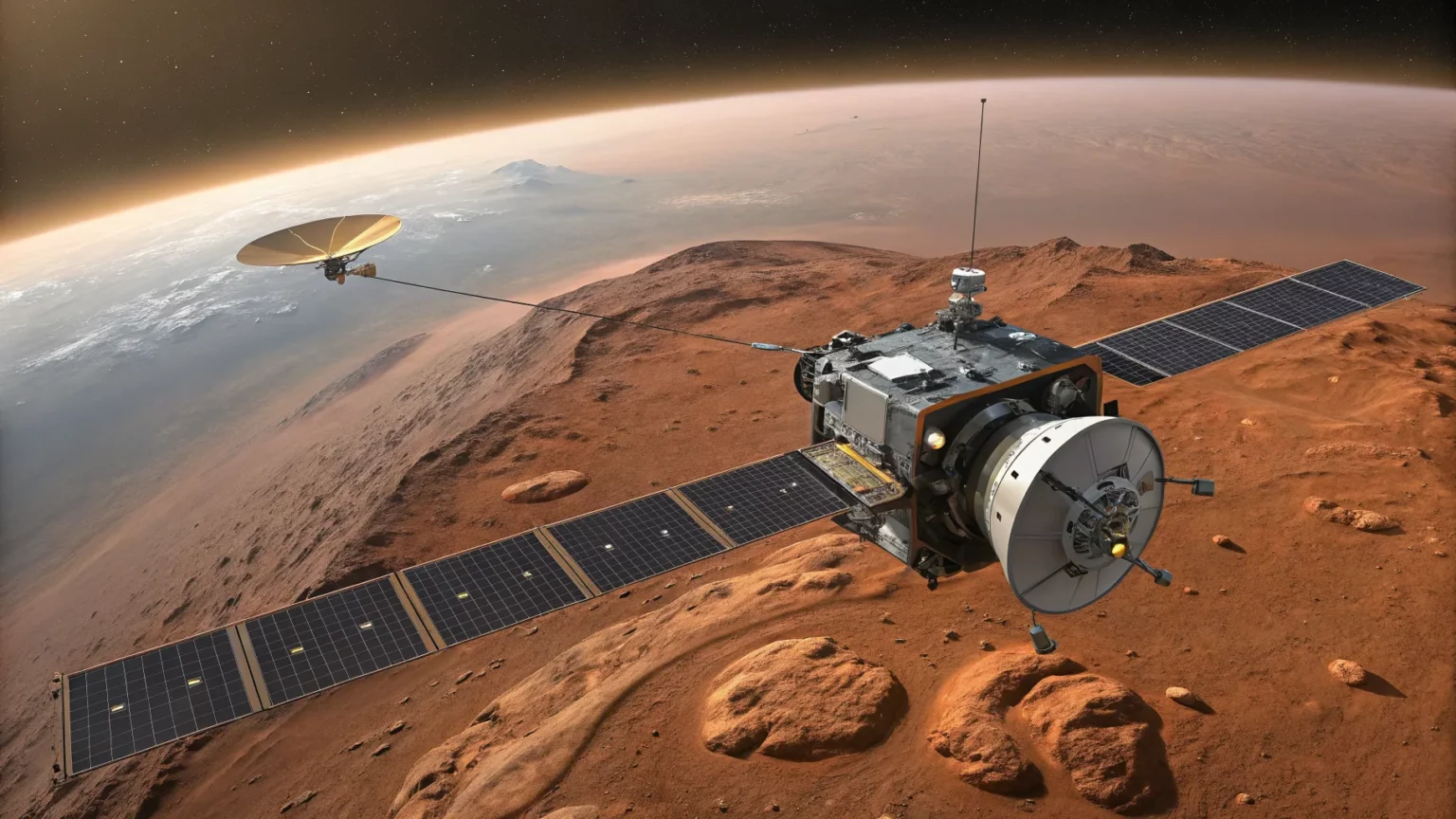
After more than ten years in orbit, a Mars spacecraft has helped answer a stubborn question: how did the Red Planet lose most of its air and water. The mission’s findings, gathered high above Mars, point to the solar wind as a steady force that stripped the atmosphere and set the stage for a cold, dry world.
The orbiter’s long watch has mapped how charged particles from the Sun erode Mars’ unprotected upper atmosphere. The results help explain why ancient riverbeds and lake basins now sit on a frozen desert. The work also guides future explorers planning for storms and radiation in deep space.
What The Orbiter Found
Over more than a decade at Mars, the orbiter revealed how the solar wind strips away the planet’s atmosphere — and why the world lost its water.
The spacecraft tracked streams of ions escaping Mars during calm solar conditions and during violent solar storms. When bursts of solar activity hit, the escape rates surged. Over billions of years, that steady leak likely thinned the air to a fraction of its former pressure.
Scientists link the loss to Mars’ weak magnetic shielding. Unlike Earth, Mars lacks a global magnetic field. That leaves its upper atmosphere exposed to the Sun’s particles and radiation. Molecules split apart, and lighter fragments, such as hydrogen, drift into space.
How Scientists Reached The Conclusion
The orbiter measured electric fields, energetic particles, and the composition of the upper atmosphere. It watched the “ion tail” stretching behind Mars, a sign of ongoing escape. It also compared conditions before and after solar events to see how the system responds.
These observations matched clues on the ground. Ancient minerals show that water once flowed on the surface. Today, only thin traces of water vapor remain in the air, with most water locked as ice or bound in minerals. The gap points to a long-term leak rather than a single event.
- Solar storms ramp up atmospheric loss for short periods.
- Day-to-night flows in the upper air shape escape paths.
- Loss is strongest for light elements, such as hydrogen.
Competing Ideas And Remaining Questions
Other forces may have helped drain Mars. Early giant impacts could have blasted away chunks of air. Volcanic activity might have waned, cutting off gas resupply. Still, continuous stripping by the solar wind offers a steady, testable process that fits the long decline.
Scientists continue to refine how fast Mars is losing air now, and how rates changed in the young solar system. The Sun was more active billions of years ago. If loss rates were higher then, the drying of Mars could have happened faster than once thought.



Why It Matters For Future Missions
Understanding atmospheric loss helps planners protect spacecraft and astronauts. Solar storms can disrupt or damage electronics. They also increase radiation risks. Knowing when loss rates spike helps schedule operations and design shielding.
The findings also shape the search for past life. If liquid water vanished as the air thinned, habitable windows may have closed earlier than expected. That guides where rovers and drills should look for signs in ancient rocks and sediments.
What Comes Next
As the orbiter enters its second decade, scientists aim to link escape patterns to the dust cycle and seasons. Other missions at Mars, including surface rovers and European orbiters, will add context from below and above. Joint datasets can pin down how chemistry, sunlight, and storms work together.
Similar processes may act on planets around other stars. Worlds without strong magnetic fields could lose air under harsh stellar winds. Mars, then, offers a nearby test case for reading the past climates of distant planets.
The mission’s message is clear: space weather shapes planets. With each orbit, the spacecraft is turning that lesson into numbers and maps. The next step is to tie those maps to rocks on the ground, and to plan safe paths for future crews. The drying of Mars may be an old story, but new measurements are still writing its ending.