



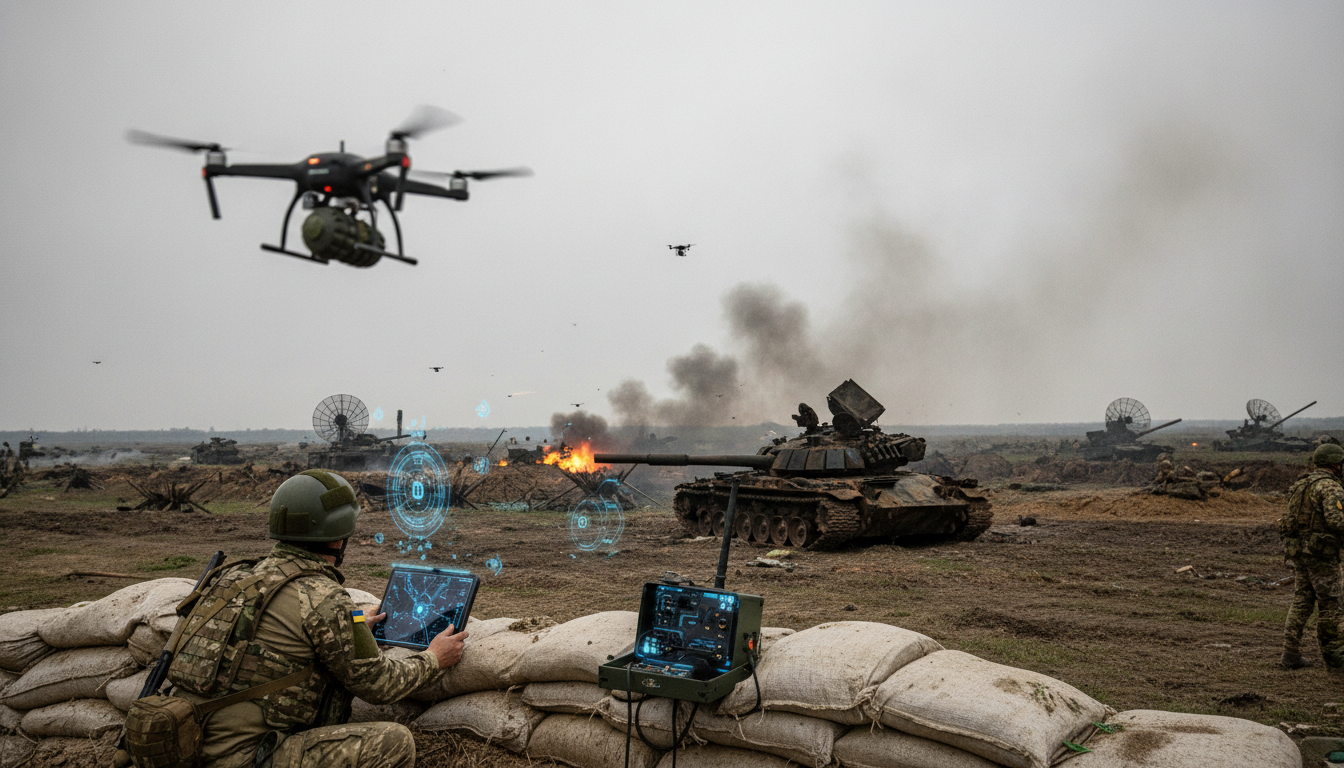
On the front lines in Ukraine, cheap drones are striking tanks, trenches, and supply lines, while electronic jammers and new software make yesterday’s models useless. The rapid cycle is reshaping how armies plan and fight, and it is rewriting procurement and training in Europe and beyond.
The core tension is clear. Drones offer reach, speed, and low cost. Yet they lose value fast as countermeasures spread. This creates a planning problem for commanders who must think in months, not years, and for governments that usually buy equipment on long timelines.
A Fast Lesson From the Battlefield
“Ukraine is showing the importance of drones in modern warfare, but also how quickly they can become obsolete, complicating long-term war planning.”
Ukraine and Russia deploy thousands of small first-person-view (FPV) drones each month. Many are made with commercial parts and simple explosives. Operators use live video to steer into armored vehicles or bunkers. The appeal is cost. An FPV drone may run hundreds of dollars. A tank costs millions.
But units on both sides report that survival rates fall as jamming grows. New radios, frequency hopping, and better antennas help for a while. Then firmware changes and stronger jammers appear. The result is a relentless cycle of adaptation.
The Economics of Attrition
Cost drives the spread of drones. A loitering munition or quadcopter can be built for a fraction of the price of a missile. Even larger models, such as one-way attack drones, cost far less than air defense interceptors. This tilts the math toward mass and saturation.
That math has caveats. Small drones often require skilled pilots and steady supplies of batteries, motors, and cameras. Losses are high. Some units report that many sorties fail because of jamming, weather, or operator error. Replacing gear and retraining crews adds hidden costs.
- Low unit price encourages volume and rapid fielding.
- High attrition and training needs raise total program costs.
- Electronic warfare can neutralize entire batches overnight.
Electronic Warfare Changes the Game
Electronic warfare now shapes every mission. Static jammers guard depots and bridges. Mobile systems ride with columns. Handheld guns target drones at short range. These tools block control links, disrupt GPS, or force drones to crash.
Units respond with mesh networks, preplanned routes, and inertial navigation. They test new frequencies and add shielding. Success is brief. A trick that works for weeks may fail the next month. This volatility makes it hard to choose a standard platform or to lock in large contracts.



Strain on Military Planning
Traditional procurement favors long development and long service life. Drones and counters to drones do not fit that model. Commanders need quick testing, rapid orders, and local repair lines. They also need software updates in days, not quarters.
Allied states are trying to adapt. Some have set up innovation funds and fast-track buying for off-the-shelf kits. Others push for domestic production of key parts like radios and chips to reduce import delays. Training also shifts, with more emphasis on field repair and pilot selection.
Impact on Doctrine and Industry
Drones change how units move and hide. Columns drive at night or under cover. Logistics disperse to avoid detection. Small teams with tablets can direct fires faster than before. Artillery units need more shells but also more drones for spotting.
Industry faces uneven demand. A camera or battery can be hot this quarter and outdated the next. Makers try modular designs that accept new radios and sensors without full redesign. They also invest in test ranges to validate gear against strong jamming.
What Comes Next
Several trends are likely. Swarming tactics may grow as software improves. Autonomy will rise, reducing dependence on jammed links. Air defenses will spread to lower tiers, merging radar, optics, and jammers. And logistics will focus on spare parts and battery lifecycles.
Policy will follow. Export controls on key components may tighten. Safety rules for commercial drones could evolve as dual-use risks mount. Training pipelines will expand, with more emphasis on electronics and coding for junior ranks.
For now, the lesson is hard but clear. Drones matter, yet they age fast under pressure. Planners who bet on one model or one signal plan may fall behind. The winners will adjust quickly, buy in smaller lots, and update tactics as the threat shifts. Watch for more local production, more software-defined radios, and faster testing cycles as militaries learn from Ukraine’s drone war.