



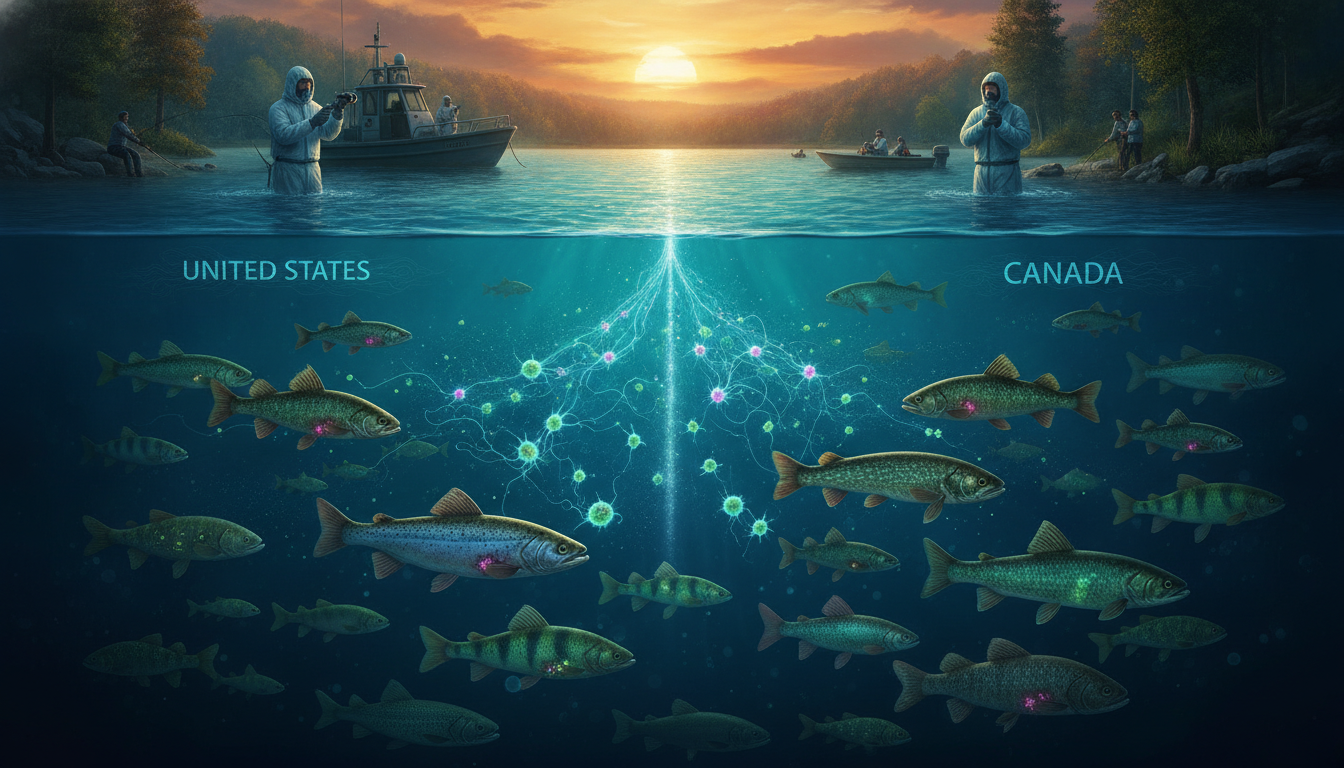
Scientists have identified the first known cancer that can spread between freshwater fish, raising urgent questions for a cross-border lake shared by the United States and Canada. The finding signals a new wildlife health challenge for a region that supports fisheries, recreation, and local economies.
The discovery was announced this week after researchers documented tumor cells that appear able to move from one fish to another in the same lake. The lake spans the international border, which means any response will require cooperation between agencies and labs on both sides.
Scientists identified the first known cancer transmissible among freshwater fish in a lake that spans the US and Canada.
The research team has not released the species, the exact location, or a timeline for spread. Even with limited details, the report marks a rare type of disease event in vertebrates and sets off a new round of monitoring in North American waters.
Why This Matters Now
Contagious cancers are uncommon in nature. The most documented examples occur in Tasmanian devils, domestic dogs, and several marine bivalves such as clams and mussels. Those diseases involve living cancer cells that move between hosts and continue to grow.
Freshwater fish had not been on that list. A confirmed case in a lake environment expands the known range of such diseases and may change how wildlife managers track mortality events, tumor clusters, and unexplained die-offs.
Scientists say these cancers do not behave like viruses or bacteria. They are actual cells that spread, survive, and divide in a new host. That feature can make detection harder, because standard pathogen tests may miss them.
What Scientists Are Looking For
Researchers will work to pin down how the cancer moves between fish. In other species, possible routes include direct contact, injury, or exposure to cancer cells released into shared waters.
Investigators are likely to run genetic tests on tumors from different fish to see if the cancer cells share the same origin. A genetic match would strengthen the case for transmission.



They will also study environmental factors. Water temperature, pollution, and population density can affect disease stress in fish. Pinpointing those links may help managers reduce risk.
Early Implications For Fisheries And Ecology
A transmissible cancer could stress local fish populations if it spreads widely. That risk is higher in species that school, spawn in close quarters, or gather near warm outflows and harbors.
Managers may increase sampling during spawning runs and in known nursery areas. Field crews could track tumor prevalence by species, age class, and location to map hot spots.
Commercial and recreational fisheries depend on healthy stocks. Any decline linked to disease could affect catch limits, season timing, or hatchery plans.
Public Health And Cross-Border Response
Scientists say there is no evidence that contagious cancers in animals spread to humans. The known cases in wildlife and dogs are species specific. Public health agencies will still watch for any changes, but experts view human risk as low.
The binational setting adds urgency. Agencies will need aligned testing, shared data, and common alert thresholds. Joint protocols could prevent gaps at the border where fish move freely.
- Common sampling standards can improve year-to-year comparisons.
- Shared reporting platforms can speed up alerts to local fishers.
- Coordinated lab methods can confirm cases faster.
What Comes Next
The priority is confirmation with peer-reviewed results that describe the species, tumor genetics, and transmission route. That paper would guide field surveillance and management actions.
In the meantime, researchers may launch pilot surveys across tributaries and nearshore zones. They could archive tissue samples for future testing as methods improve.
If the cancer is clustered in one area, targeted habitat work may reduce stress on affected fish. If it is widespread, managers might shift to long-term monitoring and risk modeling.
The report signals a new chapter in wildlife disease science. It widens the map of where contagious cancers can occur and highlights the need for flexible fish health programs. The key questions are how fast the cancer spreads, which species are most at risk, and whether targeted habitat fixes can slow it. Watch for formal publication of the findings, a shared cross-border monitoring plan, and early results from genetic testing that could set the course for the response.