



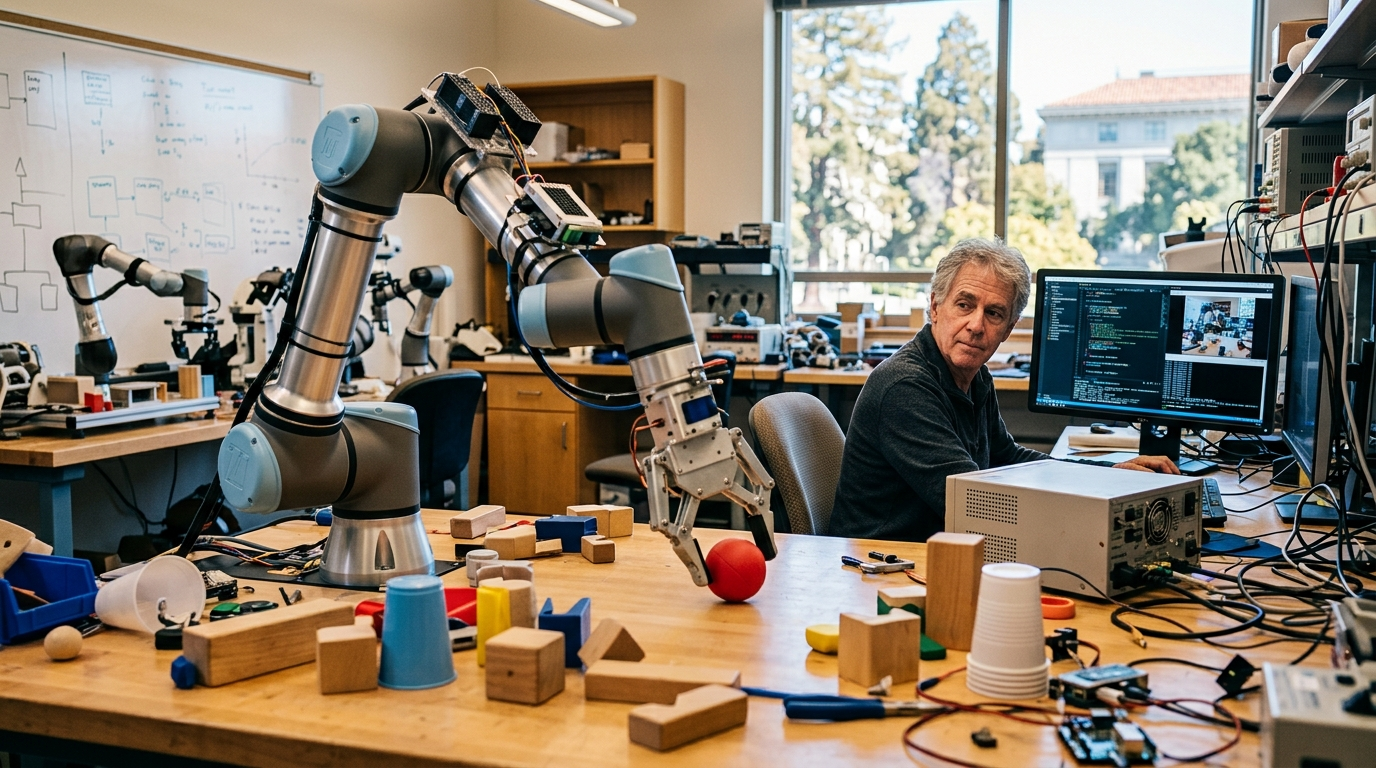
Robots are learning physical tasks far more slowly than chatbots are mastering language, according to two new papers from UC Berkeley roboticist Ken Goldberg.
The research examines why recent gains in artificial intelligence have not produced equal progress in machines that work outside software. Goldberg focuses on a central challenge: Language models learn from vast stores of digital text, while robots must gain reliable skills through physical experience.
The distinction matters for factories, warehouses, homes, hospitals and farms. A chatbot can generate a flawed answer with limited physical harm. A robot’s mistake can damage an object, disrupt a workplace or injure someone.
Digital Data Gives Chatbots an Advantage
Modern chatbots train on huge volumes of text gathered from books, websites and other digital records. That material can be copied, organized and processed at immense scale.
Robots face a tougher data problem. Useful training may require cameras, sensors, machinery and controlled spaces. Each attempt also takes real time, while a software model can process many examples in parallel.
Physical information is less standardized than text. The same task can change based on lighting, object shape, surface friction or the position of a robot’s gripper. Small differences may turn a successful movement into a failed one.
Goldberg’s analysis helps explain why language fluency can appear to improve quickly while physical skill develops in narrower steps. A chatbot works with symbols on a screen. A robot must connect perception, planning and motion within a changing setting.
Real-World Errors Carry Higher Costs
Robotic systems must do more than recognize an object or describe an action. They must apply the right force, avoid collisions and adjust when conditions shift.



These demands create several barriers to rapid learning:
- Physical training data is costly and slow to collect.
- Safety limits how freely robots can learn through trial and error.
- Tasks vary across rooms, tools, materials and machine designs.
- Success often requires precise sensing and movement at the same time.
Language systems also make errors, including false or misleading statements. Yet their outputs remain digital in many common uses. Robotics adds direct contact with people and property, raising the standard for dependable performance.
This does not mean chatbot development is simple or that language has been solved. Fluency can hide gaps in reasoning and accuracy. The comparison instead shows why apparent progress should be measured differently across software and physical machines.
Progress May Depend on Better Training Methods
Goldberg’s two-paper assessment points to the need for methods suited to physical learning. Researchers can use simulation to generate more practice, but virtual environments cannot reproduce every feature of real objects and spaces.
Human demonstrations may also help robots learn. However, collecting and translating those movements into machine actions requires added equipment and careful supervision.
Another route is to develop systems that transfer lessons from one task to another. That could reduce the amount of physical practice required for each new job. Even then, machines would need testing under varied conditions before widespread use.
For employers, the findings offer a warning against assuming that rapid chatbot gains will soon produce general-purpose robots. Near-term systems are more likely to succeed in structured settings, where objects, movements and safety rules can be tightly controlled.
The papers frame the robotics gap as a problem rooted in data, safety and the complexity of physical action. Future progress will depend not only on larger AI models, but also on better sensing, richer training and careful real-world testing. The key measure will be whether robots can perform consistently when conditions no longer match the laboratory.