



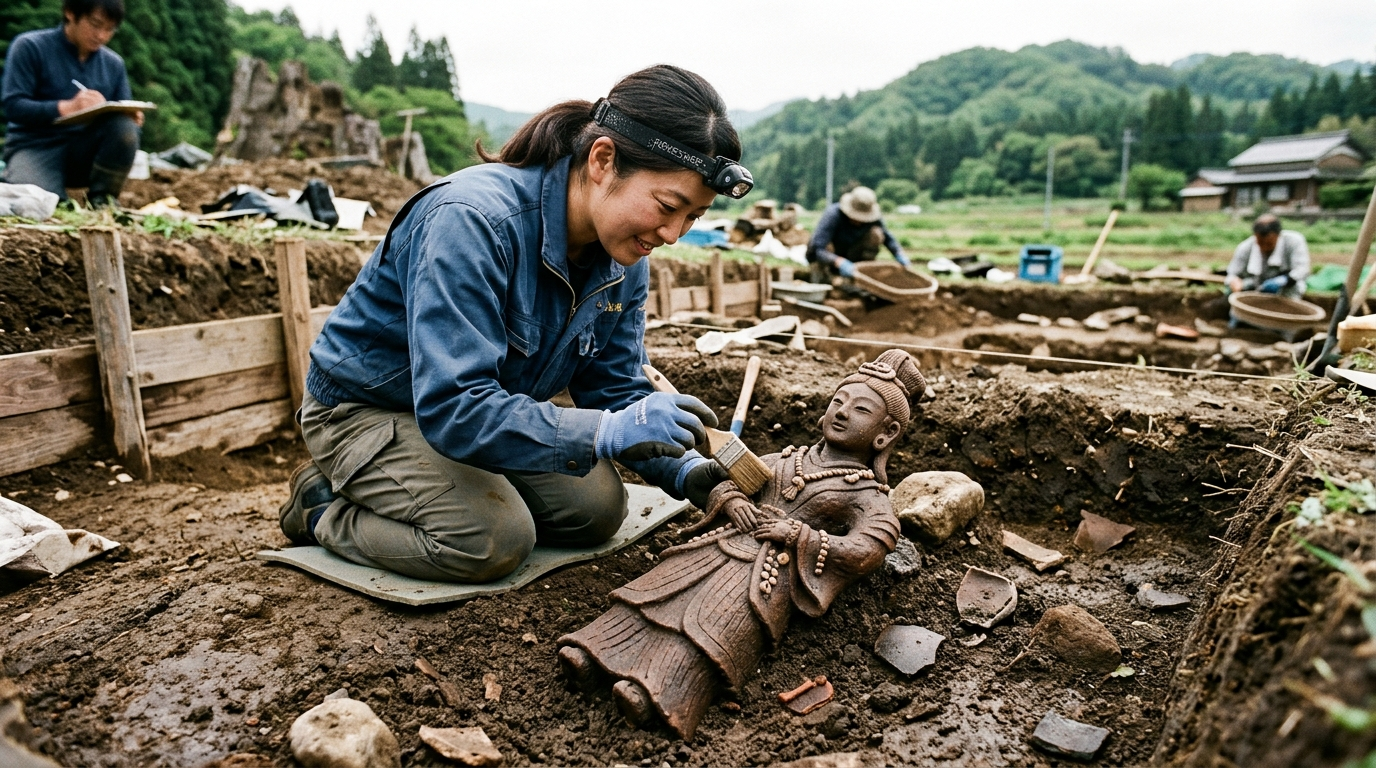
Archaeologists have unearthed a human-shaped funeral offering that may portray an ancient Japanese priestess, raising new questions about ritual life and women’s religious roles.
The discovery offers a rare physical clue about how an ancient community honored its dead. Researchers have not yet confirmed the figure’s identity, however. The interpretation rests on its form, burial setting, and possible ceremonial features.
Key details about the find, including its exact age, location, material, and excavation date, have not been released. That limits firm conclusions about who made the object and why it was placed with the dead.
A Figure With Possible Religious Meaning
Funeral offerings can reveal beliefs that written records do not preserve. Their placement may reflect ideas about death, status, protection, or the journey into an afterlife.
A human-shaped object can carry several meanings. It might depict a specific person, a deity, an ancestor, or a symbolic ritual attendant. It could also represent the deceased without serving as a realistic portrait.
The suggestion that this figure represents a priestess is important because it points to a possible female religious role. If supported by further study, the object could add evidence about women’s ceremonial authority in ancient Japan.
Still, appearance alone cannot establish identity. Researchers would need to compare the offering with similar finds and examine the burial context closely.
Evidence Archaeologists Will Examine
The strongest interpretation will depend on several forms of evidence:



- The object’s material, age, clothing, hairstyle, and decorative details
- Its position inside the grave and its relationship to human remains
- Other goods found nearby, including ritual or status objects
- Comparable figures from settlements, tombs, and ceremonial sites
Scientific testing may help identify pigments, residues, production methods, or the source of the raw material. Dating the surrounding burial layer could also place the offering within a clearer historical period.
The human remains, if preserved and available for study, may provide further context. Age, sex, diet, health, and ancestry can sometimes be assessed through skeletal and chemical analysis. Such findings would not automatically identify the figure, but they could test parts of the priestess theory.
Why Caution Matters
Archaeologists often interpret ritual objects through comparison. Similar clothing, headgear, tools, or burial positions may suggest a religious function. Yet symbols can change across regions and centuries.
Modern labels can also narrow the meaning of an ancient object too quickly. The word priestess suggests an organized religious office, but the community may have understood the role differently. The figure might instead represent a healer, spirit medium, clan leader, mourner, or divine being.
That uncertainty does not reduce the find’s value. It shows why burial context matters as much as the artifact itself. A small object can provide evidence about social rank, gender, ritual practice, and artistic traditions.
Further excavation and laboratory work will determine whether the priestess interpretation gains support. For now, the discovery remains a promising but tentative glimpse of ancient Japanese beliefs, with its identity dependent on evidence still under study.