




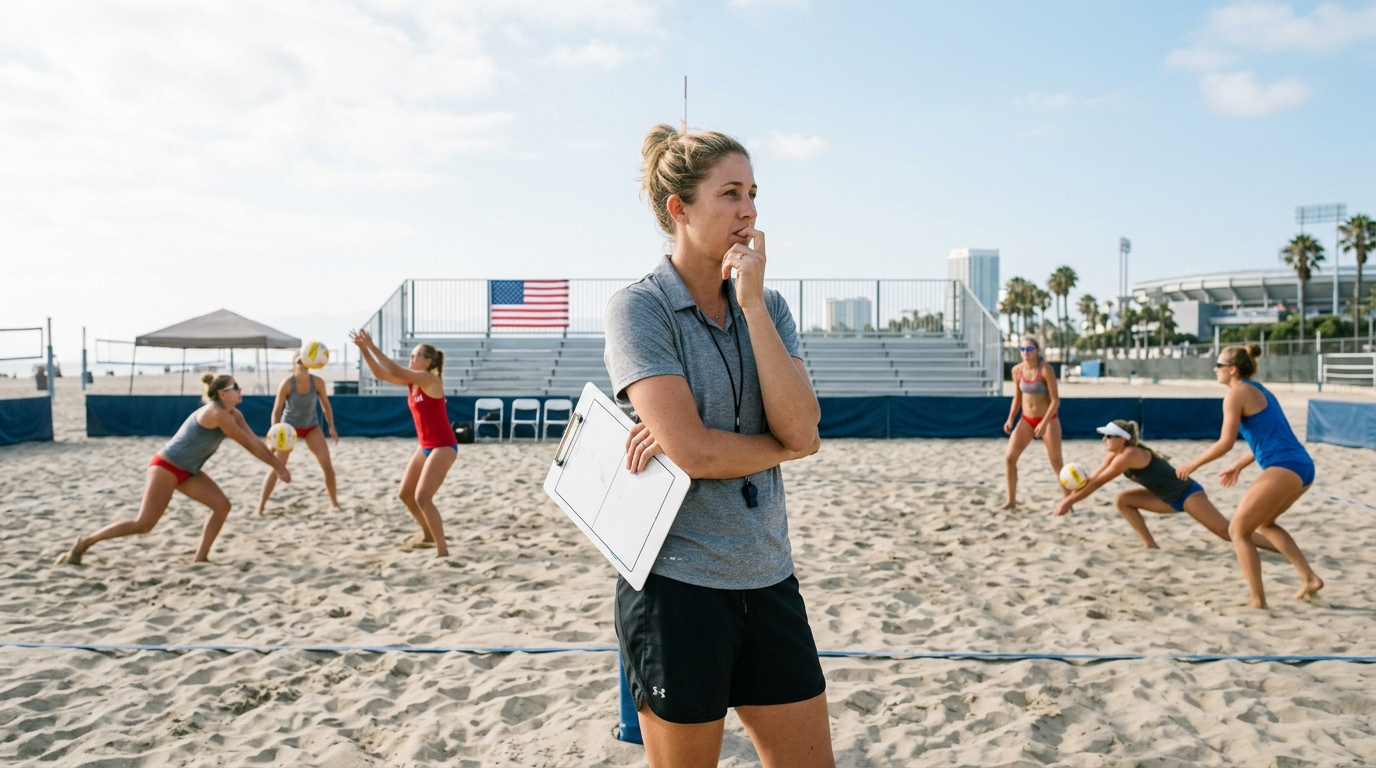
Coach April Ross is considering a broader approach to preparing the U.S. women’s beach volleyball team for the 2028 Los Angeles Olympics. Rather than building the program around one dominant pair, the strategy may focus on developing several teams capable of competing at the highest level.
The approach reflects the unusual demands of beach volleyball. Athletes compete in fixed pairs, yet Olympic qualification and selection require strength across an entire national program. For the host nation, the pressure will be greater because the tournament will take place before a home crowd in Los Angeles.
Depth Could Shape the LA28 Plan
The central question is how the United States should organize its talent during the next Olympic cycle. The assessment of Ross’s task identifies one especially interesting feature:
“The most intriguing part of preparing the U.S. women’s beach volleyball team for LA28 may not be identifying one dominant pair.”
That observation points to a strategy based on competitive depth. A program with several strong partnerships gains more options if injuries, performance declines, or partnership changes affect leading contenders.
Beach volleyball partnerships depend on more than individual skill. Players must divide court responsibilities, communicate under pressure, and match their defensive and attacking styles. The strongest individual athletes do not always form the strongest pair.
A wider pool could also create sustained competition before Olympic selections are made. Potential benefits include:
- More viable pairings during the qualification period
- Greater flexibility after injuries or roster changes
- Stronger internal competition among American teams
- More chances to test partnerships against international opponents
Ross Brings an Athlete’s Perspective
Ross enters the coaching challenge with direct knowledge of elite beach volleyball. Her perspective as a coach is likely to include both technical performance and the personal demands of maintaining a successful partnership.
That experience could influence how the U.S. program evaluates players. Results remain important, but coaches must also judge communication, consistency, tactical fit, and the ability to respond during close matches.



The strategy carries trade-offs. Concentrating resources on one leading pair can build stability and provide a clear medal contender. Spreading attention across several teams may improve depth, but it can also make training priorities and selection decisions harder.
A Longer Race to Los Angeles
The four-year Olympic cycle gives coaches time to test different combinations. Early results may guide decisions, although performances closer to the Games will carry greater weight.
International competition will provide the clearest measure of progress. American pairs must show they can handle varied playing styles, travel demands, and repeated matches against leading opponents.
Partnership decisions will also matter because beach volleyball pairs need time together. Frequent changes can slow development, while committing too early can limit options if a team stops improving.
Ross’s challenge is therefore larger than selecting two athletes. She must help create a system that produces strong partnerships and keeps alternatives ready. For LA28, the strength of the U.S. women’s program may be judged not only by its best pair, but by how many credible medal contenders it can develop.