



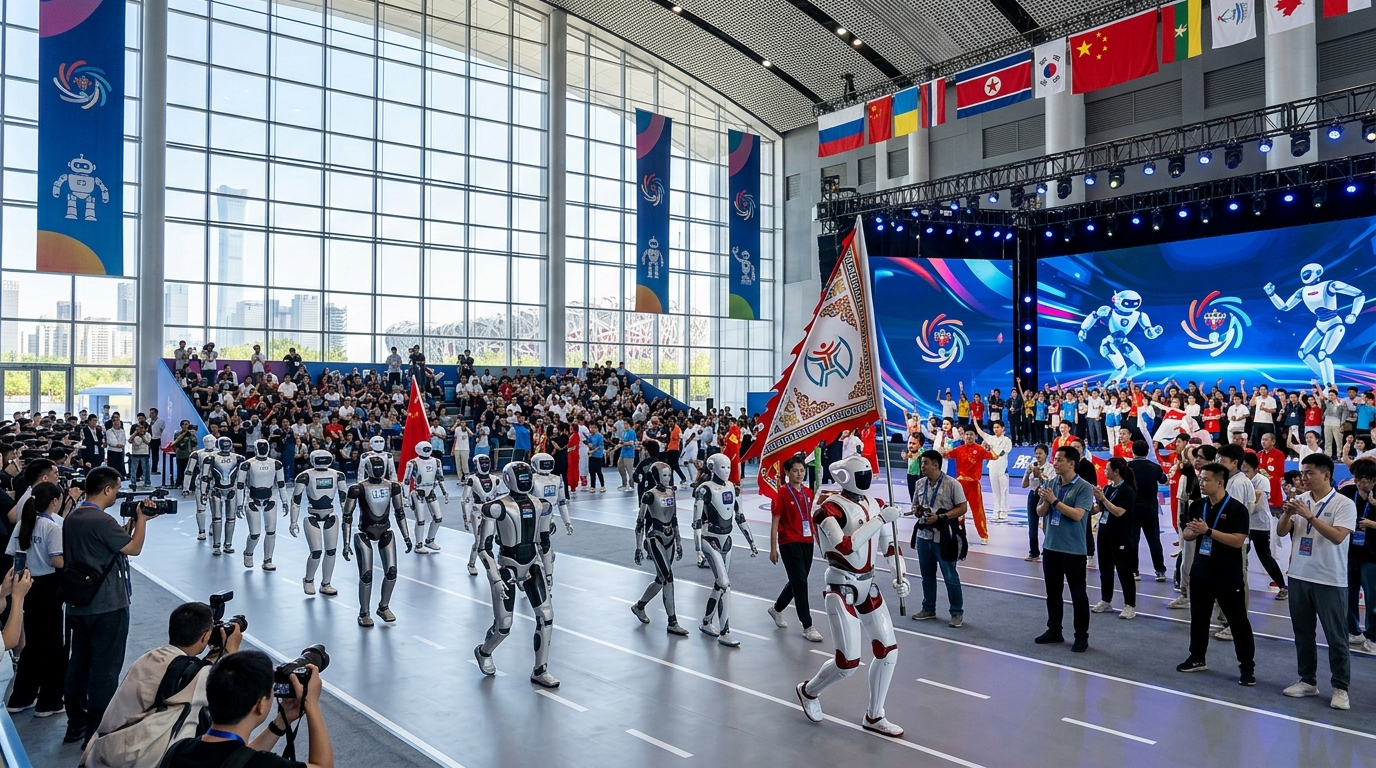
China opened its second World Humanoid Robot Games in Beijing on Saturday, placing the country’s growing robotics ambitions before a global audience.
The event brings humanoid machines into a competitive setting as China directs major investment into the sector. The games offer a public test of robots designed to move and operate in ways that resemble people.
Competition Puts Technology on Display
The Beijing spectacle gives developers a visible stage for their latest machines. Competitive events can test movement, balance, speed, coordination, and the ability to complete assigned tasks.
Public contests also make complex engineering easier for general audiences to assess. A robot that performs well under pressure can offer clear evidence of progress. Failures can expose limits that controlled demonstrations may not show.
This year’s gathering is the second World Humanoid Robot Games. Its return suggests that organizers see lasting value in using sport and competition to measure development.
However, the opening announcement did not provide attendance totals, investment figures, or detailed results. It also did not identify participating companies or explain how the robots would be scored.
China Increases Support for Humanoid Robots
The games arrive as China puts more money into its humanoid robot industry. That timing links the public event with a wider effort to build technical skills and commercial capacity.
Humanoid robots are designed around the general shape and movement of the human body. That design could help them work in spaces already built for people, including factories, warehouses, and service sites.



Developing such machines remains difficult. Walking on two legs requires constant balance. Robots must also process information, respond to changing conditions, and avoid harming nearby people or equipment.
The industry must address several practical questions before wider use:
- Whether robots can work safely near people
- How long they can operate before recharging
- Whether their performance justifies their cost
- How reliably they handle unfamiliar conditions
Games Offer Tests but Not Final Proof
Strong results in a competition can help engineers compare designs and find weaknesses. They may also attract investment, skilled workers, and public interest.
Yet sporting performance does not prove that a machine is ready for daily work. Commercial robots must repeat tasks for long periods, operate safely, and remain affordable to maintain.
The event therefore serves two purposes. It is a spectacle for spectators, but it is also a testing ground for an industry receiving increased financial support.
The next measure of progress will come after the games. Observers will watch whether the machines move from demonstrations into useful, reliable roles. They will also look for clearer data on costs, safety, and performance.
Beijing’s second World Humanoid Robot Games shows that China wants a leading position in this emerging industry. The larger question is whether investment and public competition can produce robots ready for routine use.