




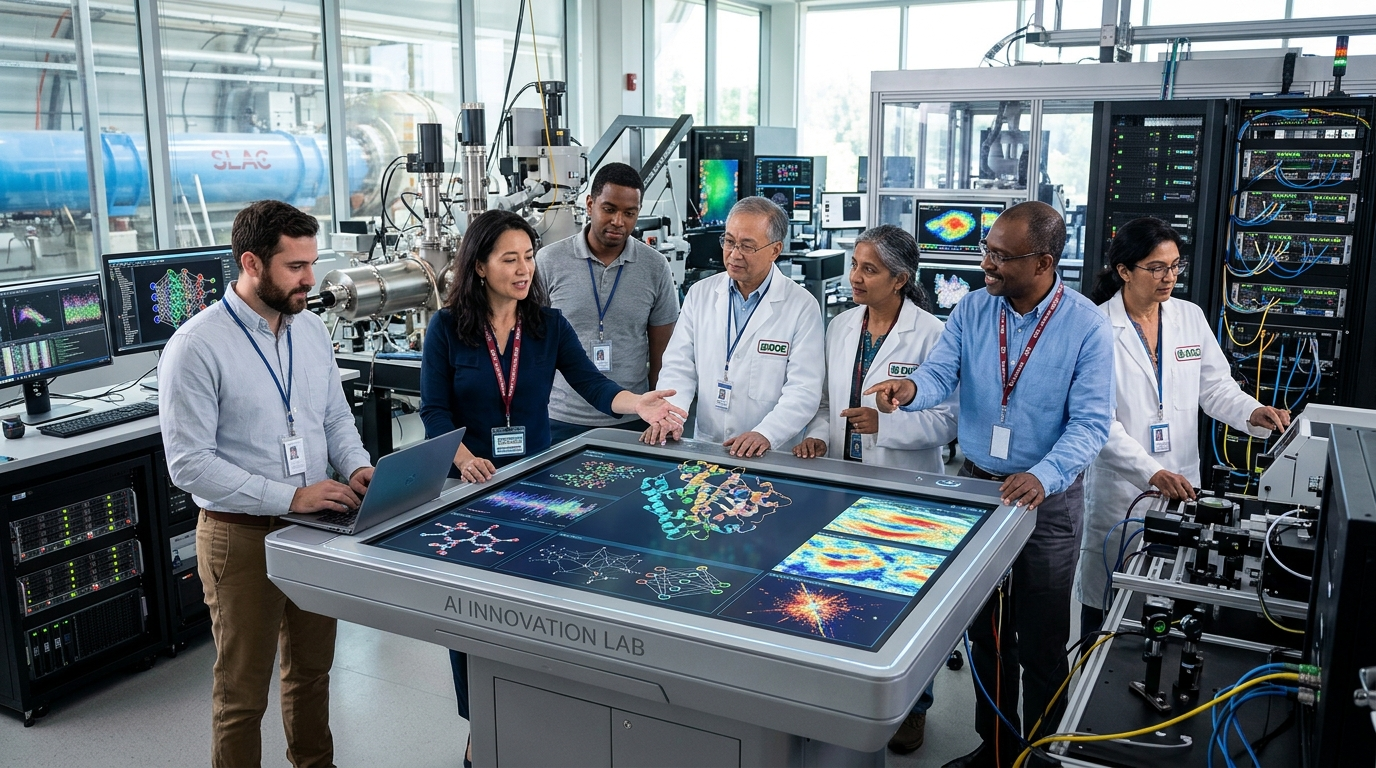
The U.S. Department of Energy has selected six projects led by Stanford University and SLAC National Accelerator Laboratory for an initial round of artificial intelligence funding. The projects will use AI to address some of the nation’s hardest science and technology problems.
The announcement places Stanford and SLAC among the institutions receiving support in the program’s first phase. The department did not provide project-level funding totals, research schedules, or technical details in its initial statement.
AI Takes a Larger Research Role
Artificial intelligence is increasingly used to sort large data sets, identify patterns, and guide experiments. Those abilities can help researchers study problems that would take far longer through traditional methods.
National laboratories are well suited to this work. They operate major scientific facilities and produce large volumes of experimental data. AI systems can help researchers analyze those results and decide which tests should come next.
The Energy Department described the effort as a response to the nation’s “most complex science and technology challenges.” That broad goal could include work tied to energy, advanced computing, materials, physics, and other areas within the department’s research mission.
However, the announcement did not identify the specific challenges assigned to each Stanford-SLAC team. It also did not state how AI models would be tested or how researchers would measure success.
Stanford and SLAC Bring Shared Expertise
Stanford and SLAC have a long research partnership. Stanford operates SLAC for the Energy Department’s Office of Science, linking university researchers with a federal laboratory and large scientific instruments.
That relationship gives the six teams access to expertise in computing and laboratory science. It may also help move AI methods from academic studies into experiments conducted at national research facilities.



The first-phase awards could support several parts of scientific work:
- Analyzing complex experimental data more quickly.
- Finding patterns that human reviewers might miss.
- Helping researchers choose promising experiments.
- Improving computer models used to study physical systems.
Such uses may shorten research cycles, but they also create risks. AI results can reflect gaps in training data or produce conclusions that appear convincing without being accurate. Scientific teams must compare AI output with experiments, established theory, and independent review.
Early Funding Leaves Key Questions
The phrase first phase of funding suggests that the Energy Department may use early results to guide later investment. Yet the agency’s brief announcement did not explain whether future support will depend on technical benchmarks, outside reviews, or other measures.
Transparency will be important as the projects advance. Researchers and federal officials will need to explain what data the systems use, how findings are verified, and where human judgment remains necessary.
The selection of six Stanford-SLAC projects also shows the scale of the institutions’ role in the federal AI research push. Still, selection alone does not prove that a system will deliver useful scientific results. Progress will depend on careful testing and clear evidence.
For now, the awards mark an early federal investment in AI-assisted science. The next signals to watch are project descriptions, funding amounts, research milestones, and published results. Those details will show whether the program can turn AI tools into reliable gains for American science and technology.