




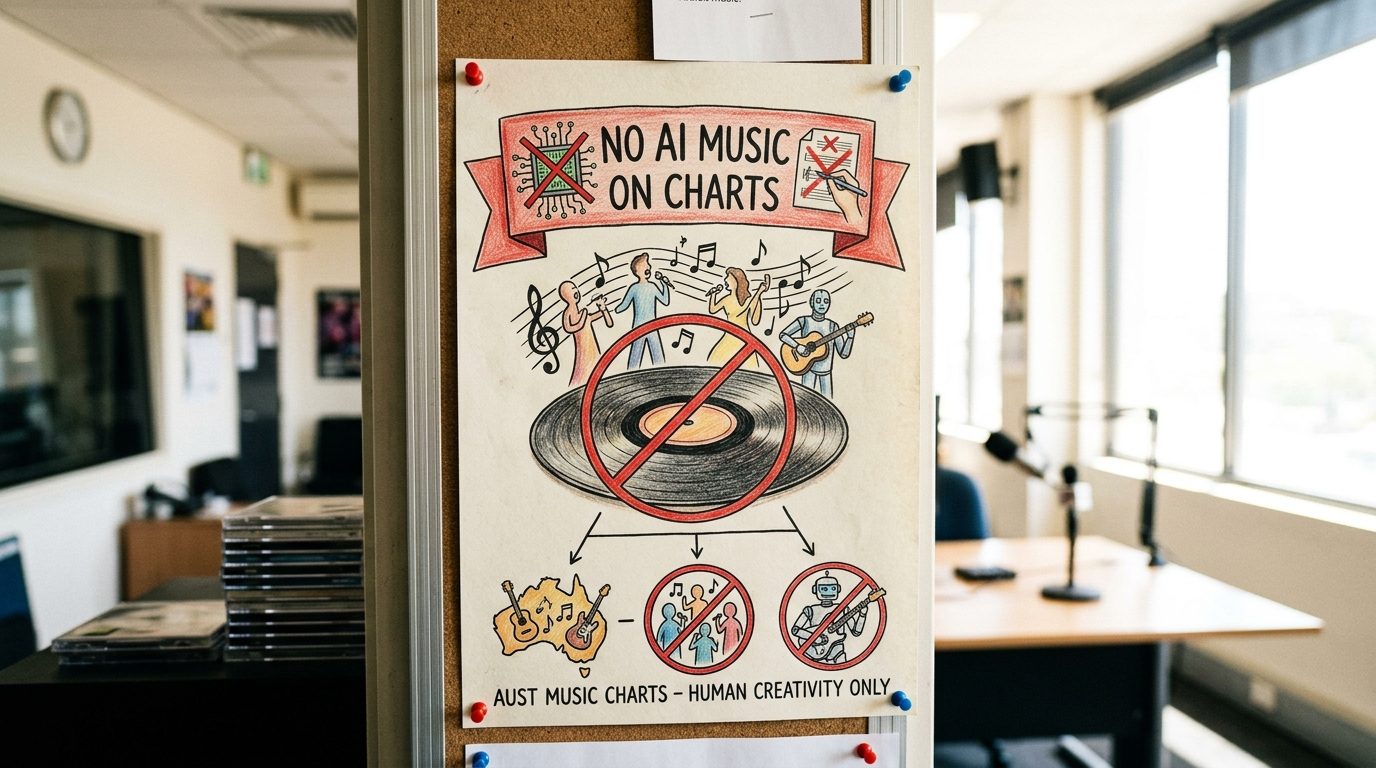
Australia’s recorded music industry will exclude songs made wholly by artificial intelligence from its official charts, drawing a firm line around human creativity.
The decision comes as generative AI tools make it easier to produce vocals, lyrics and complete tracks within minutes. Industry leaders say the technology could threaten artists’ incomes if automated music competes for chart positions and public attention.
The policy focuses on tracks generated entirely by AI. Based on the announcement, music that uses AI only as a production aid may be treated differently. That distinction could become difficult to police as artists mix human performances with machine-made sounds.
Charts Set a Human-Creation Standard
Official charts are more than weekly popularity contests. They can influence radio programming, media coverage, bookings and negotiations between musicians and record companies.
Tracks “wholly generated by AI will be barred from official charts,” Australia’s recorded music industry said.
The restriction protects chart positions for works tied to human artists. It also sends a message that popularity alone may not be enough for chart eligibility.
Generative systems can create songs at a scale no recording artist could match. A person can prompt a service to produce many tracks quickly, then distribute them through digital platforms. If those releases attract streams, legitimate or manipulated, they could compete with musicians who spend months writing and recording.
The industry’s concerns center on several practical risks:
- Automated releases could crowd streaming platforms and discovery systems.
- AI tracks may imitate the voices or styles of established performers.
- Chart success could become harder to verify without clear disclosure rules.
- Artists may lose attention, royalties and career opportunities.
The Hard Part Is Defining “Wholly”
The policy’s central word is wholly. Modern music production already relies on software for tuning, mixing, mastering and sound design. Generative tools add another layer, but their role can vary widely.



One song might use AI to clean up background noise. Another might include a machine-generated drum pattern. A third could feature synthetic lyrics, vocals and instrumentation with little human input.
Treating those works as identical would risk excluding artists who use AI much like any other studio tool. Yet a loose standard could allow fully automated songs to pass as human-led recordings.
Chart administrators may therefore need disclosure systems, audit rules and a clear test for meaningful human authorship. They will also need to decide who is responsible for accurate information: artists, labels, distributors or streaming services.
A Wider Fight Over Creative Work
The Australian move reflects a larger dispute across creative industries. Musicians, writers and visual artists are asking how AI models obtain training material and whether creators should consent or receive payment.
Supporters of stricter rules argue that human artists should not compete against systems trained on large bodies of creative work. They also warn that synthetic performances can confuse listeners and weaken trust.
AI advocates may counter that new tools can lower production costs and help independent musicians develop ideas. Used with human direction, the technology can assist experimentation rather than replace performers.
The chart ban does not settle that debate. It creates a limited rule for one influential measure of commercial success, while leaving questions about streaming availability, copyright and royalties unresolved.
Australia’s next challenge will be enforcement. Clear labels and consistent standards could keep the policy workable without punishing ordinary studio software use. The key test will be whether chart officials can reliably separate human-led songs from push-button production. The machines can make music quickly. Deciding what counts as an artist’s work will take longer.