




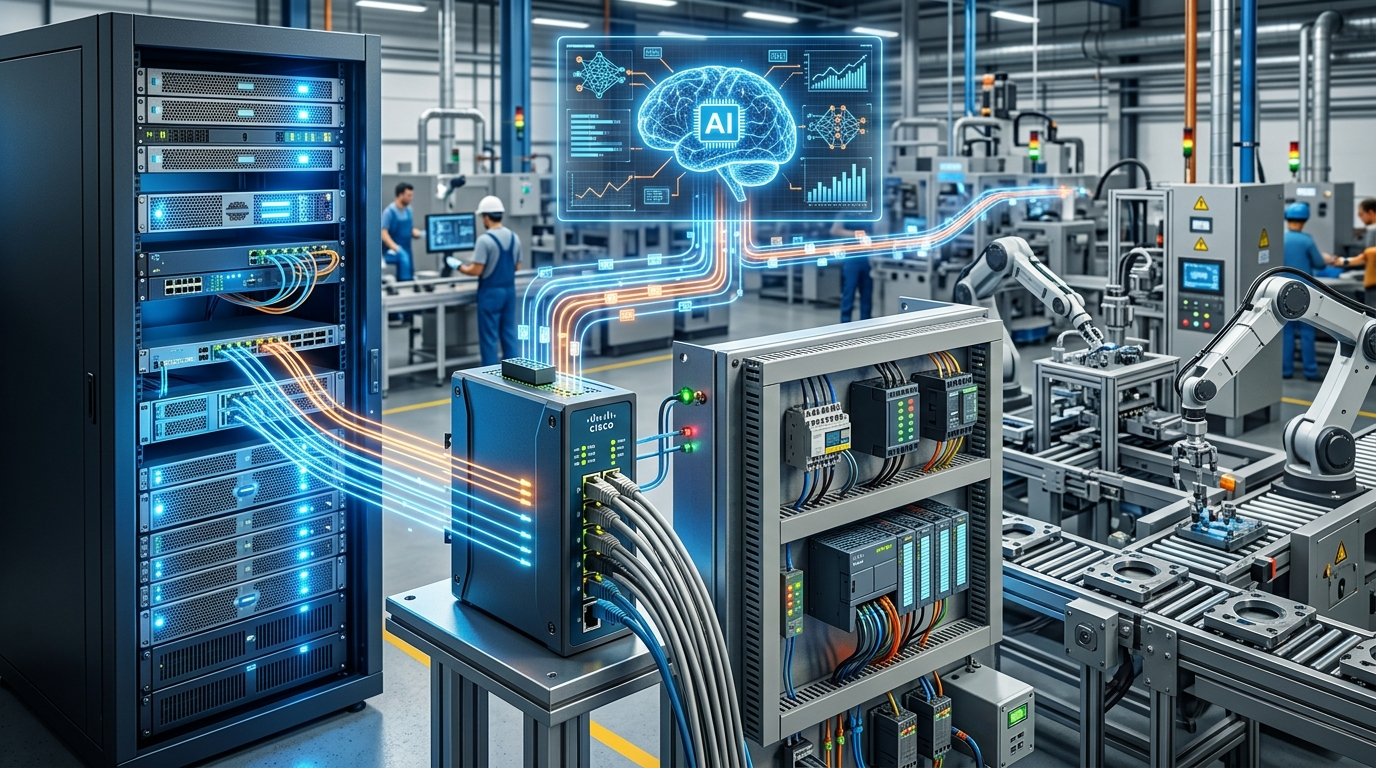
Cisco and Rockwell Automation are connecting information technology and operational technology to support industrial artificial intelligence. The effort targets manufacturers seeking better access to plant data without weakening security or production reliability.
The companies bring different strengths to the work. Cisco supplies networking, computing, and cybersecurity systems. Rockwell provides industrial automation technology used to control machines and production lines.
Their collaboration reflects a wider shift across manufacturing. Companies want factory data to move safely between machines, local computing systems, and corporate software. That access can help AI tools detect faults, improve output, and reduce unplanned shutdowns.
Closing a Long-Standing Technology Gap
IT teams manage business networks, applications, and data. OT teams oversee equipment that performs physical work, often under strict safety and timing requirements.
These groups have traditionally operated separate systems. That separation helped protect production equipment, but it also created isolated data and limited visibility.
Industrial Internet of Things technology has weakened those boundaries. Connected sensors and controllers now produce large volumes of information. Manufacturers want to use that information across their operations, rather than keep it inside individual machines.
Cisco and Rockwell are seeking to make those connections easier to manage. A shared approach could give plant operators and corporate technology teams a clearer view of network activity and equipment performance.
Industrial AI Depends on Reliable Data
AI systems require timely and accurate information. In factories, that may include temperature readings, vibration levels, energy use, production rates, and equipment alarms.


Connecting IT and OT could support several common industrial uses:
- Predicting equipment failures before production stops
- Finding quality problems earlier in the manufacturing process
- Tracking energy use and identifying waste
- Helping workers diagnose faults more quickly
However, collecting data is only part of the task. Industrial networks must deliver information with little delay while keeping critical control systems available. A brief interruption can carry financial or safety consequences.
Local, or edge, computing can address some of those concerns. It processes information near the equipment instead of sending every record to a remote data center. This can reduce delays and allow operations to continue when outside connections fail.
Security Remains a Central Concern
Greater connectivity can create more routes for cyberattacks. Older industrial equipment may lack modern security features, while plants often keep machinery running for decades.
A successful IT and OT strategy must identify connected assets, control who can reach them, and separate sensitive systems. It must also allow security teams to monitor threats without disrupting production.
The partnership may help customers apply common policies across office and plant networks. Yet technology alone will not resolve differences between IT and OT teams. Companies also need shared procedures, clear responsibility, and staff trained in industrial security.
Manufacturers Face Practical Hurdles
Industrial sites rarely use equipment from one supplier. Many plants contain a mix of new systems and older machinery built around different communications standards.
Any joint Cisco and Rockwell approach will therefore be judged by how well it works with existing assets. Cost will also matter, especially for smaller manufacturers that lack large technology teams.
Industrial AI projects can fail when data is incomplete or poorly labeled. Companies may also struggle to move a successful pilot across several plants. Standard network designs and common management tools could reduce that burden, but deployment will still require careful planning.
The Cisco and Rockwell effort signals that industrial AI is becoming a network and governance issue, not only a software project. Its impact will depend on secure integration, support for older equipment, and measurable gains on the factory floor. Manufacturers will watch whether closer IT and OT links produce safer operations, lower downtime, and AI systems that work under real production conditions.