




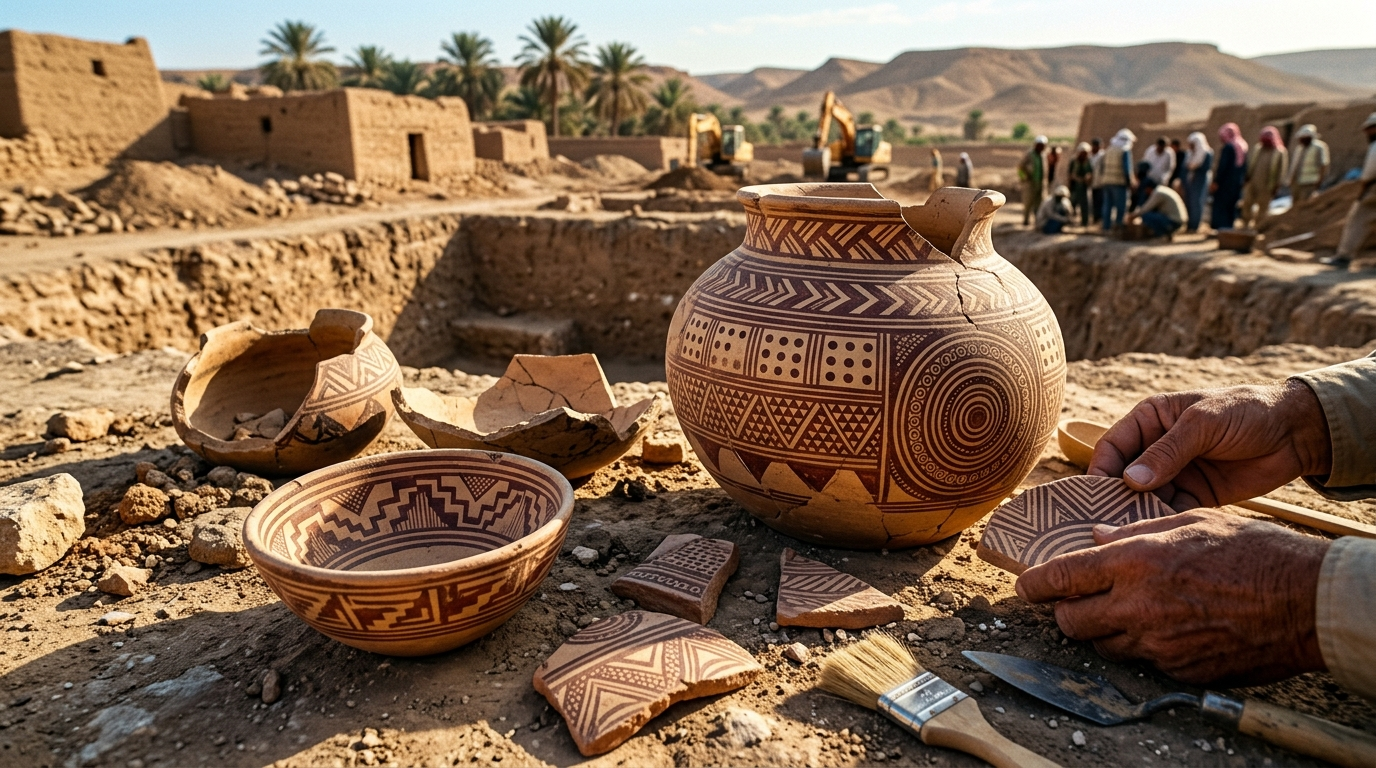
Decorated ceramics from an ancient Mesopotamian culture may preserve some of humanity’s earliest mathematical thinking, according to researchers studying the objects. Their argument links repeated designs on pottery to the growth of counting, measurement, symmetry, and planned geometry.
The claim adds a new angle to the history of mathematics. Instead of looking only at written numbers or accounting records, the researchers treat visual decoration as possible evidence of structured reasoning.
Patterns Point to Planned Design
Decorated ceramics often contain repeated lines, shapes, and bands. Producing these designs required makers to divide limited space and maintain consistent spacing around curved vessels.
The researchers argue that such work may reflect early mathematical ideas. A potter planning a repeated pattern could have counted units, estimated distance, or divided a surface into sections.
The ceramics show “some early roots of math,” the researchers argued.
This does not mean the makers used equations or formal mathematical notation. Their knowledge may have been practical and learned through experience. Yet repeated, ordered designs can still show an ability to recognize rules and apply them.
Several features could support that interpretation:
- Repeated motifs may suggest counting or grouping.
- Even spacing may indicate measurement and planning.
- Balanced designs may reflect an awareness of symmetry.
- Divided bands may show early use of fractions or proportional thinking.
Mathematics Before Written Numbers
Mesopotamia has long held a central place in the history of mathematics. Later societies in the region developed written systems for recording quantities, trade, land, and time.
The ceramic evidence may point to an earlier stage. Mathematical thought could have grown through craft, farming, construction, exchange, and other daily tasks before it appeared in formal records.



Pottery offers a useful source because ceramic objects can survive for thousands of years. Their decoration can also preserve choices made during production. Those choices include how many elements to add and where to place them.
If the researchers’ reading is correct, artisans were not merely decorating household goods. They were applying organized ideas about number, shape, and space.
Interpretation Requires Caution
Patterns alone cannot reveal exactly what ancient makers understood. A repeated design may come from habit, shared tradition, or visual preference rather than deliberate calculation.
Modern observers also risk placing current mathematical concepts onto people who described their knowledge differently. Symmetry visible to an archaeologist does not prove that a potter had a formal term for it.
For that reason, the argument depends on context. Researchers must compare many vessels, identify consistent rules, and examine whether patterns changed across places or periods. Production methods and signs of advance planning can provide further support.
Craft Offers a Wider Historical Record
The study of decorated ceramics broadens the search for early mathematics. Written evidence often reflects officials, merchants, or trained scribes. Crafted objects can offer clues about knowledge used by workers whose ideas were never recorded in text.
The findings also suggest that art and mathematics may have developed together. Repetition creates visual order, but it also demands decisions about quantity and proportion.
Future analysis will need to test whether the patterns follow measurable rules across larger groups of artifacts. If that evidence holds, Mesopotamian pottery could help trace mathematical reasoning to ordinary acts of making, measuring, and decorating.