



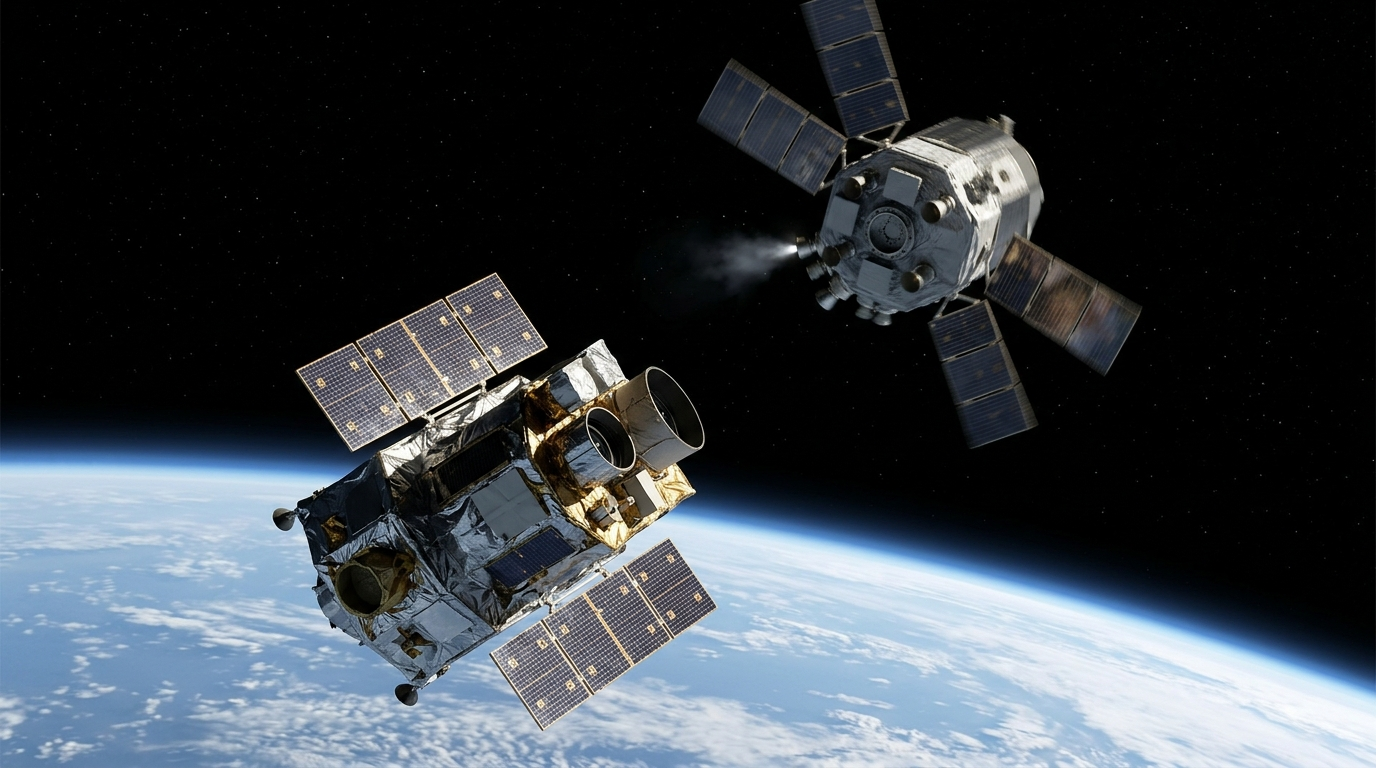
Katalyst Space’s LINK spacecraft needs more time before it can attempt to rescue NASA’s falling Swift observatory. LINK entered an unexpected spin in orbit, forcing the company to focus on stabilizing the spacecraft before approaching the science satellite.
The setback adds urgency to a difficult mission. Swift’s orbit is gradually dropping, while LINK must prove it can operate safely and reliably near another spacecraft.
LINK Works to Regain Control
Katalyst Space said LINK is recovering from the unplanned rotation. The available update did not identify the cause, the spacecraft’s current spin rate, or when recovery might be complete.
“Katalyst Space’s LINK spacecraft is recovering from an unexpected spin in orbit, and will need a little more time to rescue NASA’s falling Swift observatory.”
An orbital spin can disrupt communications, power generation, navigation, and thermal control. The exact effects depend on the spacecraft’s design and the severity of the motion.
Controllers typically use onboard sensors and thrusters to determine a spacecraft’s orientation and stop unwanted rotation. Engineers must then confirm that propulsion, guidance, communications, and power systems remain healthy.
Those checks matter before any close approach to Swift. A servicing spacecraft must maintain precise control to avoid contact that could damage either vehicle.
Why Swift Matters
NASA launched the Neil Gehrels Swift Observatory in 2004. The spacecraft studies gamma-ray bursts, which are brief and powerful explosions linked to events such as collapsing stars and merging neutron stars.
Swift can detect a burst and quickly direct its instruments toward the source. It also sends alerts that allow telescopes on Earth and in space to conduct follow-up observations.


The observatory has operated far longer than its original mission period. However, atmospheric drag slowly lowers satellites in low Earth orbit. That process can eventually lead to reentry unless a spacecraft has propulsion or receives outside assistance.
A successful LINK mission could address several goals:
- Raise Swift’s orbit and extend its useful life.
- Protect continued access to time-sensitive astronomy data.
- Test commercial servicing methods for older government satellites.
A High-Stakes Servicing Test
The delay shows the risks facing orbital servicing missions. LINK must first recover its own stability, then demonstrate accurate navigation during operations near Swift.
Mission planners also must weigh Swift’s declining altitude against the hazards of moving ahead too quickly. Waiting reduces the chance of a control error, but a long delay could narrow the available rescue window.
The incident may also influence plans for future satellite life-extension work. Many older spacecraft were not designed for servicing. Commercial vehicles must therefore approach, inspect, and assist targets with limited attachment points or navigation aids.
Katalyst’s next updates will need to clarify LINK’s condition, the cause of the spin, and a revised schedule. Engineers will also need to show that the spacecraft can hold a stable orientation before rescue operations resume.
For now, Swift continues its scientific work while its orbit declines. LINK’s recovery will determine whether the mission proceeds soon, changes course, or faces another delay. The central challenge is clear: stabilizing the rescue spacecraft must come before attempting to save the observatory.