




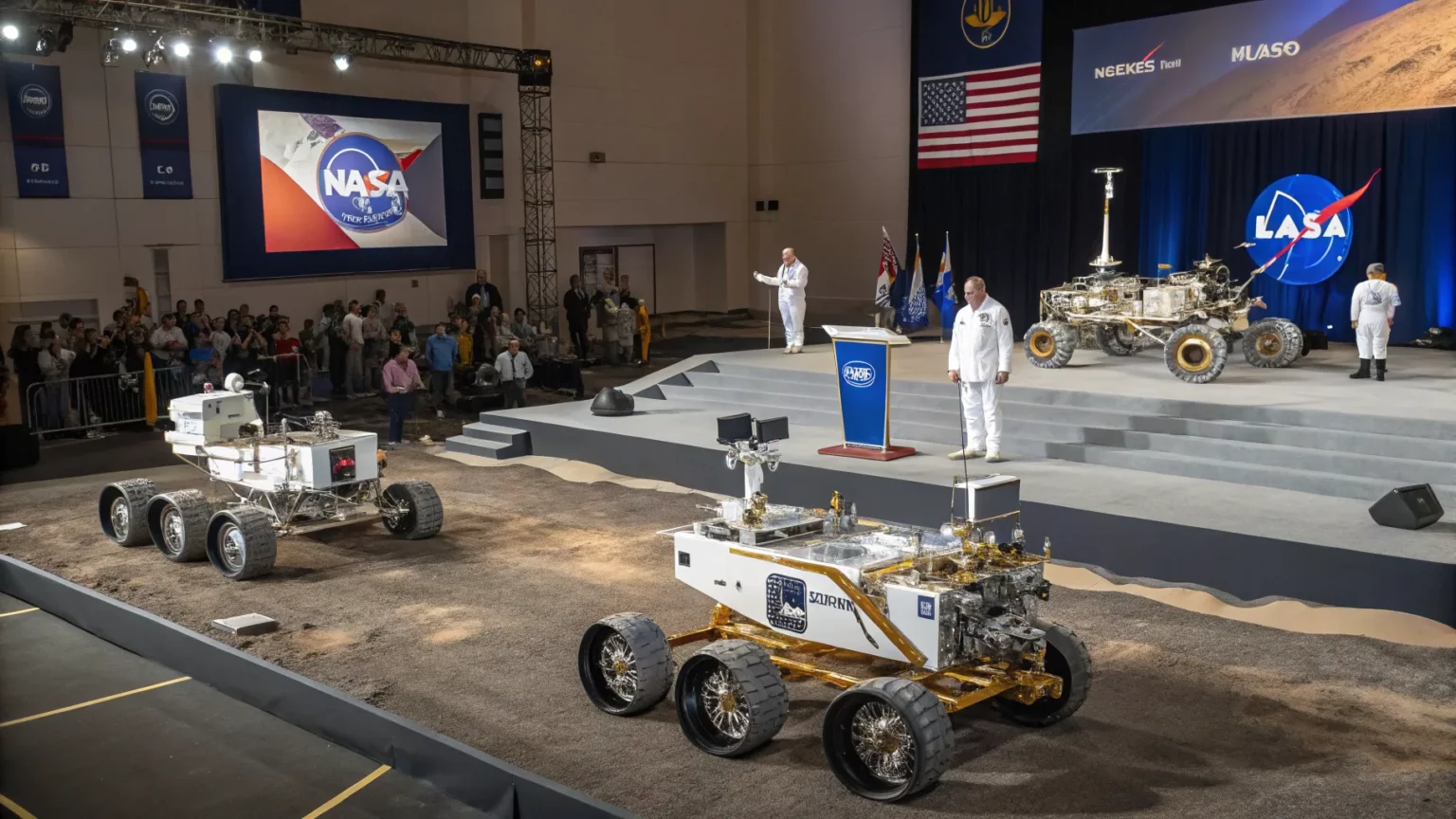
NASA has taken a public step toward building a foothold on the Moon, unveiling the first rovers and landers bound for the lunar south pole at an event at its headquarters. Agency leaders said the early hardware will scout the terrain and deliver supplies that set up a future outpost, a key waypoint for longer missions and science on the Moon.
The announcement highlighted the who, what, and where: NASA officials, new robotic craft, and the agency’s headquarters. The why is clear. The south pole is rich in resources that could support crews, including water ice locked in shadowed craters. The move signals momentum for the next phase of lunar exploration under Artemis.
Why The South Pole Matters
The lunar south pole has become the top target for exploration. Sunlight near high ridges can power systems for long periods. Nearby, deep craters may hold frozen water that could be turned into drinking water, oxygen, and rocket fuel.
Since Apollo, NASA has aimed to return astronauts to the Moon, this time to stay longer. Artemis seeks to put crews on the surface, build up infrastructure, and test systems for future trips deeper into space. Early robotic missions act as scouts, mapping hazards, validating landing techniques, and checking how equipment holds up in the harsh cold.
Recent lunar attempts have shown both promise and risk. A U.S. commercial lander reached the Moon in early 2024, proving new delivery models. Another failed to land, showing how difficult the final descent can be. These lessons shape NASA’s plans for south pole operations.
What NASA Revealed
“At an event at NASA Headquarters, space agency officials unveiled the first rovers and landers headed to the future site of its planned lunar south pole outpost.”
Officials described a phased approach. Early landers will bring instruments, communications nodes, and power systems. Small rovers will survey slopes, test mobility on uneven, powdery soil, and scout safe routes for larger cargo. Each mission will add data needed to select exact outpost sites and refine landing procedures.
These steps are designed to reduce risk for human missions. The south pole’s lighting is tricky. Some areas never see the Sun. Others have brief sunlight. Rovers will measure temperature swings, dust behavior, and radio links. Landers will test precision navigation to touch down near targets without sending up debris that can damage equipment.
Industry Partners And Delivery Cadence
NASA’s plan leans on commercial providers to deliver gear. Under service contracts, companies build and fly landers while NASA supplies payloads. This can speed up launches and lower costs by sharing risk and encouraging competition.



That approach has already produced hard-won knowledge. Recent missions showed how fuel margins, terrain mapping, and software must align. By sending multiple small deliveries instead of one large platform, NASA can learn fast and adjust. If a lander misses a target or a rover fails, another flight can try again with fixes in months, not years.
Still, timelines remain tight. Hardware must survive extreme cold in permanently shadowed regions and long lunar nights. Regulators, suppliers, and launch schedules also affect when each piece can fly. NASA stressed that data from the first sorties will shape the pace of later cargo runs.
Science Goals And Daily Operations
South pole science supports both exploration and research. Instruments will hunt for hydrogen signatures, map ice deposits, and study how radiation affects electronics and materials. Rovers will carry drills and spectrometers to sample near-surface layers and test extraction techniques.
- Map lighting and temperatures across potential outpost zones.
- Locate and characterize water ice in shadowed areas.
- Demonstrate power, communications, and navigation for sustained use.
- Test dust mitigation on landers, suits, and solar arrays.
Operationally, the first missions will practice a simple pattern. A lander arrives with several payloads. A rover deploys to scout nearby terrain. Data flows to mission control, informing the next flight. Over time, these runs could pre-position supplies, including batteries, solar panels, and relay antennas, to support crews.
What Success Would Mean
If the first rovers and landers perform as planned, NASA will have a clearer map of safe zones and resource-rich sites. That would tighten plans for crewed landings, reduce risk, and improve odds of sustained operations.
Challenges are real. Dust can foul moving parts. Uneven lighting complicates power budgets. The south pole’s cold can be harsher than anything most space hardware has faced. Yet each flight narrows the unknowns and builds experience that money alone cannot buy.
NASA’s reveal marks a new phase for lunar return. The early machines will not only gather data. They will lay down the first pieces of a southern foothold. Over the next few missions, watch for steady progress: more precise landings, better maps of ice deposits, and longer rover treks. Those gains will set the stage for astronauts to follow, with a safer path and a stronger plan.