




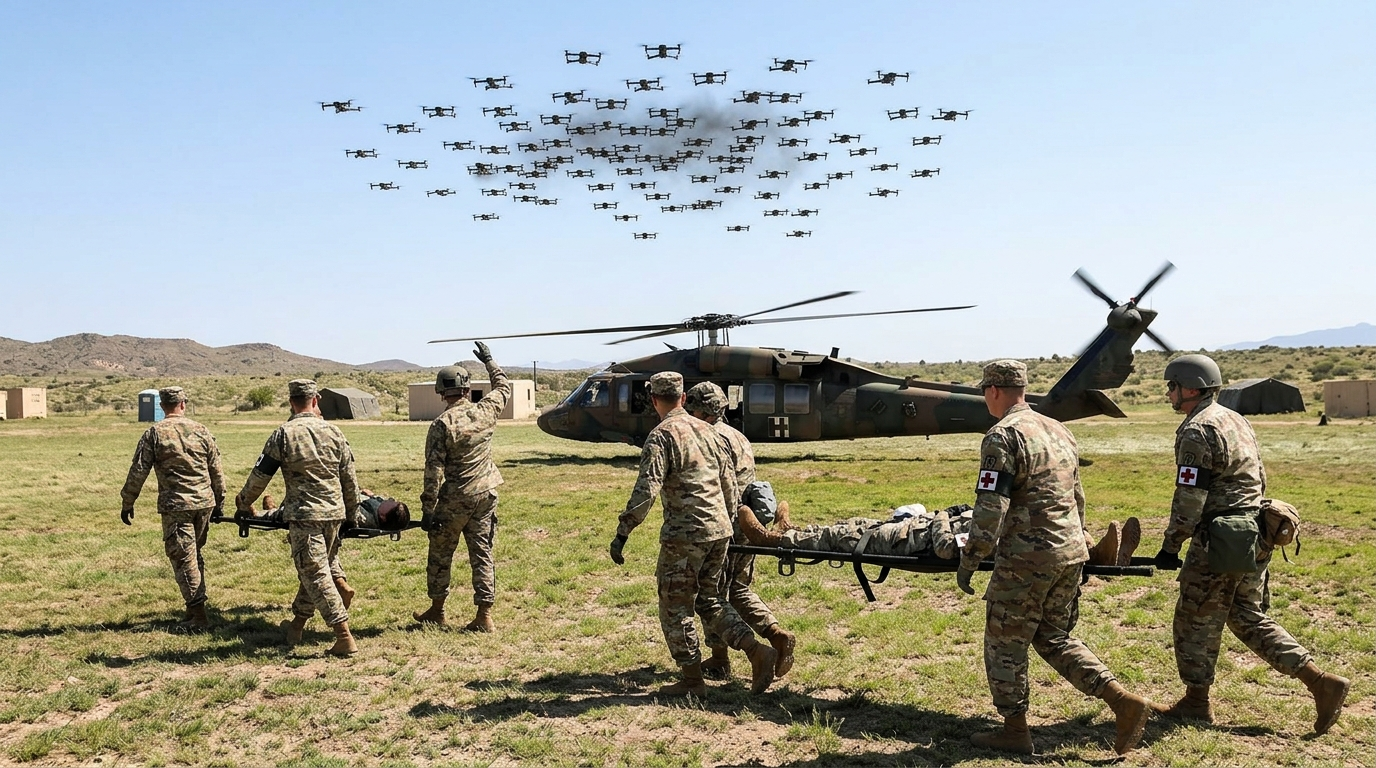
U.S. National Guard units are using advice from Ukrainian doctors to prepare for patient evacuations under drone-swarm attacks, signaling a shift in combat medical care.
The training draws on Ukraine’s direct experience treating and moving casualties while hostile drones watch roads, track vehicles, and threaten medical teams. It reflects an urgent concern for U.S. forces: evacuation methods built for earlier wars may not work under constant aerial surveillance.
Ukraine’s Experience Shapes U.S. Training
Ukrainian doctors have worked in a conflict where small drones can locate troops and guide attacks. Some aircraft also carry explosives or strike targets directly.
Their advice gives National Guard personnel access to recent battlefield lessons. Those lessons can help units assess how quickly to move patients, where to gather them, and how to limit exposure during transport.
The exchange also shows how military knowledge now moves from a partner at war to American units preparing for future conflicts. Ukraine is providing practical medical insight shaped by repeated attacks, limited movement, and pressure on evacuation routes.
No individual doctors or Guard units were identified. Details about the training location, date, and specific procedures also were not provided.
Traditional Evacuation Faces New Risks
Combat medicine often depends on moving an injured person through several stages of care. A casualty may first receive aid near the point of injury, then travel to a facility with more staff and equipment.
That system depends on transportation and time. Drone swarms can disrupt both.



- Drones may detect ambulances, aircraft, or troop movements.
- Repeated surveillance can expose evacuation routes and treatment sites.
- Medical crews may need to delay movement or change routes quickly.
- Patients could remain near the fighting longer than expected.
These risks place greater demands on medics close to the front. Teams may need enough supplies and training to stabilize patients for longer periods. Commanders may also have to balance medical urgency against the danger of exposing more people during a rescue.
A Wider Change in Combat Medicine
The training points to a broader move away from assumptions formed during U.S. operations in Iraq and Afghanistan. In those campaigns, American forces often had strong control of the air and could use helicopters for rapid evacuation.
A war involving dense air defenses and large numbers of inexpensive drones would create different conditions. Aircraft could face greater danger, while ground vehicles might be observed throughout their journey.
Medical planning must therefore account for prolonged casualty care, concealed movement, dispersed treatment sites, and disrupted communications. It may also require closer coordination among medics, drone operators, electronic warfare teams, and commanders.
Drone threats do not make rapid evacuation obsolete. Fast transport can still save lives. However, speed alone may not protect a patient or crew when an adversary can watch likely routes and send several aircraft at once.
Lessons With Limits
Ukraine offers current battlefield experience, but its methods may not transfer directly to every U.S. mission. Terrain, equipment, air support, medical staffing, and enemy capabilities can differ sharply between conflicts.
National Guard units also serve both overseas and at home. Training for attacks under battlefield surveillance is distinct from civilian disaster response, though both require flexible transport plans and care under strained conditions.
The central lesson is that casualty evacuation can no longer be treated as a protected step after combat. Under persistent drone observation, it may remain part of the fight.
Future exercises will show how deeply these lessons affect U.S. doctrine, equipment, and medical staffing. The key test will be whether units can keep patients alive while reducing the exposure of rescuers, vehicles, and treatment sites.