



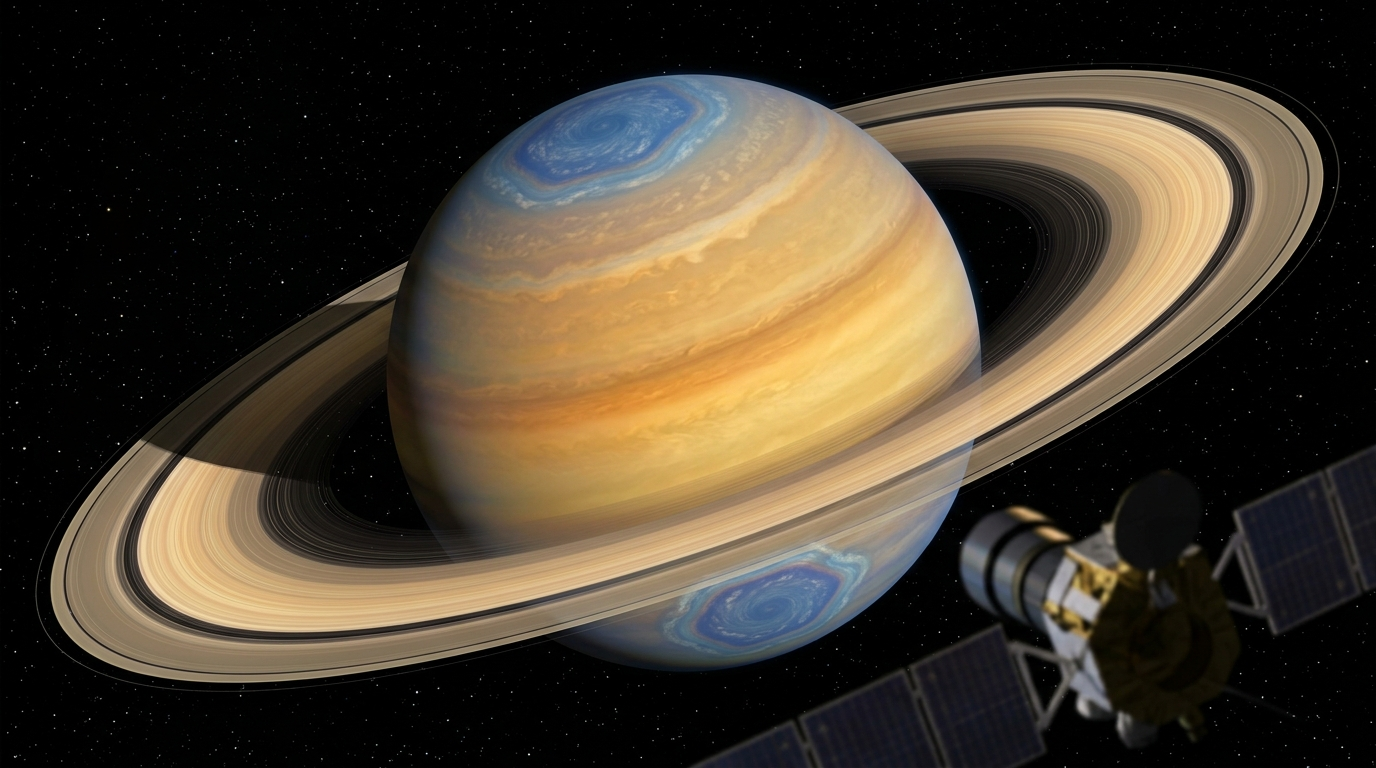
A hexagon-shaped atmospheric wave has been identified at Saturn’s other pole, giving astronomers a new counterpart to the planet’s famous northern formation. The finding could help researchers test how winds, storms, and seasonal changes shape the gas giant’s atmosphere.
Saturn’s northern hexagon appears as a dark, six-sided pattern over the north pole. Researchers have now found a similarly shaped wave at the opposite pole. The discovery suggests that related atmospheric forces may operate in both polar regions.
A Familiar Shape in a New Place
The northern hexagon has long stood out among Saturn’s weather systems. Unlike a typical circular storm, its outer boundary forms six sides while powerful winds move through the polar atmosphere.
The newly reported feature does not mean Saturn has two identical hexagons. Describing it as a similarly shaped atmospheric wave leaves key questions open, including its size, strength, altitude, and stability.
Astronomers will also need to determine whether the southern pattern lasts for years or appears only under certain conditions. That distinction could reveal whether the wave is a permanent structure or a seasonal event.
Why Saturn Produces Geometric Weather
Saturn is made mostly of gas and lacks a solid surface like Earth’s. Its visible weather unfolds within thick cloud layers driven by rapid rotation, heat, and strong bands of wind.
Scientists generally study the northern hexagon as an atmospheric wave linked to differences in wind speed. Under some conditions, flowing fluids can form stable geometric patterns rather than smooth circles.
Several factors could influence the shape at either pole:


- The speed and direction of high-latitude winds
- Temperature differences between neighboring air masses
- Saturn’s rotation and changing seasons
- Storm activity at different depths in the atmosphere
A second polar example gives researchers a valuable comparison. If both formations behave in similar ways, a shared physical process may explain them. If their behavior differs, local temperatures or wind structures may play a larger role.
A Test for Atmospheric Models
The finding offers a new way to assess computer models of planetary weather. A model that explains only the northern structure may not fully describe Saturn’s polar circulation.
Researchers can compare the two shapes over time, tracking their edges, movement, color, and surrounding clouds. Such observations may show whether the southern wave changes with sunlight as Saturn travels around the Sun.
Caution remains important. Similar outlines do not prove that both waves formed through the same process. Images can also reveal cloud-top patterns without showing the deeper winds that support them.
Clues for Weather Across the Solar System
Saturn’s polar waves may also inform research on other planets. Giant planets host strong jet streams and long-lived storms, making them natural laboratories for fluid motion under conditions unavailable on Earth.
The new southern feature strengthens the case for sustained monitoring of Saturn’s poles. Future observations could establish whether the shape persists, drifts, or fades as seasons change.
For now, the discovery turns Saturn’s best-known geometric storm into part of a larger polar puzzle. The next task is to learn whether the two hexagons share an origin or merely share a shape.