




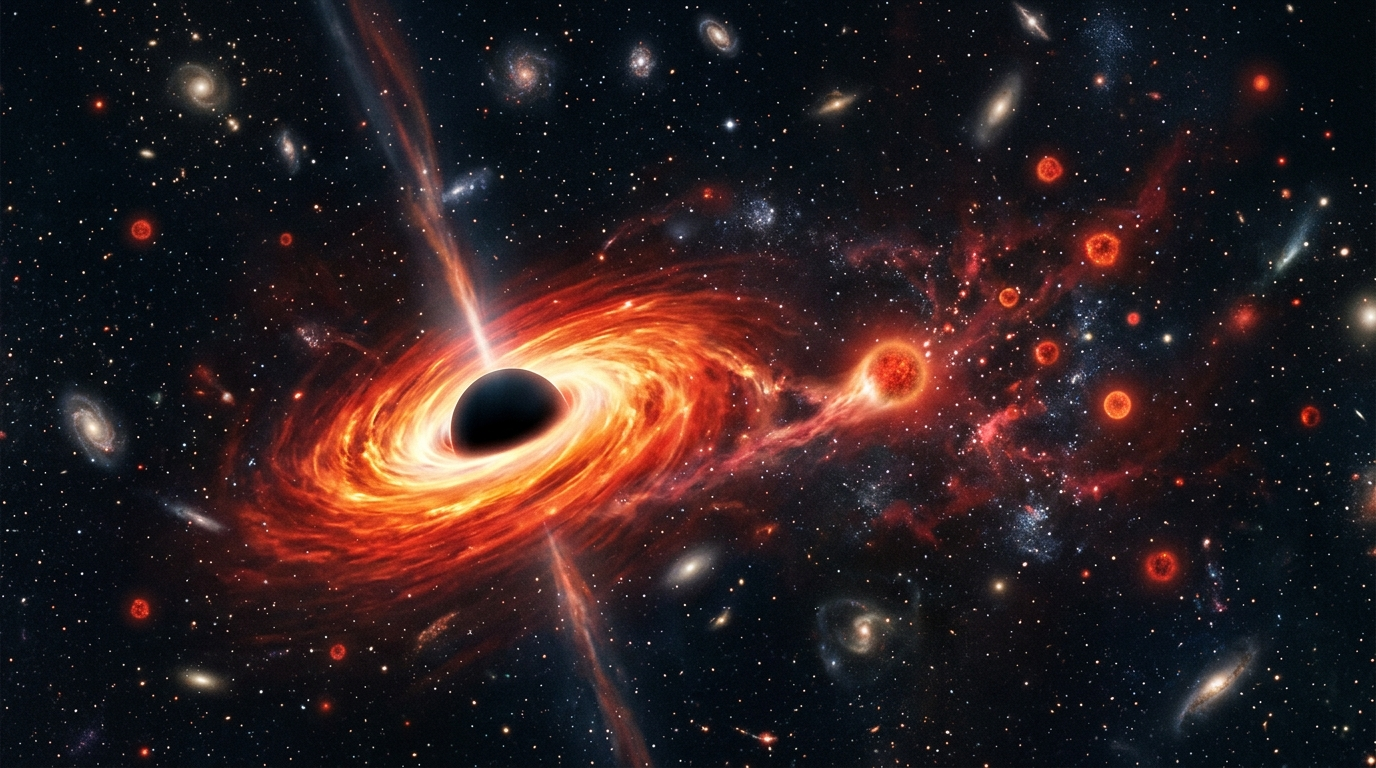
A new simulation suggests that mysterious objects called “little red dots” may represent a stage in the growth of black holes. The finding offers a possible explanation for compact, reddish sources seen in deep-space images of the early universe.
The objects have drawn attention because they appear small and bright, yet their true nature remains uncertain. Researchers have considered several explanations, including dense groups of young stars and rapidly feeding black holes.
A Clue From the Early Universe
Little red dots are unusually compact sources identified in images of distant space. Their red appearance can reflect their great distance, dust surrounding them, or the physical processes producing their light.
Because light takes time to travel, astronomers see distant objects as they existed billions of years ago. These observations provide a record of an early period when galaxies and their central black holes were still developing.
The new simulation places the dots within that growth process. Rather than treating them as a separate class of object, it suggests they might be a temporary phase in black hole evolution.
The simulation indicates that little red dots “might be one stage in the evolution of black holes.”
If that interpretation is correct, the objects could show black holes during a compact and active period. Matter falling toward a black hole heats up and releases intense radiation. Dust and gas can alter that light, making the source appear red.
Why Their Identity Remains Unclear
An image alone cannot confirm what powers a distant source. A dense stellar population may resemble an active black hole when both are viewed across immense distances.
Astronomers must separate several possible causes:


- Light from stars packed into a small region
- Radiation produced as a black hole consumes matter
- Dust that absorbs and reddens shorter wavelengths
- Effects caused by the expansion of the universe
These explanations are not always exclusive. A young galaxy can contain both vigorous star formation and a growing central black hole. Dust may hide much of that activity from direct view.
Simulations help researchers test whether known physical processes can create objects resembling those in telescope images. However, a model is not direct proof. Its result depends on assumptions about gas, dust, stars, radiation, and black hole feeding.
Testing the Black Hole Connection
Further observations will be needed to determine whether little red dots share a common origin. Spectroscopy, which separates light into different wavelengths, can reveal chemical signatures and the motion of gas.
Broad or highly shifted spectral features may point to gas moving rapidly near a black hole. Other patterns may show that young stars produce most of the light. X-ray or infrared observations could supply added evidence, although dust can make detection difficult.
Researchers will also need to compare the number of observed dots with the number predicted by simulations. Their ages, brightness, sizes, and distribution across cosmic time can test the proposed evolutionary link.
Implications for Black Hole Growth
The interpretation could help address a major question in astronomy: how some black holes grew so large relatively early in cosmic history. A visible intermediate stage would give scientists another way to track that process.
It could also change estimates of activity inside young galaxies. If many little red dots contain feeding black holes, early black hole growth may have been more common than surveys previously indicated.
For now, the simulation provides a testable explanation rather than a final identification. The next step is to match its predictions against detailed observations. Those comparisons may show whether little red dots are young galaxies, hidden black holes, or systems where both are growing together.