



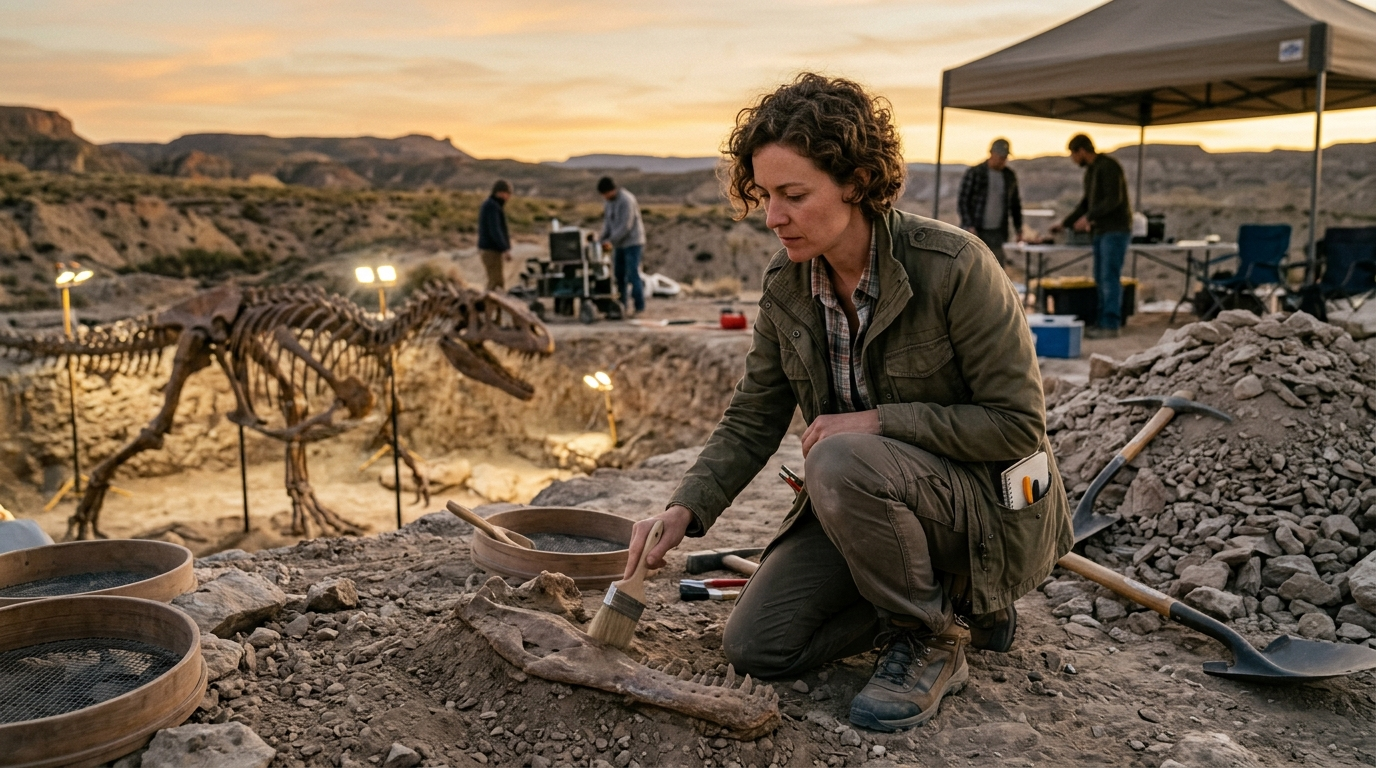
Paleontologist Riley Black’s latest book revisits a misunderstood prehistoric carnivore, shifting attention from its fearsome reputation to the harder question of how it lived.
The book uses paleontology to examine the animal’s likely behavior, daily challenges, and place within its ecosystem. Rather than treating a predator as a simple killing machine, Black considers the evidence needed to rebuild a life lost to deep time.
Looking Past the Predator Image
Prehistoric carnivores are often presented through teeth, claws, and dramatic hunting scenes. Those features help identify how an animal fed, but they reveal only part of its story.
Black’s focus on how the carnivore “might have lived” reflects the limits of fossil evidence. Bones can preserve signs of age, injury, growth, and disease. Tracks may record movement or group behavior. The surrounding rock can offer clues about climate and habitat.
Yet such evidence rarely provides a complete answer. Researchers must compare fossils, living animals, and ancient environments. Their conclusions may change when new remains are found or older specimens are studied again.
That uncertainty is central to responsible paleontology. The phrase might have lived separates evidence-based interpretation from claims that fossils cannot support.
Why Carnivores Are Often Misunderstood
Popular culture tends to cast large predators as prehistoric villains. Films, museum displays, and artwork often stress conflict because it creates an immediate and memorable scene.
Real predators must do much more than attack prey. They conserve energy, avoid injury, find water, respond to rivals, and survive environmental change. They may also scavenge when the opportunity arises.



A fuller study of an extinct carnivore may ask several questions:
- What prey shared its habitat?
- How did its body change as it aged?
- Could it recover from serious injuries?
- Did it hunt alone or interact with others?
Each question moves the animal away from a monster image and closer to an organism shaped by hunger, competition, and risk.
Reconstructing Behavior From Fossils
Behavior is among the hardest parts of extinct life to study. A skeleton can show what movements were possible, but possibility does not prove a regular habit.
For example, sharp teeth establish a meat-based diet. They do not show every feeding strategy. Powerful limbs may suggest speed or force, yet their use depends on body mass, terrain, and prey.
This is why books about prehistoric life often combine firm findings with informed interpretation. The distinction matters because readers may otherwise mistake an illustration or vivid scene for direct proof.
A Wider Story About Science
Black’s latest work also points to a broader change in how extinct predators are discussed. Modern accounts increasingly present them as animals within food webs, not isolated attractions.
That approach can deepen public understanding of extinction and ecology. Predators depend on healthy prey populations and suitable habitats. Changes at one level of an ecosystem can affect many species, including those at the top.
By reexamining a misunderstood carnivore, Black invites readers to question familiar images and weigh evidence more carefully. The book’s central value may lie in that shift. It asks not only what the animal could do, but how it survived from one day to the next.
Future fossil discoveries may revise parts of that picture. For now, the work offers a measured lesson: extinct predators were neither movie monsters nor simple biological machines. They were living animals, and their stories remain open to careful revision.