



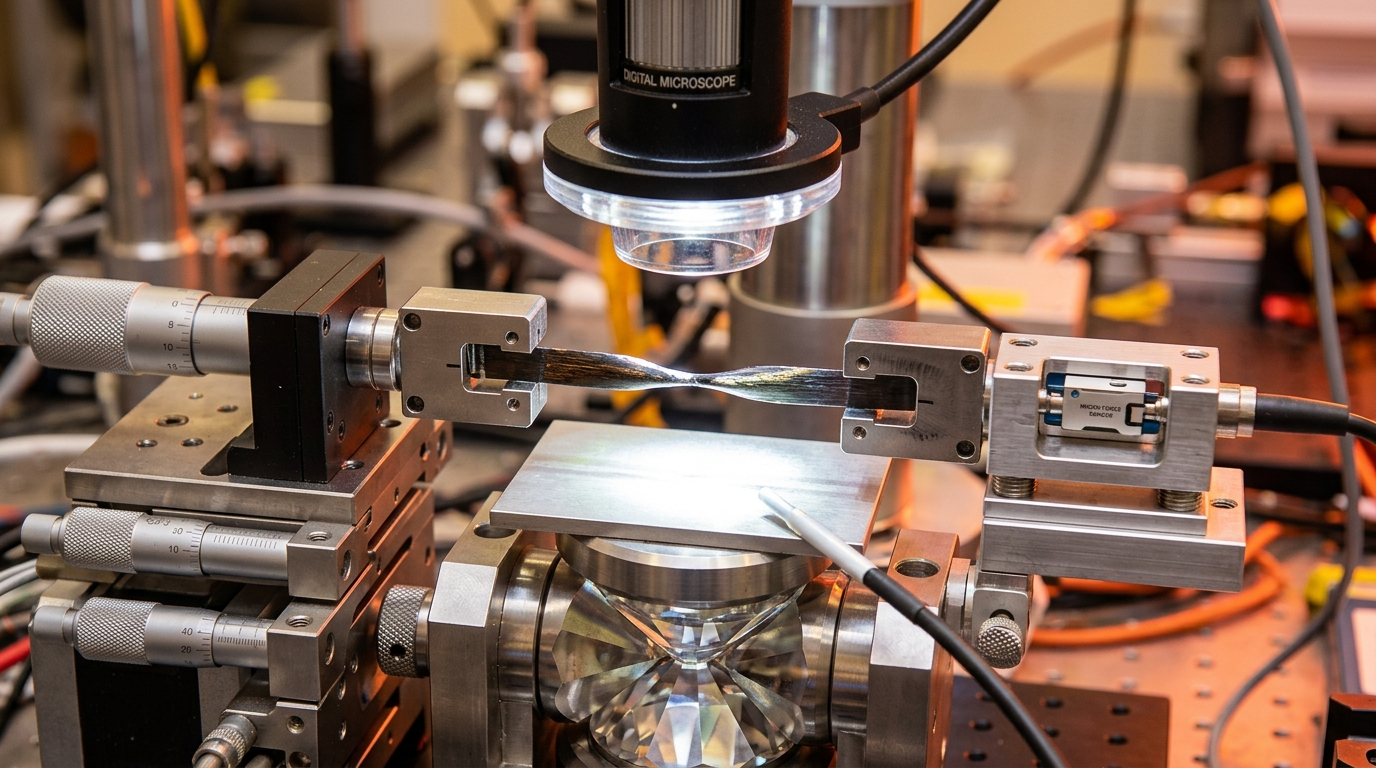
A boron phase created under pressure can be stretched, according to a report in Nature. The finding points to an unusual mechanical property in a material produced under extreme conditions.
The result matters because stretching tests reveal how a material responds to tension. Such behavior can shape whether a material is useful in devices, coatings, or research under mechanical stress.
Pressure Produces a Different Boron Phase
A phase is a specific structural form of a material. The same element can form several phases because its atoms may arrange themselves in different ways.
Pressure can force atoms into configurations that do not form under ordinary conditions. Those arrangements may give a material different electrical, thermal, or mechanical properties.
In this case, the reported boron phase was prepared under pressure. It was then found to tolerate stretching, although the available report does not state how much strain it endured.
The finding links two important steps. Researchers first created the phase under pressure, then examined its response to tensile force. That sequence helps connect atomic structure with visible material behavior.
Why Stretching Behavior Matters
Boron is often associated with hard materials and strong chemical bonds. Yet hardness alone does not show how a sample will behave when it is pulled.
A hard material may still fracture with little warning. A stretchable phase, by contrast, may absorb more deformation before failing. The terms are not interchangeable, and detailed measurements are needed to define the reported behavior.



Key questions for assessing the result include:
- How much strain the boron phase can withstand
- Whether it returns to its original shape
- Whether stretching causes permanent structural changes
- Whether the phase remains stable after pressure is removed
- Whether researchers can produce samples at larger scales
Answers would show whether the effect is mainly of scientific interest or could support practical material design.
Limits and Possible Uses
High-pressure preparation can restrict production. Specialized equipment may be required, and phases formed under pressure do not always remain stable under ordinary conditions.
Sample size also matters. A microscopic specimen may display properties that are difficult to preserve in a larger piece. Defects, grain boundaries, and manufacturing stresses can change mechanical performance.
Still, the reported stretchability gives researchers a new target for study. It may help test models of bonding in boron and explain how pressure changes the element’s mechanical response.
Potential applications cannot be judged from the brief finding alone. Any use would depend on stability, repeatability, production cost, and performance against existing materials.
What Researchers Will Need to Confirm
Future work will need to measure tensile strength, strain limits, fracture behavior, and structural changes during stretching. Independent reproduction would also help establish how consistent the property is.
The central result remains clear: a boron phase prepared under pressure can be stretched. The next stage is to determine why, by how much, and under which conditions the behavior persists. Those answers will decide whether the discovery stays a laboratory insight or develops into a useful material strategy.