



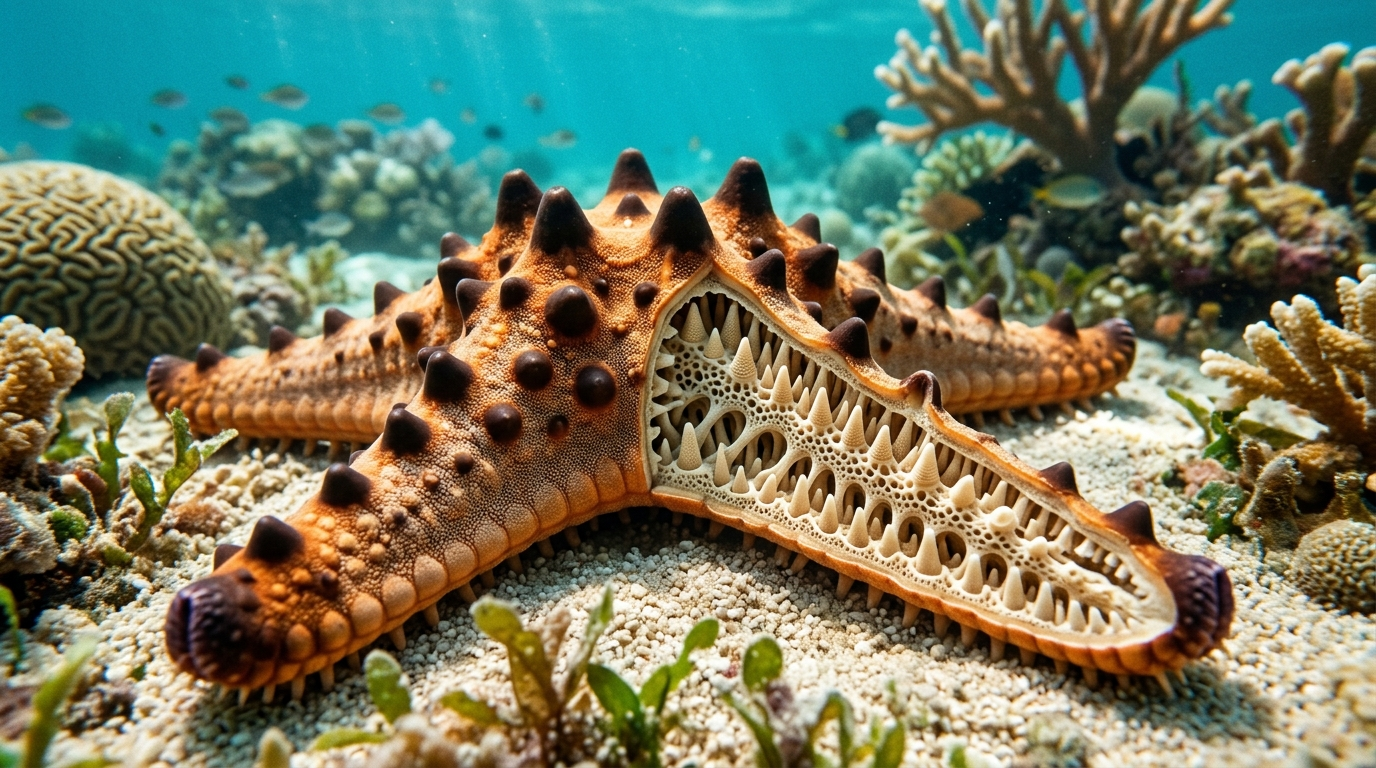
Tiny cone-shaped structures inside the arms of chocolate-chip sea stars can triple the strength of their skeletons, revealing an efficient form of natural reinforcement.
The finding links the animals’ internal shape to their ability to resist force. It also suggests that small structural details can have a major effect on skeletal performance.
Small Structures Deliver Large Gains
Chocolate-chip sea stars are named for the dark, raised features across their bodies. Inside their arms, much smaller cone-shaped structures help support the skeleton.
The key result is striking: these cones increase skeletal strength by about three times. That gain shows how geometry can matter as much as the material itself.
“The tiny cone-shaped structures in arms of chocolate-chip sea stars also triple their skeleton’s strength.”
The finding indicates that the cones distribute or resist mechanical forces within the arms. However, the available report does not identify the exact loading conditions, measurement methods, or number of animals studied.
Those details would help establish how the threefold increase was calculated. They would also show whether the effect remains consistent across sea stars of different sizes and ages.
How Sea Star Skeletons Work
Sea stars are echinoderms, a group of marine animals that includes sea urchins and sand dollars. Their skeletons are made from many hard pieces beneath the skin.
This arrangement differs from a single rigid shell. It allows an animal to combine support with movement as its arms bend, grip surfaces, and respond to waves.



That balance creates a structural challenge. The arms must stay flexible enough for movement while resisting damage from predators, impacts, and environmental forces.
The cone-shaped features appear to offer an answer. Rather than relying only on thicker skeletal material, the sea star gains strength through internal design.
Possible Lessons for Engineered Materials
Natural structures often guide research into lighter and stronger materials. A threefold increase linked to tiny cones could interest engineers working on protective equipment, buildings, vehicles, or medical implants.
The most useful lesson may be efficiency. If shape improves strength without adding much material, designers could reduce weight while preserving resistance to stress.
- Small geometric changes may produce large strength gains.
- Distributed supports can protect flexible structures.
- Natural designs may inform lighter manufactured materials.
Still, a biological structure cannot be copied directly into every product. Sea star skeletons operate underwater and grow through biological processes. Manufactured materials face different forces, costs, and safety rules.
Questions for Further Study
Future research could test how the cones respond to compression, bending, twisting, and repeated loading. Imaging may also clarify how their size and spacing affect performance.
Comparisons with other sea star species could show whether this design is common or tied to the chocolate-chip sea star’s habitat and behavior. Such work may explain how skeletal forms changed over time.
For now, the result offers a clear takeaway: structure can sharply increase strength without requiring a solid, heavy skeleton. The next step is to determine how widely that principle applies, both among marine animals and in human-made designs.