



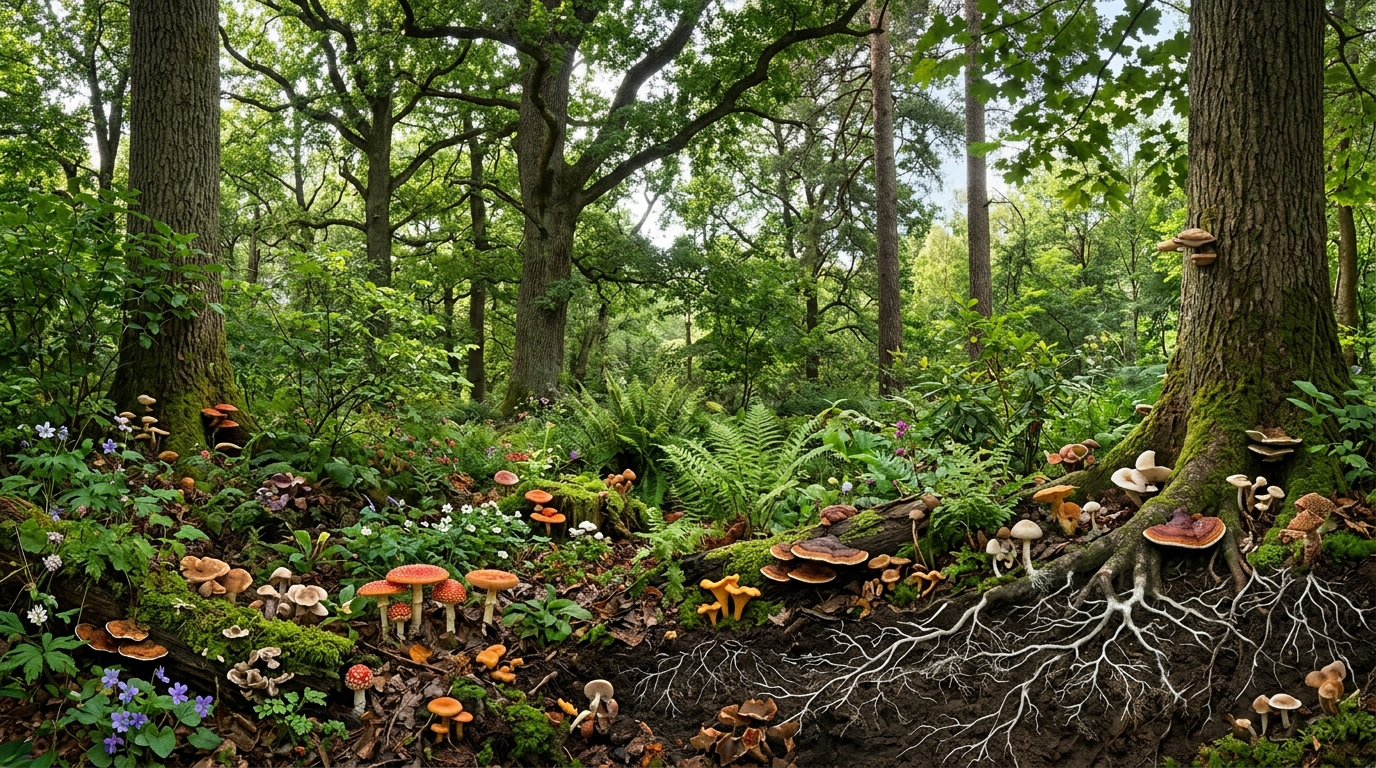
Canopy trees may govern plant diversity far below their branches through partnerships with fungi, highlighting a hidden link within temperate forests.
The finding connects tree species, underground fungal networks, and the mix of herbs growing on the forest floor. It suggests that canopy composition can influence understory plants through more than shade, rainfall, and fallen leaves.
“In temperate forests, canopy trees shape understory herb diversity through the fungal partnerships they make.”
This relationship matters because understory herbs support insects, protect soil, and contribute to nutrient cycling. They also account for much of the plant variety found beneath mature trees.
Fungal Partners Connect Forest Layers
Many trees form close relationships with fungi around or within their roots. These partnerships are commonly known as mycorrhizal associations.
The fungi receive sugars produced by trees through photosynthesis. In return, they help roots gain water and nutrients from the soil.
Understory herbs can form fungal partnerships of their own. Their success may depend on whether local soil conditions and fungal communities suit their needs.
As a result, canopy trees could affect herbs by favoring certain fungi. Those fungi may help some understory species while offering fewer benefits to others.
The proposed pathway can be summarized in three stages:



- Canopy trees associate with particular groups of soil fungi.
- Those fungi alter nutrient access and conditions around plant roots.
- Understory herbs respond differently, changing local plant diversity.
More Than a Question of Shade
Forest ecologists have long recognized the canopy’s physical influence. Large trees control how much sunlight reaches the ground. They also intercept rain and produce leaf litter.
The fungal connection adds a biological route. Two forest sites with similar light levels could support different herbs if their canopy trees host different fungal communities.
However, fungal partnerships are unlikely to act alone. Soil acidity, moisture, browsing animals, tree age, and past land use can also shape understory vegetation.
That makes cause and effect difficult to separate. A tree species may influence fungi, but both may also respond to the same soil conditions. Long-term field studies would help clarify which relationship comes first.
Implications for Forest Management
The finding could affect how foresters approach conservation and restoration. Decisions about canopy trees may create lasting effects below ground and across the forest floor.
Removing one tree species could reduce its fungal partners. Planting another could shift soil communities, changing which herbs establish or persist.
This means tree diversity alone may not provide a full measure of forest health. Managers may also need to track understory plants and fungal associations.
Such monitoring could be useful after logging, storms, wildfire, disease outbreaks, or replanting. Each event can change canopy composition and disturb fungal communities.
Climate Change Adds Pressure
Temperate forests face warmer temperatures, altered rainfall, invasive species, and expanding tree diseases. These pressures may move some tree species while reducing others.
If canopy trees and fungi shift together, understory herbs could face indirect effects. A plant might remain within a suitable climate but lose fungal conditions that support its growth.
The central lesson is that forests function through connected layers. Protecting canopy trees without considering fungi and ground plants may miss key drivers of diversity. Future research must test how durable these links are across soils, tree species, and changing climates.