



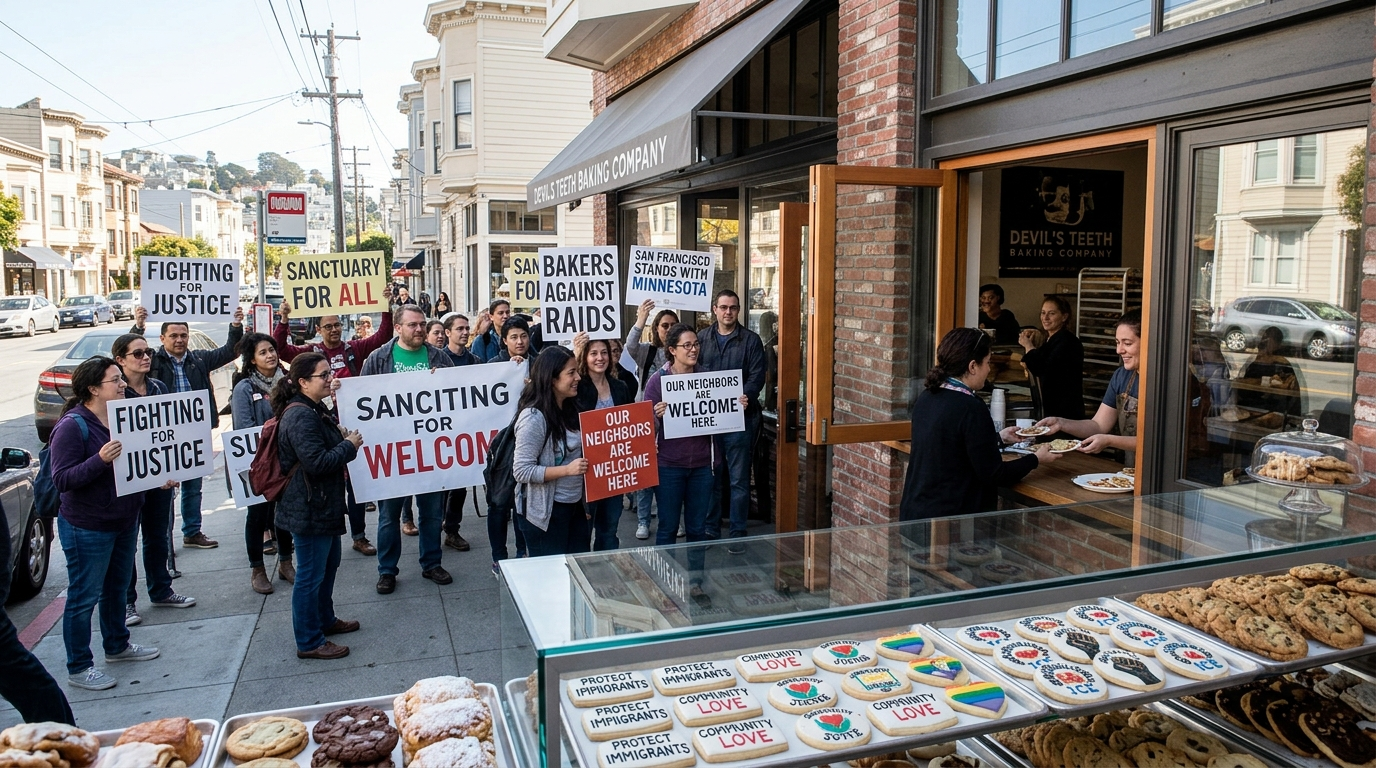
Devil’s Teeth Baking Company began selling cookies marked with an anti-ICE message at its three San Francisco locations this week, responding to recent events in Minnesota.
The cookies are iced with the phrase “F— ICE,” turning a familiar bakery item into a blunt political statement. Video of the products was credited to television station KTVU.
The protest places the local business within a wider public debate over immigration enforcement. However, the bakery did not provide further details about the Minnesota events that prompted its response.
A Protest Displayed on Food
Businesses often express political views through signs, donations, or public statements. Devil’s Teeth Baking Company chose a product sold directly to customers.
The message refers to U.S. Immigration and Customs Enforcement, commonly known as ICE. The federal agency enforces immigration laws and investigates certain cross-border crimes.
“F— ICE”
The short phrase leaves little doubt about the bakery’s position. Its placement on cookies also gives the protest a visual form that customers can buy, photograph, and share.
The available information does not identify the cookies’ price, sales volume, or how long they will remain available. It also does not include comments from customers, employees, ICE officials, or people affected by the Minnesota events.
Local Businesses Enter Political Debates
San Francisco businesses have often operated in a city where immigration policy draws strong public attention. A company that takes a public stand may strengthen ties with customers who share its views.



Such action can also carry commercial risks. Some customers may object to the political message or its profanity, while others may see the cookies as a form of community advocacy.
The bakery’s decision raises several practical questions:
- Whether proceeds support an immigration-related group
- How customers at the three locations have responded
- Whether the cookies are a brief protest or a longer campaign
- Which specific events in Minnesota shaped the decision
Without answers to those questions, the clearest fact is the public nature of the gesture. The bakery has attached its name, retail space, and products to a direct criticism of federal immigration enforcement.
Context Remains Limited
The reference to Minnesota provides the stated reason for the campaign, but no specific incident was identified. That limits any firm assessment of what policy, enforcement action, or public controversy the company intended to address.
The lack of detail also makes careful wording important. Connecting the cookies to an unconfirmed event could misstate the bakery’s motive or the circumstances in Minnesota.
For now, the protest shows how quickly local companies can respond to national or out-of-state news. A small retail product can become a political message, especially when images travel through television and social media.
Further reporting will be needed to establish the bakery’s plans, customer reaction, and the precise Minnesota events behind the campaign. Those details will determine whether the cookies remain a short-lived statement or develop into a broader public action.