



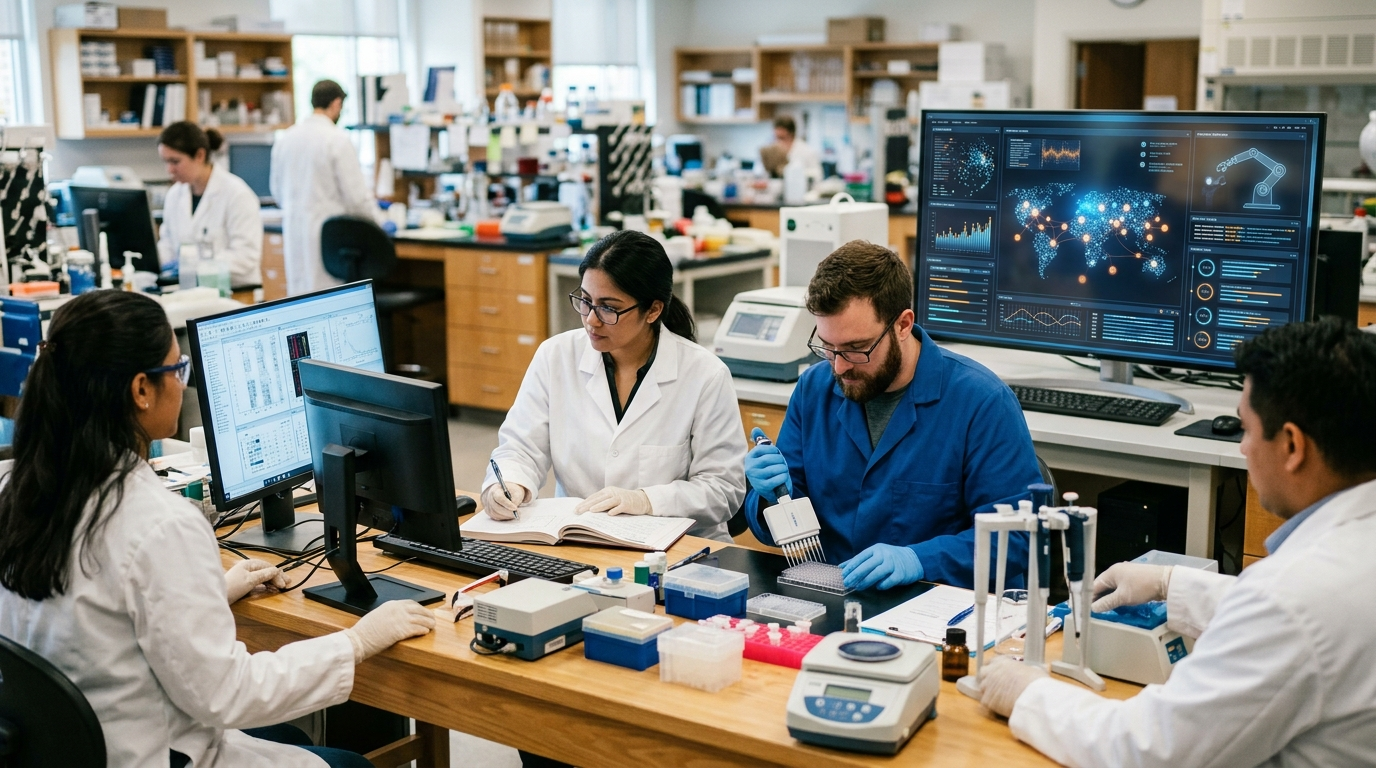
An artificial intelligence model is tracking researchers’ actions to learn how they produce successful results, including habits the researchers may not recognize themselves.
The effort focuses on a basic problem in science: skilled researchers often rely on experience, judgment, and repeated adjustments. They may reach the right outcome without being able to explain every step. By watching each move, the model seeks to identify patterns linked to success.
The approach could help laboratories document hidden parts of research work. It also raises questions about privacy, oversight, and whether observed behavior can explain why an experiment succeeds.
Studying the Process, Not Just Results
Scientific reports usually describe methods, evidence, and conclusions. Yet published accounts may leave out small decisions made during the work.
A researcher might change the order of tasks, inspect one result more closely, or repeat a step after noticing an unusual sign. Such choices can matter, even if they never appear in a final paper.
“Even the most adept researchers may not know exactly what they do to get successful results.”
The AI model addresses that gap by observing behavior rather than reviewing only the final outcome. Its goal is to connect specific actions with successful results.
This method reflects a wider use of AI for pattern recognition. Instead of relying on a person’s memory, a model can compare many recorded steps. It may find repeated actions that people overlook.
Possible Gains for Scientific Work
If the model identifies reliable patterns, laboratories could use those findings to improve training. New researchers might learn practical methods that previously took years to develop.


The system could also support efforts to repeat experiments. Reproducibility remains a core measure of scientific reliability. When teams cannot reproduce a result, missing procedural details may be one cause.
Potential uses could include:
- Recording small decisions during experiments
- Identifying habits associated with accurate results
- Helping new staff learn laboratory procedures
- Comparing work across researchers or research teams
However, an observed pattern is not proof of cause. A successful researcher may perform a certain action often, but that action may have little effect on the outcome. Any lesson produced by the model would still require testing.
Privacy and Oversight Questions
Constant observation may create pressure for researchers. A system that watches “every move” could collect sensitive information about mistakes, unfinished ideas, or individual work styles.
Those records could become useful for training, but they might also influence performance reviews or workplace decisions. Clear limits would be needed on what is recorded, who can review it, and how long it is stored.
Researchers may also change their behavior when they know they are being monitored. That response could distort the data and make the model’s findings less reliable.
AI Still Needs Human Testing
The model’s output would not replace scientific judgment. Researchers would need to test whether its suggested practices work across different people, institutions, and experiments.
Human experts must also separate useful insight from coincidence. Models can detect relationships in recorded data, but they do not automatically explain the reason for those relationships.
The project points to a shift in how AI may assist science. Rather than only analyzing experimental data, AI could study the act of research itself. The next test will be whether those observations produce methods that other scientists can verify, repeat, and use without sacrificing trust or privacy.