





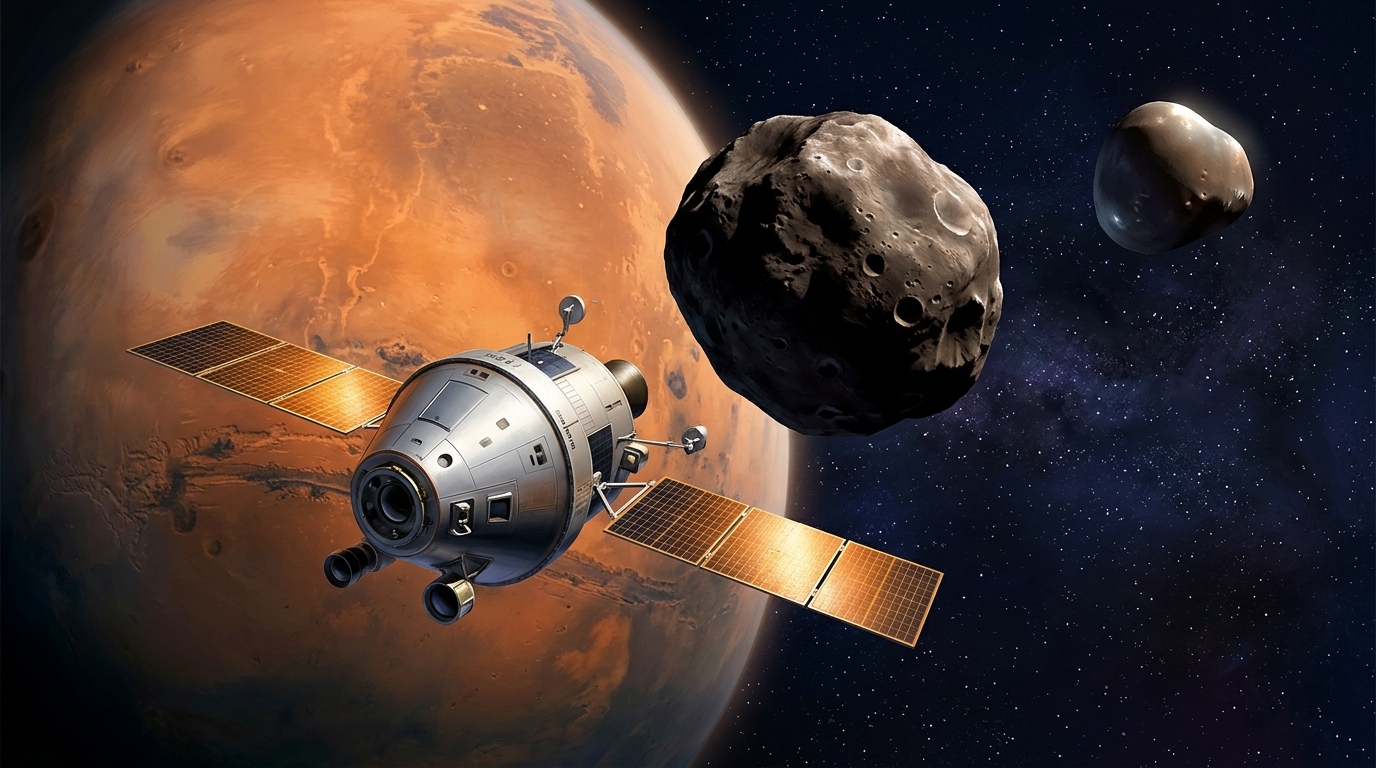
A newly launched spacecraft is seeking answers to one of Mars’ oldest mysteries: how its two small moons, Phobos and Deimos, were formed.
The moons may resemble “lumpy space potatoes,” but their unusual shapes hide a serious scientific puzzle. Researchers still do not know whether the objects formed near Mars or arrived from another part of the solar system.
Data from the mission could help scientists reconstruct the early history of Mars. It may also reveal how planets gain moons and how material moved through the young solar system.
Two Moons With Uncertain Origins
Phobos and Deimos are much smaller and less rounded than Earth’s moon. Their irregular forms have helped fuel questions about where they came from.
One possible explanation is that Mars captured passing objects. Their rough appearance is consistent with the look of some asteroids. However, appearance alone cannot establish their history.
Another explanation is that the moons formed near Mars. Material orbiting the planet could have gathered into small bodies. Such debris may have come from an ancient collision involving Mars or another object.
Each account would point to a different chapter in the planet’s development. A captured origin would show that Mars could pull small bodies into stable orbits. A local origin would connect the moons more directly to Martian material.
“No one knows how they formed, but a newly launched spacecraft should soon offer answers.”
Why Phobos and Deimos Matter
The origin question reaches farther than the moons themselves. Scientists use small bodies as records of conditions that existed early in the solar system.



If Phobos and Deimos came from asteroid-like objects, their material could preserve evidence from a region far from Mars. If they formed from debris around the planet, they could contain clues about the Martian crust and major impacts.
The spacecraft’s observations may help researchers compare several key traits:
- The moons’ surface features and physical structure
- The composition of their rocks and dust
- Evidence linking them to Mars or asteroid material
- Signs of collisions and other changes over time
These findings could help distinguish between competing ideas. Yet researchers may need several lines of evidence before reaching a firm conclusion.
A Mission With Wider Scientific Value
Mars has been studied by orbiters, landers and rovers, but its moons offer a different view of the planet’s past. Their small size and irregular shapes make them separate scientific targets, not mere companions to Mars.
Phobos and Deimos may also show how difficult it is to identify an object’s origin from images alone. Two bodies can look asteroid-like while having very different histories. Chemical and structural evidence can provide a stronger test.
The mission’s work may also shape future studies of small moons elsewhere. Similar objects orbit other planets, and their origins can reveal how planetary systems changed after formation.
For now, the central mystery remains open. The spacecraft must complete its journey and return useful measurements before either leading explanation gains stronger support.
If the mission succeeds, two modest moons could answer major questions about Mars. Scientists will be watching for evidence that shows whether Phobos and Deimos were captured travelers or products of the planet’s own violent past.