




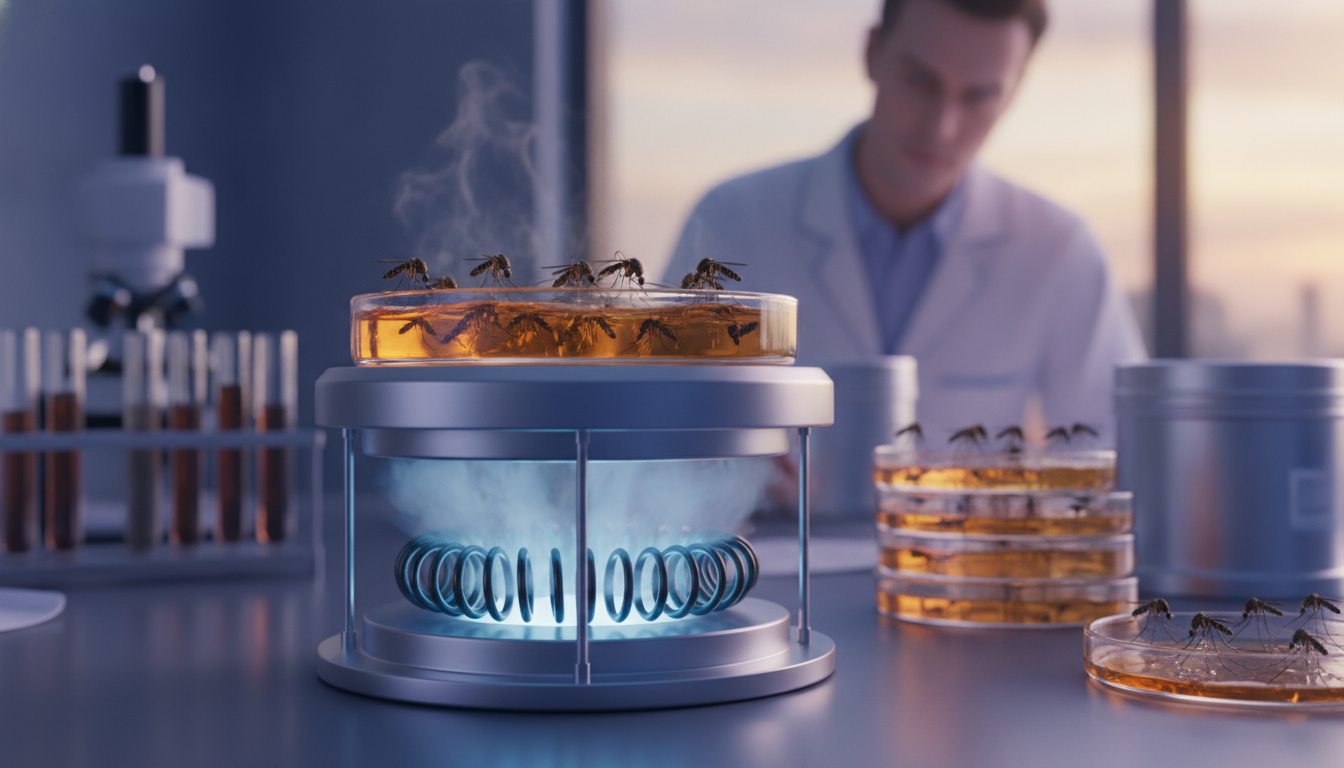
A new approach to cryostorage could reshape how scientists preserve and share mosquito strains used to fight malaria. Researchers say vitrification, a fast-freezing method that avoids ice crystals, can make storage simpler and more resilient. The advance comes as malaria programs seek steadier supplies of key Anopheles lines for testing, training, and field work.
Malaria remains a major threat in Africa, Asia, and parts of Latin America. Health agencies report hundreds of thousands of deaths each year, most of them children. Programs rely on known mosquito strains to screen insecticides, test traps, and support trials. Keeping those strains alive is hard, since most labs must maintain constant colonies that are vulnerable to power outages, disease, and staffing gaps.
What Vitrification Promises
Vitrification enables simpler, more resilient storage of key mosquito strains used in malarial vector control.
Vitrification cools cells so quickly that water solidifies into a glass-like state. That avoids the ice crystals that can rupture membranes. In practice, it can store embryos or early-stage tissues in small vials, held at very low temperatures for long periods.
Applied to malaria vectors, vitrification could reduce the need to keep live colonies running at all times. Labs could bank strains, ship them on dry ice, and revive them when needed. This would protect valuable lines during emergencies and help standardize research across regions.
Why Storage Matters Now
Global malaria control has stalled in recent years. The World Health Organization estimated about 249 million cases and roughly 608,000 deaths in 2022. Insecticide resistance is spreading in many countries. Accurate testing of new tools requires stable, well-characterized mosquito strains.
Today, many facilities maintain continuous colonies to supply eggs or adults for assays. These colonies can drift genetically, and they demand constant care. Outages, contamination, or air-conditioning failures can wipe out years of work. A reliable cryostorage method would reduce those risks and costs.
How It Could Change Field and Lab Work
Researchers see several practical gains if vitrification of Anopheles mosquitoes proves reliable at scale:
- Lower costs by pausing colonies between projects.
- Faster recovery after lab disruptions or natural disasters.
- Easier global sharing of standard strains for insecticide testing.
- Better control of genetic drift and contamination over time.
Public health agencies could set up reference biobanks, similar to seed or pathogen collections, to safeguard essential lines. Regional centers could revive and expand strains for national programs, improving supply during peak transmission seasons.



Methods, Limits, and Open Questions
Cryopreservation of insects is not new, but mosquitoes pose specific challenges. Embryos have tough shells and timing is critical. Protocols must balance cryoprotectant toxicity with survival. Success also depends on revival steps and the speed at which revived lines regain full fitness.
Specialists caution that not every strain will freeze and thaw equally well. Some lines may show reduced hatch rates or altered behavior after revival. Quality assurance will be needed to confirm susceptibility profiles and mating performance match pre-freeze records.
There are logistical questions too. Many labs lack liquid nitrogen storage or trained staff. Start-up costs can be high, even if long-term savings are likely. Standard operating procedures and training materials would help adoption.
What Comes Next
If labs can achieve consistent survival rates, vitrification could support broader strategies, including sterile insect technique trials and resistance monitoring. It would also make multi-site studies easier by aligning the mosquito stock used in different locations.
Experts suggest pilot projects to test viability across multiple Anopheles strains and to document costs, training time, and recovery performance. Data sharing on outcomes would speed refinement of methods and help set common benchmarks.
Malaria programs need dependable tools as resistance erodes old gains. Vitrification offers a path to safer, steadier storage of the mosquitoes that underpin much of this work. The next phase will hinge on published protocols, clear quality control, and investment in regional capacity. If those pieces come together, biobanked mosquito strains could become a quiet backbone of vector control, ready when countries need them most.