




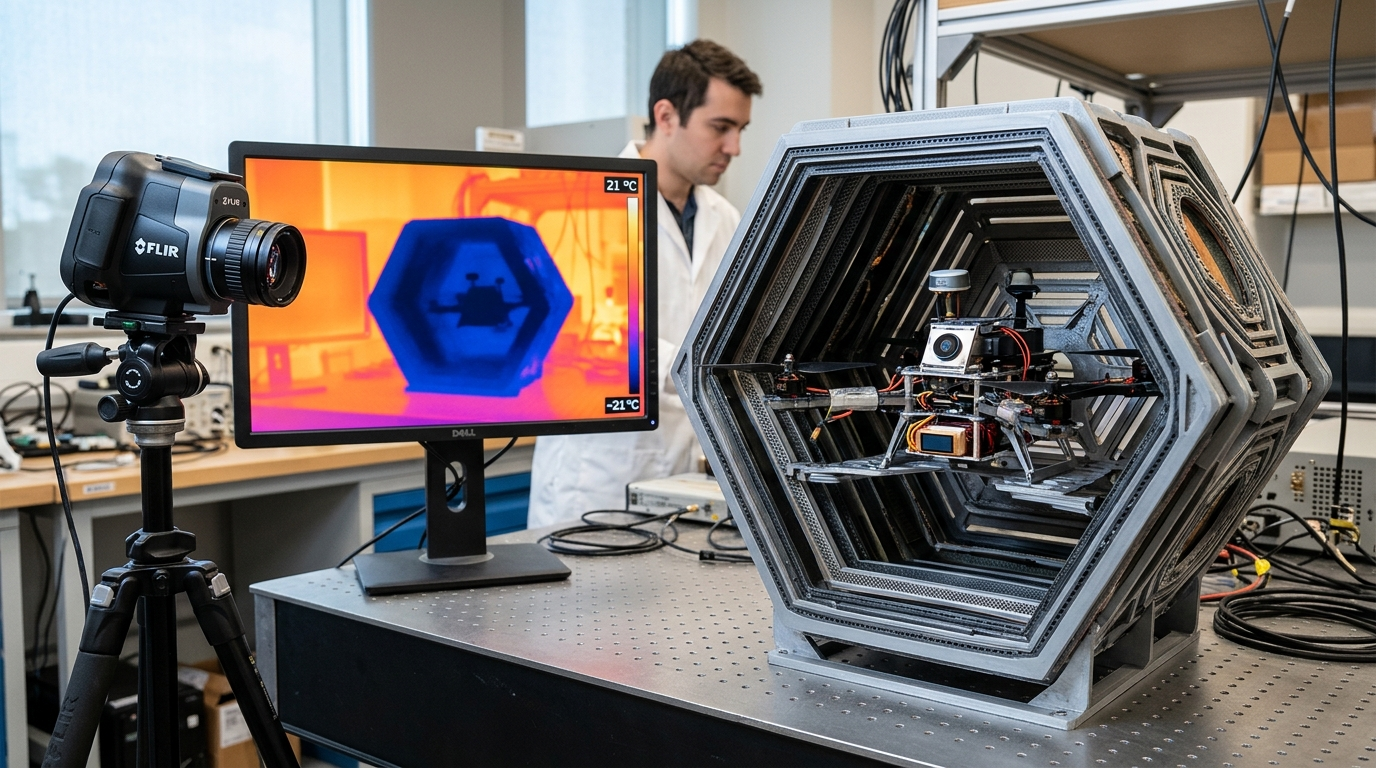
Researchers have built and tested a 3D cloak that hides complex objects from infrared cameras while shielding them from extreme temperatures.
The newly reported device redirects heat around an enclosed object. As a result, thermal cameras cannot easily detect the object from almost any viewing direction.
The work could support better electronics cooling, stronger thermal protection and new stealth systems. However, wider use will depend on how the cloak performs outside controlled tests.
Redirecting Heat Instead of Blocking It
Infrared cameras detect differences in surface temperature. Warmer and cooler areas form visible patterns that can reveal people, machines and other objects.
Traditional thermal barriers try to slow or block heat. The 3D cloak takes a different approach by guiding heat around the hidden object.
“Instead of blocking heat, the device guides it around an object, making the object appear invisible to thermal imaging from virtually any direction.”
This controlled flow helps the surrounding thermal pattern appear less disturbed. The camera therefore receives fewer clues that an object is present.
The ability to work from many angles is an important feature. A device effective from only one viewpoint would have limited value in moving or open settings.
Protection Across Temperature Extremes
The cloak does more than reduce infrared visibility. It also protects the enclosed object from severe heat and cold.


That dual role may be useful for sensitive equipment. Electronic parts can fail or lose performance when temperatures move outside safe limits.
A system that redirects heat could help manage hot spots while limiting exposure to harsh conditions. Possible uses identified by the researchers include:
- Cooling electronic devices and heat-sensitive parts
- Protecting equipment in very hot or cold settings
- Reducing the infrared signature of selected objects
These uses involve different design demands. Electronics cooling requires reliable heat movement over long periods. Protective systems must withstand repeated temperature changes. Stealth equipment may also need to remain light and durable.
A Step Past Flat Thermal Cloaks
Thermal cloaking has often focused on simplified shapes or limited viewing angles. Complex, three-dimensional objects are harder to conceal because heat can travel around them in many directions.
The successful construction and testing of a 3D device suggests that thermal control can work on more realistic forms. It also moves the idea from a theoretical model to a physical prototype.
Still, infrared concealment is not the same as invisibility to the human eye. The cloak addresses thermal imaging, not ordinary visible-light detection.
Its reported performance also does not establish how well it would work at large scale, while moving, or under changing weather conditions. Those questions will shape its practical value.
Promise and Limits for Stealth Systems
Military and security applications are an obvious concern because infrared sensors are widely used for surveillance and target detection. A cloak that reduces thermal contrast could make some objects harder to track.
Yet the same heat-control method may have broad civilian value. Data centers, industrial machinery and scientific instruments all face problems caused by excess heat or sudden temperature shifts.
Future testing will need to measure durability, production cost and performance across different object sizes. Researchers must also examine whether redirected heat creates detectable patterns elsewhere.
The prototype shows that a 3D structure can both manage thermal flow and conceal complex objects from infrared cameras. Its next test will be practical deployment, where changing temperatures, scale and viewing conditions may determine whether the concept becomes a useful technology.