




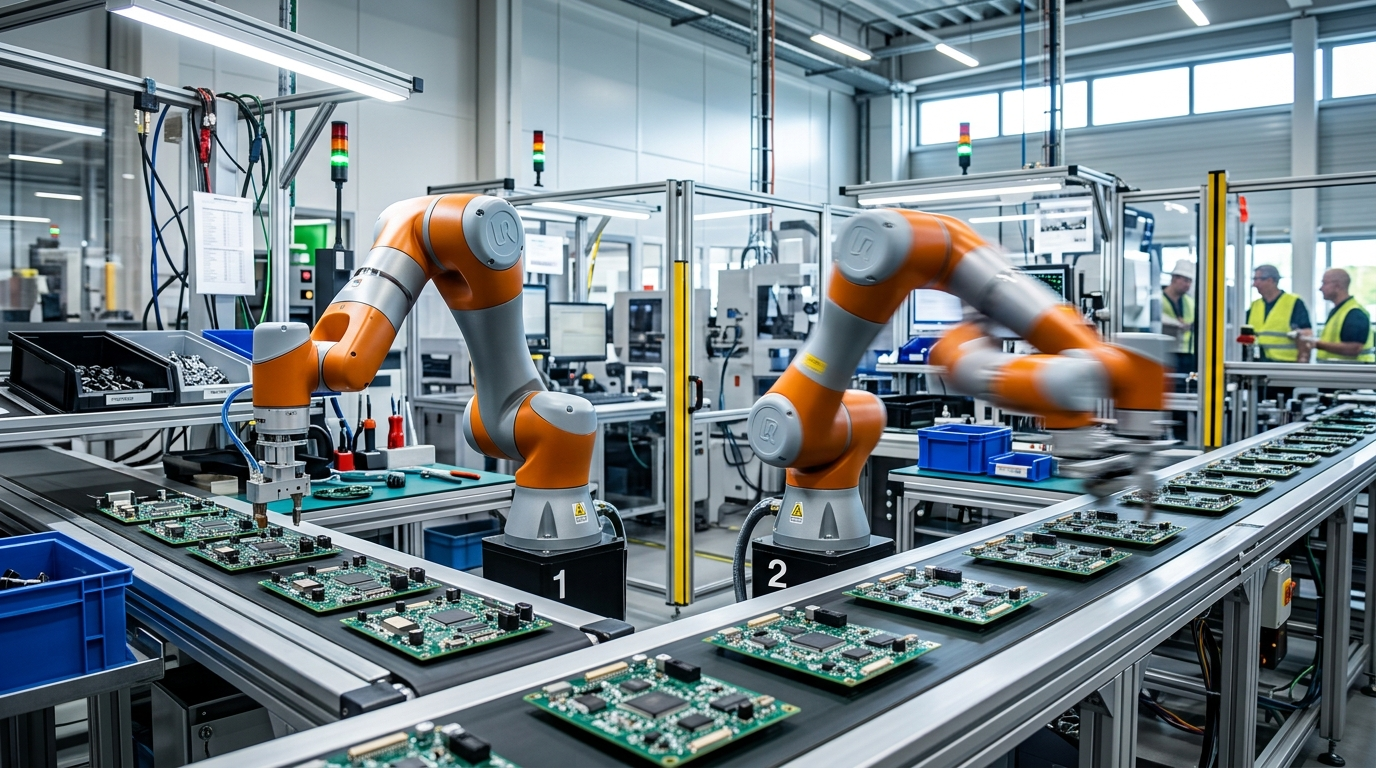
A new artificial intelligence system allows robots to plan while moving, cutting reaction delays and doubling task speeds without added computing overhead.
The system changes how robots decide what to do next during a task. Instead of completing one movement and pausing to plan another, a robot can prepare its next action before the current motion ends.
That approach could improve machines used in factories, warehouses, laboratories, and other settings where small delays add up. However, the available report does not identify the developers, testing site, robot models, or release date.
Planning Without the Pause
Many robotic tasks involve a repeated cycle. A machine observes its surroundings, calculates an action, moves, and then starts planning again. Even brief pauses between those stages can slow production.
The new system is designed to overlap planning and movement. Its central claim is simple:
“A new AI system lets robots plan their next move while they’re in motion.”
Removing reaction delays could be useful for jobs that involve many short, linked actions. Examples may include sorting products, moving parts, packing orders, or completing assembly steps.
The reported speed gain is large. Task speeds doubled during the cited work. Yet no benchmark details were provided, making it unclear whether the result applies broadly or only to selected tests.
No Extra Computing Overhead
The system also reportedly achieves its gains without extra computing overhead. That point may matter as much as the speed increase.



More complex robotic planning can demand faster processors, added memory, or remote computing services. Those upgrades can raise costs and energy use. They may also make deployment harder in older machines.
If the new method works on existing hardware, operators could gain faster performance without replacing computing equipment. The most important reported benefits are:
- Planning continues while the robot is moving.
- Reaction delays are removed or reduced.
- Task speeds increase by as much as two times.
- No added computing overhead is reported.
Still, computing overhead is only one measure of efficiency. Future tests would need to examine power use, reliability, safety, accuracy, and performance during unexpected events.
Safety and Real-World Limits
Faster movement does not always produce better results. Industrial robots must remain precise, especially near workers, fragile products, or changing obstacles.
Planning during motion could shorten idle time, but it may also require careful safeguards. A robot must be able to revise or stop an action when its environment changes. The report does not say how the system handles those cases.
Independent testing will also be needed to confirm the twofold speed increase. Results can vary by task complexity, robot design, workspace conditions, and the quality of sensor data.
What Comes Next
The next key step is disclosure of detailed test results. Researchers and operators will need comparisons with standard planning methods across several machines and job types.
They will also need evidence that faster planning does not reduce accuracy or increase collisions. Long-duration trials could show whether the gains persist under routine operating conditions.
The early claim points to a practical shift in robot control: treating planning and movement as overlapping activities rather than separate stages. If verified at scale, the method could increase output while limiting hardware costs.
For now, the reported doubling of task speed is promising but preliminary. The system’s wider value will depend on transparent benchmarks, safe operation, and results outside controlled tests.