






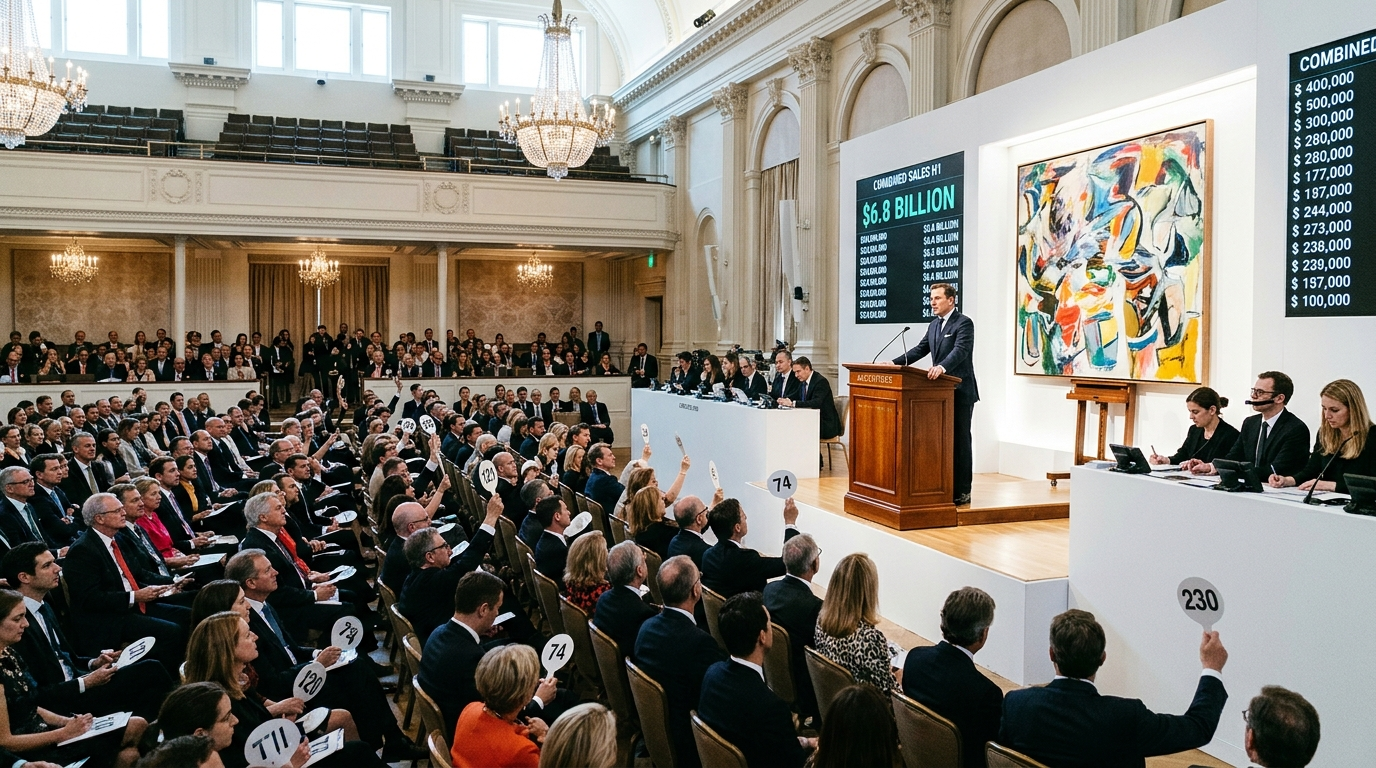
Christie’s, Sotheby’s and Phillips generated $6.8 billion in combined sales during the first half of the year, signaling sustained demand at the top of the auction market.
The total covers three firms that dominate international auctions for fine art, jewelry, watches and collectibles. It offers a broad measure of buyer activity, though it does not show how sales were divided among the companies.
A Key Measure of Auction Demand
The reported figure captures sales during a six-month period. That timing matters because major auctions are often concentrated around seasonal events in global art centers.
“Sales at Christie’s, Sotheby’s, and Phillips hit $6.8 billion in the first half of the year.”
The combined result suggests wealthy collectors and institutional buyers continued to compete for high-value property. Major auction houses also attract sellers through global marketing, specialist advice and access to established buyer networks.
However, the headline total should not be read as profit. Auction sales figures usually reflect the value of property sold. Revenue comes from buyer premiums, seller fees and related services. Costs can include guarantees, marketing, staff and event operations.
Three Firms Shape the Market
Christie’s and Sotheby’s have long held leading positions in international art sales. Phillips is smaller, with a strong focus on modern and contemporary works, watches and design.
The three companies compete for consignments, which are items placed with an auction house for sale. Securing a major collection can shift market share and influence results for an entire season.
The combined $6.8 billion figure highlights several market forces:



- Demand remains concentrated among established global auction brands.
- High-value consignments can strongly affect six-month totals.
- Private wealth remains an important source of art-market spending.
- Sales totals alone do not reveal profitability or bidder depth.
Competition can benefit sellers through lower fees, financial guarantees or favorable sale terms. Yet guarantees also create risk. An auction house may face losses if bidding fails to reach the promised amount.
What the Total Does Not Reveal
The figure lacks a breakdown by company, category, region or sales channel. It also does not state how much came from public auctions compared with private transactions.
Those details are important for judging market health. A strong total driven by a few expensive works may hide weaker demand across lower price levels. A market supported by many bidders and categories would indicate broader participation.
Sell-through rates offer another useful measure. They show the share of offered lots that found buyers. Average prices, withdrawals and post-sale deals can also clarify whether sellers and buyers agreed on value.
Signals for Collectors and Sellers
For collectors, the total indicates that significant capital remains active in auction rooms. Buyers may still act selectively, especially when economic conditions, interest rates or currency changes affect purchasing decisions.
For sellers, strong aggregate sales can support confidence. Still, the result does not guarantee demand for every object. Condition, ownership history, rarity and pricing remain central to an item’s performance.
The next set of company results will provide a clearer test. Analysts will watch whether sales remain steady, how the $6.8 billion is distributed, and whether activity depends on a small group of trophy works.
For now, the first-half total shows that Christie’s, Sotheby’s and Phillips continue to command substantial spending. The market’s deeper strength will depend on bidder participation, profitable transactions and the quality of future consignments.